Q: I took an honors creative writing class last year and I have read lots of books on writing, but what do they mean by write what you know? They all say that but I don't really understand. My English teacher gave me some good feedback but I'd like to hear what you think.
A: Yes, we always say that--write what you know.
Write what you know, but what do you know? You are still young, a high school student, right?
Well, let's try to understand it this way--write what you don't know . . . . Now think about that for a while. Think of all the things you don't know--how interesting would those things be to write about? How difficult? How much research would you have to do? How interesting would it be to read? Write about nuclear physics, for example, something that neither you (I presume) nor I know very much about.
But you do know what it means to be you (among other things). So now let's go back to that nuclear physics assignment. What if a kid like you, say, found out that his new stepfather was a nuclear physicist . . . after a little research on nuclear physics, you would find that story a lot more natural for you to write, and a lot more authentic feeling for the reader to read.
The best stories are always in one way or another about human truths--and you, because of who you are, know the truth about being a teen--or maybe you know the truth about getting a new stepfather that is out of your league--it is that truth that will make the story worthy of reading--even though it is, for the most part, a complete fabrication.
"Writers have to know how to tell the truth before they know how to tell a lie."
--some guy whose name I don't recall
"Fiction is the lie that tells the truth."
--John Dufresne
"Authenticity comes from personal truth. Speak your personal truth and you have found your voice as a writer."
--Some guy named Preston L. Allen
Now don't confuse "write what you know" with "limit yourself to writing from your limited, peronal vantage point." Study. Research. Learn things. Engage the world. Live life. Study people. Learn people. Then tell the truth disguised as a lie.
I often tell people that BOUNCE, my novel written from the point of view of a black hispanic female who is still in love with an abusive ex-husband, is my most autobiographical novel. And it is. Cindique is me, but so is her lover Roderick Redd . . . I will not explain further.
At a reading once, a woman asked me, "How can you presume to write from the point of view of a woman?"
My answer was a challnege, something like: "Because no one knows THIS woman better than me, not even another woman. In other words, you may know women, but I know Cindique. I also know my mother--who do you think could write more effectively about her, you or me? Writers must learn to write the personal truth of all of the characters that they create. Writers can't be afraid to write out of their sex, or out of their race and ethnicity, if that is where the personal truth leads them."
Read these two interesting novels by writers writing out of their sex: MEMOIRS OF A GEISHA (written by a man); Damage (written by a woman).
As a CRW teacher, I have noticed a couple things about young/beginning writers.
Thing 1) They tend to write a great deal of science fiction and fantasy stories and stories involving dreams or dream sequences. I think that the reason for this is that, when we are young and our knowledge of human nature is till limited, we write such fabulist fiction so that no one can point a finger at us and say, "You don't know what you're talking about." If they point their finger thus in criticism, we can simply answer, "Yeah, but I made it up, so anything can happen. It's not real. It's science fiction." (As though good science fiction or fantasy is any less real to the reader than any other genre of writing.)
Thing 2) The best young/beginning writers tend to be those who have suffered a great deal of pain and thus have a personal well of painful truth to pull from. Thus, some of the best writings we find in CRW classes is from students writing about abuse, rape, poverty, homelessness, and the consequences of any number of bad choices they have made.
I had a friend in grad school I hadn't heard from in a while. When I did, I said to him, "Hey man, are you still writing? Are you getting anything published?"
He said, "No. After I graduated, I married a beautiful woman and we had three great kids. My life improved. I made up with my horrible father. I'm not sad anymore. I am happy now. I guess now I have nothing to write about."
I guess.
Here's something else to ponder: Although there are many exceptions, most writers write their best stuff AFTER the age of forty,
(After they have lived life a bit?
Hmmmmmm.
Thanks,
Preston
At the Pen Festival 2010
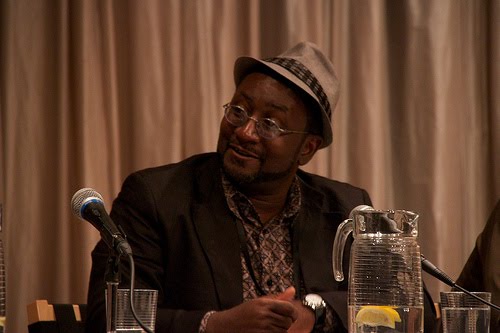
© PEN American Center/Susan Horgan. All rights reserved. Please contact media@pen.org for usage and rights.
August 26, 2008


August 23, 2008
What Are You Working On?
Q: What are you working on right now?
A: I think I answered this one before. At any rate, I answer it a lot. Here is my latest verison of the answer--I am shopping a book that has lots of serial killers in it--it is sort of a sequel to my first novel "Hoochie Mama"; I am shopping a romance about a cougar; I am completing the middle book of the White Face trilogy; I am pondering the All or Nothing seqel, "Son of a P."
It is 5 a.m. in the morning. I've finished my writing for the day. I'm going to bed now.
Preston
A: I think I answered this one before. At any rate, I answer it a lot. Here is my latest verison of the answer--I am shopping a book that has lots of serial killers in it--it is sort of a sequel to my first novel "Hoochie Mama"; I am shopping a romance about a cougar; I am completing the middle book of the White Face trilogy; I am pondering the All or Nothing seqel, "Son of a P."
It is 5 a.m. in the morning. I've finished my writing for the day. I'm going to bed now.
Preston
August 21, 2008
Book Club
Q: Hello, Preston L. Allen. I saw your book on my neighbor's bookshelf and I began excitedly to discuss it with her until she told me that she hadn't read it yet. She is one of those book lovers who buy a lot more books than they can ever read. She explained that she saw the book's review in the NY Times and she bought it that Sunday along with several other books that she also hadn't gotten around to reading just yet.
When I told her that this was a book she needed to read, she asked me why.
When I told her because it was great, she said to me, "I've read many gambling books, what is so great about this one?" That question, for some reason, stumped me. I tried for several moments stumblingly and bumblingly to explain what was so great about the book, to explain the addictive plot, to explain all of the insights that I had garnered about gambling, to explain the incredible humor, to explain the unique voice until I finally gave up and yelled, "This book is unlike any other book you will ever read, seriously. It will grip you from the first page and take you on a wild crazy ride not just through the world of casino gambling, but through the mind of a unique character. What I'm trying to tell you is that it's great and unique. Just read it! You won't be disappointed!"
She called me later that night laughing and making sounds of delight. She said, "Great book! Thank you for making me read it. It's not just about gambling, it's about everything. I can't explain it." I told her, "See, I told you." We spent nearly two hours discussing it.
We would like to invite you to come to our book club if that is possible. We live in Fort Walton Beach, Florida. Would that be possible, we see that you live in Miami? Do you visit book clubs as far away as we are? We are able to pay for gas. Thanks, J and T.
A: J and T. Thanks for your email! I'm blown away. Yes, I do present at book clubs all the time, but Fort Walton Beach is really a very long drive for us. I usually try to stick to the Miami area, though I have gone as far north as Palm Beach for a book club reading at Lynn University. However, if you keep loving my book the way you do and passing the word along to all your friends, I just might convince my wife that maybe we should make a trip up there. In fact, give me a call at 786-389-9263 or 305 586-6423.
Thanks for your support.
Preston
When I told her that this was a book she needed to read, she asked me why.
When I told her because it was great, she said to me, "I've read many gambling books, what is so great about this one?" That question, for some reason, stumped me. I tried for several moments stumblingly and bumblingly to explain what was so great about the book, to explain the addictive plot, to explain all of the insights that I had garnered about gambling, to explain the incredible humor, to explain the unique voice until I finally gave up and yelled, "This book is unlike any other book you will ever read, seriously. It will grip you from the first page and take you on a wild crazy ride not just through the world of casino gambling, but through the mind of a unique character. What I'm trying to tell you is that it's great and unique. Just read it! You won't be disappointed!"
She called me later that night laughing and making sounds of delight. She said, "Great book! Thank you for making me read it. It's not just about gambling, it's about everything. I can't explain it." I told her, "See, I told you." We spent nearly two hours discussing it.
We would like to invite you to come to our book club if that is possible. We live in Fort Walton Beach, Florida. Would that be possible, we see that you live in Miami? Do you visit book clubs as far away as we are? We are able to pay for gas. Thanks, J and T.
A: J and T. Thanks for your email! I'm blown away. Yes, I do present at book clubs all the time, but Fort Walton Beach is really a very long drive for us. I usually try to stick to the Miami area, though I have gone as far north as Palm Beach for a book club reading at Lynn University. However, if you keep loving my book the way you do and passing the word along to all your friends, I just might convince my wife that maybe we should make a trip up there. In fact, give me a call at 786-389-9263 or 305 586-6423.
Thanks for your support.
Preston
August 19, 2008
Money for the Cure
Q: When you came to our class the other day, you mentioned something about gamblers' getting no sympathy. What did you mean? I enjoyed your classroom visit to my Reading class and your novel ALL OR NOTHING. It is the first complete novel I have read in ENGLISH since leaving Haiti four years ago. Studentfan
A: Yes, studentfan, I enjoyed that Saturday session with your Reading class. I was surprised and pleased to see you there because I have you in one of my English classes and you never mentioned that your Reading class was reading the novel. I'm glad you enjoyed the book.
What I meant by that comment was that most people have a certain amount of sympathy for those with serious substance abuse and addiction problems, more sympathy than they have for gamblers. Let me give you an example of what I mean.
Jane: So How's your uncle Mike?
Suszy: Well, you know, his cocaine problem overcame him again. They caught him breaking into a neighbor's house. He's in jail and we're trying to get a lawyer for him and we're trying to get the neighbor to drop the charges. He's really not a bad guy.
Jane: Poor guy. I'll keep him in my prayers.
Suszy: He tries, but he's hooked, you know?
Jane: Yeah. So sad. So how's your cousin Joe?
Suszy: That jerk! I never want to talk to him again. He set me up and borrowed a hundred dollars--he said it was for the rent, but my roommate says she saw him at the casino right after he had borrowed it from me. What a jerk!
Jane: Yeah, what a jerk! You just can't trust a gambler.
Or here's another way to look at it--
If you had to do one of the following, which would it be?
1) Mortgage the house to get your cocaine addicted brother out of jail?
2) Mortgage the house to clear up your gambling brother's finances?
Thanks,
Preston
A: Yes, studentfan, I enjoyed that Saturday session with your Reading class. I was surprised and pleased to see you there because I have you in one of my English classes and you never mentioned that your Reading class was reading the novel. I'm glad you enjoyed the book.
What I meant by that comment was that most people have a certain amount of sympathy for those with serious substance abuse and addiction problems, more sympathy than they have for gamblers. Let me give you an example of what I mean.
Jane: So How's your uncle Mike?
Suszy: Well, you know, his cocaine problem overcame him again. They caught him breaking into a neighbor's house. He's in jail and we're trying to get a lawyer for him and we're trying to get the neighbor to drop the charges. He's really not a bad guy.
Jane: Poor guy. I'll keep him in my prayers.
Suszy: He tries, but he's hooked, you know?
Jane: Yeah. So sad. So how's your cousin Joe?
Suszy: That jerk! I never want to talk to him again. He set me up and borrowed a hundred dollars--he said it was for the rent, but my roommate says she saw him at the casino right after he had borrowed it from me. What a jerk!
Jane: Yeah, what a jerk! You just can't trust a gambler.
Or here's another way to look at it--
If you had to do one of the following, which would it be?
1) Mortgage the house to get your cocaine addicted brother out of jail?
2) Mortgage the house to clear up your gambling brother's finances?
Thanks,
Preston
A Trap for the Pure In Heart
Q: Dear Preston, I haven't been to "the casino" since September 23, 2007.
In January, I filed Chapter 13 bankruptcy, in part because of the credit card debt I ran up by taking cash advances so I could play the slot machines.
Sometimes I get the itch. Sometimes I really want to play "Double Diamond Run," "Cleopatra" or "Hot Flashes," but I've somehow been able to resist. It's been very difficult lately, though. I've been wanting to go so I can win enough money to buy my friend a concert ticket for her birthday. One of my other friends talked me out of it, thankfully. Another friend thinks I should go and see if I can only gamble a "certain amount" and make sure I can't get more by leaving my ATM card at home.
Well, I just finished reading your book.
Thank you from the bottom of my heart.
S.
A: Thanks for your email, S (named after one of the characters in the novel, LOL), and thanks for reading ALL OR NOTHING. I hope that it helped in some way, though I know that the only “dependable” and “trusted” ways for a gambler to be helped are to seek it professionally from a mental health counselor or to go to GA—and even if you seek help in one of these manners, you will feel the itch for the rest of your life. Sadly, they can teach us how not to scratch, but they can’t teach us how not to itch.
Therefore, the friend who advises you not to return to the casino to “win” money to buy a concert ticket for someone you care about is right. What many fail to understand about us gamblers is that we are usually good people at heart—we have wonderfully generous and altruistic plans for what to do with the money once we win it. We want to save the world with all of that money, and we would, if we could just win it. The casino is a trap for the pure in heart. You go there to win money for a good cause, and instead you become addicted to the most dangerous vice there is: the vice of throwing your money to the winds for enjoyment. If you go to the casino to win money for that concert ticket, you will lose the money for your rent and for other essential things.
I have been a lucky gambler at times. I once went to the casino to win money to help bury a close family friend. Was God watching me? I hit big on the first machine I touched upon entering—I hit more than enough to bury her and then have a few hundred left over. Then as I was waiting for them to review my ID documents and print me the check, I fooled around with another machine, and hit again! This was not so much as the first time, about half as much—but it was still nice. This amount was small enough for them to give it to me in cash without checking my ID, which I did not have because they were still checking it for the big amount I had hit previously and was still waiting to be given the check for. Of course, I put this money back into the machines and hit again! I was on a roll that night. By the time they finally brought me my check, I had won almost as much in smaller increments on random machines. So that was a good night . . .
But the problem is that the few and far between nights like that helped to create in me the twisted logic known as “magical thinking”: i.e., when I need money, instead of working I will go get it from the casino. Thinking like that leads to disaster. I have too many examples of disastrous nights like that, as I am sure you have.
Our habit is not in the making of money or the winning of money—our habit is in the ritual of risking money. Winning encourages us to take more risks (because we incorrectly feel we are lucky); losing encourages us to take more risks (because our financial situation has been destroyed by our habit and we need to get our money back and ironically the only way to get it back is to . . . gamble more and harder).
But you know all of this already, I am sure.
And the friend who tells you to go to the casino to see if you can gamble only a small amount is in gross misunderstanding of your addictive condition. You are trying to see if you can control it . . . but we have already determined that you are a gambler and therefore cannot control it . . . furthermore, did you do anything in the interim to “learn” to control it?
Did you go to GA? Did you seek counseling? No?
So here is your answer: of course, you cannot control it. That is not control talking to you. That is simply the monkey on your back talking. That is your itch begging to be scratched. You will tell yourself any lie to get back into the casino—including, “I want to buy a gift for my friend,” or even worse, “It’s my money and I can do what I want with it.”
LOL
But it is not your money anymore . . . really, it is not. It is NOT your money.
You have already spent all of YOUR money. You are now spending borrowed money—money borrowed to save your life!
Money borrowed from credit cards. Money borrowed (I am sure) from friends. Money borrowed from bankruptcy (a program that, despite its name and connotation, is really a system of consolidating and repaying your debt).
YOUR money has already been spent—you are now spending money that you OWE to other people.
No, by law it is not your money, and you cannot do what you want with it (not legally anyway). But you will gamble anyway . . . we will gamble anyway, because we are gamblers and we are ill. We have the worst kind of illness, a mental illness that tells us lies like “all we need is self-control to stop gambling” and “we will save the world and buy concert tickets for our friends with the money we will win at the casino” and “it’s my money and I can do what I want with it.”
Here is what you need to do:
1) Stay away from the casino forever—get help from a program like GA so that you can stay away from the Dante’s inferno called casino.
2) Find a new kind of thrill. Fall in love. Write a book. Take up sky diving. Here is something you may not have noticed, S. See, now that you are not gambling you have a lot more free time—a lot more—gamblers spend countless HOURS a week in casinos—countless. See, casinos not only steal your money. They steal your life. One hour at a time. When was the last time your played with your children? When was the last time you hung out with an old friend? It steals your time--and time, unlike money, cannot be won back. Suddenly all of your children are grown and they are strangers to you. Suddenly all of your old friends have replaced you with other friends. Like the song says, "Time keeps on ticking, ticking, ticking . . . into the future."
So when you stop gambling you have all of this free time, S, and . . . if you do not fill it up, you WILL eventually end up back in the casino. So why not use that free time to start a business? Help a charity? Do self repairs on the house? Learn to play the piano? Learn a foreign language?
Quitting gambling gives you back your time, so use it, S, or gambling WILL take it back.
Thanks,
Preston
In January, I filed Chapter 13 bankruptcy, in part because of the credit card debt I ran up by taking cash advances so I could play the slot machines.
Sometimes I get the itch. Sometimes I really want to play "Double Diamond Run," "Cleopatra" or "Hot Flashes," but I've somehow been able to resist. It's been very difficult lately, though. I've been wanting to go so I can win enough money to buy my friend a concert ticket for her birthday. One of my other friends talked me out of it, thankfully. Another friend thinks I should go and see if I can only gamble a "certain amount" and make sure I can't get more by leaving my ATM card at home.
Well, I just finished reading your book.
Thank you from the bottom of my heart.
S.
A: Thanks for your email, S (named after one of the characters in the novel, LOL), and thanks for reading ALL OR NOTHING. I hope that it helped in some way, though I know that the only “dependable” and “trusted” ways for a gambler to be helped are to seek it professionally from a mental health counselor or to go to GA—and even if you seek help in one of these manners, you will feel the itch for the rest of your life. Sadly, they can teach us how not to scratch, but they can’t teach us how not to itch.
Therefore, the friend who advises you not to return to the casino to “win” money to buy a concert ticket for someone you care about is right. What many fail to understand about us gamblers is that we are usually good people at heart—we have wonderfully generous and altruistic plans for what to do with the money once we win it. We want to save the world with all of that money, and we would, if we could just win it. The casino is a trap for the pure in heart. You go there to win money for a good cause, and instead you become addicted to the most dangerous vice there is: the vice of throwing your money to the winds for enjoyment. If you go to the casino to win money for that concert ticket, you will lose the money for your rent and for other essential things.
I have been a lucky gambler at times. I once went to the casino to win money to help bury a close family friend. Was God watching me? I hit big on the first machine I touched upon entering—I hit more than enough to bury her and then have a few hundred left over. Then as I was waiting for them to review my ID documents and print me the check, I fooled around with another machine, and hit again! This was not so much as the first time, about half as much—but it was still nice. This amount was small enough for them to give it to me in cash without checking my ID, which I did not have because they were still checking it for the big amount I had hit previously and was still waiting to be given the check for. Of course, I put this money back into the machines and hit again! I was on a roll that night. By the time they finally brought me my check, I had won almost as much in smaller increments on random machines. So that was a good night . . .
But the problem is that the few and far between nights like that helped to create in me the twisted logic known as “magical thinking”: i.e., when I need money, instead of working I will go get it from the casino. Thinking like that leads to disaster. I have too many examples of disastrous nights like that, as I am sure you have.
Our habit is not in the making of money or the winning of money—our habit is in the ritual of risking money. Winning encourages us to take more risks (because we incorrectly feel we are lucky); losing encourages us to take more risks (because our financial situation has been destroyed by our habit and we need to get our money back and ironically the only way to get it back is to . . . gamble more and harder).
But you know all of this already, I am sure.
And the friend who tells you to go to the casino to see if you can gamble only a small amount is in gross misunderstanding of your addictive condition. You are trying to see if you can control it . . . but we have already determined that you are a gambler and therefore cannot control it . . . furthermore, did you do anything in the interim to “learn” to control it?
Did you go to GA? Did you seek counseling? No?
So here is your answer: of course, you cannot control it. That is not control talking to you. That is simply the monkey on your back talking. That is your itch begging to be scratched. You will tell yourself any lie to get back into the casino—including, “I want to buy a gift for my friend,” or even worse, “It’s my money and I can do what I want with it.”
LOL
But it is not your money anymore . . . really, it is not. It is NOT your money.
You have already spent all of YOUR money. You are now spending borrowed money—money borrowed to save your life!
Money borrowed from credit cards. Money borrowed (I am sure) from friends. Money borrowed from bankruptcy (a program that, despite its name and connotation, is really a system of consolidating and repaying your debt).
YOUR money has already been spent—you are now spending money that you OWE to other people.
No, by law it is not your money, and you cannot do what you want with it (not legally anyway). But you will gamble anyway . . . we will gamble anyway, because we are gamblers and we are ill. We have the worst kind of illness, a mental illness that tells us lies like “all we need is self-control to stop gambling” and “we will save the world and buy concert tickets for our friends with the money we will win at the casino” and “it’s my money and I can do what I want with it.”
Here is what you need to do:
1) Stay away from the casino forever—get help from a program like GA so that you can stay away from the Dante’s inferno called casino.
2) Find a new kind of thrill. Fall in love. Write a book. Take up sky diving. Here is something you may not have noticed, S. See, now that you are not gambling you have a lot more free time—a lot more—gamblers spend countless HOURS a week in casinos—countless. See, casinos not only steal your money. They steal your life. One hour at a time. When was the last time your played with your children? When was the last time you hung out with an old friend? It steals your time--and time, unlike money, cannot be won back. Suddenly all of your children are grown and they are strangers to you. Suddenly all of your old friends have replaced you with other friends. Like the song says, "Time keeps on ticking, ticking, ticking . . . into the future."
So when you stop gambling you have all of this free time, S, and . . . if you do not fill it up, you WILL eventually end up back in the casino. So why not use that free time to start a business? Help a charity? Do self repairs on the house? Learn to play the piano? Learn a foreign language?
Quitting gambling gives you back your time, so use it, S, or gambling WILL take it back.
Thanks,
Preston
July 26, 2008
BOUNCE is my most autobiographical novel, though the protagonist is a female
Q: I read your novel BOUNCE two years ago and it was great, I could not put it down. I thought you were a romance writer and read your story in Brown Sugar about the girl who fell in love with her brother-in-law. I wasn't sure I would like the gambling book because I do not know much about gambling and that world, but it is a great book, I am almost finished with it. The two books are different, but the style is the same. The gambling book has me turning pages like the romance book BOUNCE did. I really like your style and I want to know how you do it. What is your secret to making the characters in your book interesting?
A: Thank you. I am glad you mentioned BOUNCE and ALL OR NOTHING because those are two books that still astonish me when I read them. I am turning pages, saying to myself, "I wrote this? I wrote this? When? I don't remember writing this." I am very conscious of the other things that I have written. I can recall pretty much what I was thinking when I designed this chapter or the other, this character, this scene, chose this word. With BOUNCE and ALL OR NOTHING, there are times when it's almost like someone else wrote it. Those are two novels that I can just sit down and read and enjoy like a fan, though I am the author.
ALL OR NOTHING, of course, is about a character that I know well, a gambler, so I can turn off my brain and channel what I know about that world and cruise through the details, writing in a dreamlike state. I am a gambler, P is a gambler, the rest is easy.
BOUNCE is similar. I can't really explain it, but BOUNCE is the most autobiographical novel I have ever published . . . even though the protagonist is female.
Once upon a time, I was Cindique. I was a girl, er, boy, trapped in an abusive situation. My heart was elsewhere, but those roads were blocked to me too, only I was too young to recognize the CLOSED ROAD signs posted along the way. I had to live through the pain, the illusion of love that was really more abuse, but masked. I had to live through the pain. It was the only path that allowed growth for me. For Cindique.
So I closed my eyes and wrote, I became Cindique, I closed my eyes and wrote in a dreamlike state.
Thanks,
Preston
A: Thank you. I am glad you mentioned BOUNCE and ALL OR NOTHING because those are two books that still astonish me when I read them. I am turning pages, saying to myself, "I wrote this? I wrote this? When? I don't remember writing this." I am very conscious of the other things that I have written. I can recall pretty much what I was thinking when I designed this chapter or the other, this character, this scene, chose this word. With BOUNCE and ALL OR NOTHING, there are times when it's almost like someone else wrote it. Those are two novels that I can just sit down and read and enjoy like a fan, though I am the author.
ALL OR NOTHING, of course, is about a character that I know well, a gambler, so I can turn off my brain and channel what I know about that world and cruise through the details, writing in a dreamlike state. I am a gambler, P is a gambler, the rest is easy.
BOUNCE is similar. I can't really explain it, but BOUNCE is the most autobiographical novel I have ever published . . . even though the protagonist is female.
Once upon a time, I was Cindique. I was a girl, er, boy, trapped in an abusive situation. My heart was elsewhere, but those roads were blocked to me too, only I was too young to recognize the CLOSED ROAD signs posted along the way. I had to live through the pain, the illusion of love that was really more abuse, but masked. I had to live through the pain. It was the only path that allowed growth for me. For Cindique.
So I closed my eyes and wrote, I became Cindique, I closed my eyes and wrote in a dreamlike state.
Thanks,
Preston
July 19, 2008
Wolf Girl 3
Q: Did/do you use any reference books on writing? Are there any you
would recommend? (Or any novels you would recommend?) Wolfgirl.
A:
John Dufresne's "THE LIE THAT TELLS THE TRUTH."
Stephen King's "ON WRITING."
Ken Macrorie's "TELLING WRITING."
Janet Burroway (several texts on writing).
Bernays and Painter’s "WHAT IF?"
PRIZE STORIES: THE O. HENRY AWARDS.
BEST AMERICAN SHORT STORIES.
PUSHCART PRIZE STORIES.
The short works of John Cheever.
The short works of Flannery O'Connor.
The short works of Ray Carver, but especially the collections "WHERE I'M CALLING FROM" and "WHAT WE TALK ABOUT WHEN WE TALK ABOUT LOVE."
Isaac Asimov's short stories, but especially "I, ROBOT" and the novels in the FOUNDATION TRILOGY.
Ray Bradbury's short stories, but especially "THE MARTIAN CHRONICLES," "R IS FOR ROCKET" and "S IS FOR SPACE."
Thanks,
Preston
would recommend? (Or any novels you would recommend?) Wolfgirl.
A:
John Dufresne's "THE LIE THAT TELLS THE TRUTH."
Stephen King's "ON WRITING."
Ken Macrorie's "TELLING WRITING."
Janet Burroway (several texts on writing).
Bernays and Painter’s "WHAT IF?"
PRIZE STORIES: THE O. HENRY AWARDS.
BEST AMERICAN SHORT STORIES.
PUSHCART PRIZE STORIES.
The short works of John Cheever.
The short works of Flannery O'Connor.
The short works of Ray Carver, but especially the collections "WHERE I'M CALLING FROM" and "WHAT WE TALK ABOUT WHEN WE TALK ABOUT LOVE."
Isaac Asimov's short stories, but especially "I, ROBOT" and the novels in the FOUNDATION TRILOGY.
Ray Bradbury's short stories, but especially "THE MARTIAN CHRONICLES," "R IS FOR ROCKET" and "S IS FOR SPACE."
Thanks,
Preston
Luck . . . Again
Q: What lucky or coincidental things have happened to you in your life and maybe helped you to write you novel ALL OR NOTHING.
A: Please let this be the last luck/fate question. Please.
I believe in skill, not luck. I do not believe that things are pre-ordained or predestined and will not believe until someone shows me some hard evidence or makes a more convincing argument than any I have heard so far.
That being said . . .
1) At work, my office was the office of novelist James Lee Burke when he taught at my college. People are always saying to me, "What a coincidence. That is the same desk James Lee Burke sat at. You are destined for great things."
2) As concerns poker, I seem to have a lucky seat--seat 3. I have caught seven royal flushes in seat 3. Seat 7 is also lucky for me. I have caught 4 royal flushes in seat 7. In a ten-handed Texas Hold'em or Omaha Hi-lo game, both seat 3 and seat 7 are three seats away from the dealer. As far as I can recall, I have never caught a royal flush in any other seat.
3) I seem to have had a lucky friend. While at the casino in the swamp one night, I was losing my shirt. This guy walked in, sat down at the table, and said to me, "You look like you are having bad luck. I'm gonna give you some luck." Players often joke like that to each other. I few minutes later, I hit a royal flush. It had a nice jackpot attahced to it, so I tipped all of the players at the table as well as the dealer. My new lucky friend said to me, "I brought you luck. You should tip me more than you did the rest of them." I laughed and gave him another hundred.
The very next night, while at the casino up in Broward, I was losing my shirt. The lucky guy I had met down in the swamp came in. He was not seated at my table this time, but at a table next to mine. In fact, we were back to back. I joked ove my shoulder to him, "If you are so lucky, bring me some more luck." He joked back, "I'm doing my best, bro." A few minutes later, I caught another royal flush. When they paid me the jackpot, I tipped everybody at my table and then turned around and tipped my lucky friend, too.
Every time we saw each other, we would joke around about how he brought me luck. It was kind of funny, really. And on nights when he was in the casino, I tended to win. I made note of this . . . coincidence. One night as I was leaving the casino, I found him hanging out in the parking lot. He had lost all of his money, he was afraid to go home to his wife, he had bills to play--blah, blah, blah--typical gambler spiel. What he really wanted was money to gamble with.
I had won a couple hundred that night and so I split it with him, but he said, "I am your good luck, bro. You should give me more money. Give me everything you won because I need it. Then go back inside and use the luck you get from me to win something really big."
This was complete BS, and I knew it, but I had been lucky with him. So I gave him all of my winnings from that night, then went back inside and sat down at the poker table. As I recall it, I could not seem to LOSE a hand that night. Before I knew it, my chips amounted to way more than the $200 or so that I had given him. Then a few hours later I hit a royal flush for about ten grand.
When I saw my lucky friend again a few weeks later, I pulled out a few hundreds and stuck them in his hand. He was suprised because he had not asked me for anything. He said, "What's this for?" I told him about the royal flush I had hit the night I had met him in the parking lot.
We laughed and laughed. "What do you think it means?" he asked.
"Well, I don't believe in luck, so I have no idea what it means," I told him.
And he said, "Well, believe this. I am moving out of town. I got a new job up in New York. I'm leaving tomorrow. Let's see how you do when I'm gone."
I laughed and told him, "I'll do just fine."
We slapped five and I never saw him again. I guess he moved to New York.
I also have never hit another royal flush.
4) After my divorce, I told my mother that I would never marry again. I had just started my new job that week. I had left the public schools for the community college. I was looking forward to making money and being single for the rest of my life. What need had I of marriage? I already had two kids from my ex, and I did not desire any further "marital torment," as I described it to my mother. I meant it. I was adamant about this thing.
The next day at work, my new boss, who, to my delight, seemed to like me very much, asked me to do some extra work (over time, more money!) in the writing lab at our satellite campus in Hialeah. Well, I was going through a divorce and needed the money, so I said, eagerly, "Yes."
So after work, I went to do my part-time night gig at the Hialeah Center, and upon meeting the woman who ran the lab felt a bit of the old lightning bolt. When I got home that night, I told my mother, "I just met the woman I am going to marry."
My mother could only nod her head, smiling at her fickle son.
Fickle, my big fat butt. My wife and I will have been married seventeen years in October.
In one of my many chats with my colleague and fellow writer poet/novelist Geoffrey Philp, I mentioned how I met my wife. I said, "If Elaine hadn't sent me over there, we never would have met."
And he said, "Elaine put me and my wife together too. She was in charge of the labs back then and assigned us to work together."
I forget who our other colleague was, but she overheard us and exclaimed, "Elaine put me and my husband together, too!"
5)
This is the one that makes me sad, but here goes. My mother passed away a year ago.
On the anniversary of her passing, I kept seeing three 7s. I saw them on a license plate. I saw them on a billboard. I saw them painted on the side of a truck. Then I even saw three Zs on something, but the bottom was obscured and the three Zs looked more like three 7s.
That night in the Play-4, the number was 7773, which was mother mother's phone number.
The next night 1972 came up boxed in the Play-4. My brother Anthony, who was not at the funeral and for all intents and purpoes is estranged from the family, was born in 1972.
I told my other brothers about it. It freaked them out.
6) One day I was playing Hold'em, and my cards were bad. Bad. For about three hours I was getting nothing but crappy hole cards. So I said to myself, I don't care what kind of crap I get in the hole, I am going to play the next hand. When I got my next hand, I looked at my hole cards: 2, 9. More crap. But I kept my promise and I played bad cards. The flop came 2, 2, 2. This meant that I now had four 2s, an unbeatable hand. Amazing.
7) I once picked up a hitchhiker during a very bad storm. She was a tall young woman with a dainty umbrella. When she got into my car, she said, "Do you smoke?"
I said, "No."
She said, "Do you get high? You mind if I get high?"
What kind of girl was this? She looked to be maybe 16. She had tattoos and piercings all over her face and arms. Her hair was cut short like a man's. As the rain and wind pelted thec car, I said, "No. I do not get high, and you will not get high in my car, either. Ma'am, would you just tell me where you'd like me to drop you off."
"No problem," she smirked, brushing me off as old school, out of touch, a square, a geezer. "The house is in Opa-Locka. You know where that is, pops?"
"Yes."
I knew where it was. Opa-Locka is not the safest neighborhood in Miami. In fact, it is reputed to be one of the most dangerous. I grew up in Opa-Locka back when it wasn't so bad.
When she gave me the address, I was in for another surprise. It was my old address! This girl lived in my old house.
I told her this, and her attitude changed. She became friendlier, more respectful. I told her which room used to be mine and she said, "That's my room now. Me and my little sister's!"
When we got to her house, the rain had abated, and we were both in for another surprise--she more than I. I spotted a man standing at the open door of her house and asked her who he was. She said, "My dad."
But he looked familiart. A little taller, a little stouter, but the same sleepy eyes and fat cheeks. I told her, "His name is __________ __________, right?"
She said, "Yes! How do you know him?"
"We were in fourth grade together. We sat next to each other in fourth grade."
The tattooed girl said to me as I was getting out of the car to go greet my old buddy, "Don't tell him what I asked you about getting high, okay? Please don't tell him."
I winked at her. It would be our secret.
A: Please let this be the last luck/fate question. Please.
I believe in skill, not luck. I do not believe that things are pre-ordained or predestined and will not believe until someone shows me some hard evidence or makes a more convincing argument than any I have heard so far.
That being said . . .
1) At work, my office was the office of novelist James Lee Burke when he taught at my college. People are always saying to me, "What a coincidence. That is the same desk James Lee Burke sat at. You are destined for great things."
2) As concerns poker, I seem to have a lucky seat--seat 3. I have caught seven royal flushes in seat 3. Seat 7 is also lucky for me. I have caught 4 royal flushes in seat 7. In a ten-handed Texas Hold'em or Omaha Hi-lo game, both seat 3 and seat 7 are three seats away from the dealer. As far as I can recall, I have never caught a royal flush in any other seat.
3) I seem to have had a lucky friend. While at the casino in the swamp one night, I was losing my shirt. This guy walked in, sat down at the table, and said to me, "You look like you are having bad luck. I'm gonna give you some luck." Players often joke like that to each other. I few minutes later, I hit a royal flush. It had a nice jackpot attahced to it, so I tipped all of the players at the table as well as the dealer. My new lucky friend said to me, "I brought you luck. You should tip me more than you did the rest of them." I laughed and gave him another hundred.
The very next night, while at the casino up in Broward, I was losing my shirt. The lucky guy I had met down in the swamp came in. He was not seated at my table this time, but at a table next to mine. In fact, we were back to back. I joked ove my shoulder to him, "If you are so lucky, bring me some more luck." He joked back, "I'm doing my best, bro." A few minutes later, I caught another royal flush. When they paid me the jackpot, I tipped everybody at my table and then turned around and tipped my lucky friend, too.
Every time we saw each other, we would joke around about how he brought me luck. It was kind of funny, really. And on nights when he was in the casino, I tended to win. I made note of this . . . coincidence. One night as I was leaving the casino, I found him hanging out in the parking lot. He had lost all of his money, he was afraid to go home to his wife, he had bills to play--blah, blah, blah--typical gambler spiel. What he really wanted was money to gamble with.
I had won a couple hundred that night and so I split it with him, but he said, "I am your good luck, bro. You should give me more money. Give me everything you won because I need it. Then go back inside and use the luck you get from me to win something really big."
This was complete BS, and I knew it, but I had been lucky with him. So I gave him all of my winnings from that night, then went back inside and sat down at the poker table. As I recall it, I could not seem to LOSE a hand that night. Before I knew it, my chips amounted to way more than the $200 or so that I had given him. Then a few hours later I hit a royal flush for about ten grand.
When I saw my lucky friend again a few weeks later, I pulled out a few hundreds and stuck them in his hand. He was suprised because he had not asked me for anything. He said, "What's this for?" I told him about the royal flush I had hit the night I had met him in the parking lot.
We laughed and laughed. "What do you think it means?" he asked.
"Well, I don't believe in luck, so I have no idea what it means," I told him.
And he said, "Well, believe this. I am moving out of town. I got a new job up in New York. I'm leaving tomorrow. Let's see how you do when I'm gone."
I laughed and told him, "I'll do just fine."
We slapped five and I never saw him again. I guess he moved to New York.
I also have never hit another royal flush.
4) After my divorce, I told my mother that I would never marry again. I had just started my new job that week. I had left the public schools for the community college. I was looking forward to making money and being single for the rest of my life. What need had I of marriage? I already had two kids from my ex, and I did not desire any further "marital torment," as I described it to my mother. I meant it. I was adamant about this thing.
The next day at work, my new boss, who, to my delight, seemed to like me very much, asked me to do some extra work (over time, more money!) in the writing lab at our satellite campus in Hialeah. Well, I was going through a divorce and needed the money, so I said, eagerly, "Yes."
So after work, I went to do my part-time night gig at the Hialeah Center, and upon meeting the woman who ran the lab felt a bit of the old lightning bolt. When I got home that night, I told my mother, "I just met the woman I am going to marry."
My mother could only nod her head, smiling at her fickle son.
Fickle, my big fat butt. My wife and I will have been married seventeen years in October.
In one of my many chats with my colleague and fellow writer poet/novelist Geoffrey Philp, I mentioned how I met my wife. I said, "If Elaine hadn't sent me over there, we never would have met."
And he said, "Elaine put me and my wife together too. She was in charge of the labs back then and assigned us to work together."
I forget who our other colleague was, but she overheard us and exclaimed, "Elaine put me and my husband together, too!"
5)
This is the one that makes me sad, but here goes. My mother passed away a year ago.
On the anniversary of her passing, I kept seeing three 7s. I saw them on a license plate. I saw them on a billboard. I saw them painted on the side of a truck. Then I even saw three Zs on something, but the bottom was obscured and the three Zs looked more like three 7s.
That night in the Play-4, the number was 7773, which was mother mother's phone number.
The next night 1972 came up boxed in the Play-4. My brother Anthony, who was not at the funeral and for all intents and purpoes is estranged from the family, was born in 1972.
I told my other brothers about it. It freaked them out.
6) One day I was playing Hold'em, and my cards were bad. Bad. For about three hours I was getting nothing but crappy hole cards. So I said to myself, I don't care what kind of crap I get in the hole, I am going to play the next hand. When I got my next hand, I looked at my hole cards: 2, 9. More crap. But I kept my promise and I played bad cards. The flop came 2, 2, 2. This meant that I now had four 2s, an unbeatable hand. Amazing.
7) I once picked up a hitchhiker during a very bad storm. She was a tall young woman with a dainty umbrella. When she got into my car, she said, "Do you smoke?"
I said, "No."
She said, "Do you get high? You mind if I get high?"
What kind of girl was this? She looked to be maybe 16. She had tattoos and piercings all over her face and arms. Her hair was cut short like a man's. As the rain and wind pelted thec car, I said, "No. I do not get high, and you will not get high in my car, either. Ma'am, would you just tell me where you'd like me to drop you off."
"No problem," she smirked, brushing me off as old school, out of touch, a square, a geezer. "The house is in Opa-Locka. You know where that is, pops?"
"Yes."
I knew where it was. Opa-Locka is not the safest neighborhood in Miami. In fact, it is reputed to be one of the most dangerous. I grew up in Opa-Locka back when it wasn't so bad.
When she gave me the address, I was in for another surprise. It was my old address! This girl lived in my old house.
I told her this, and her attitude changed. She became friendlier, more respectful. I told her which room used to be mine and she said, "That's my room now. Me and my little sister's!"
When we got to her house, the rain had abated, and we were both in for another surprise--she more than I. I spotted a man standing at the open door of her house and asked her who he was. She said, "My dad."
But he looked familiart. A little taller, a little stouter, but the same sleepy eyes and fat cheeks. I told her, "His name is __________ __________, right?"
She said, "Yes! How do you know him?"
"We were in fourth grade together. We sat next to each other in fourth grade."
The tattooed girl said to me as I was getting out of the car to go greet my old buddy, "Don't tell him what I asked you about getting high, okay? Please don't tell him."
I winked at her. It would be our secret.
Wolf Girl 2
Q: When did you publish your first novel and how did you feel about it? Wolfgirl.
A: I self-published my first novel HOOCHIE MAMA in 2001 and I felt great
about it.
I had another book that was supposed to come out that year,
CHURCHBOYS AND OTHER SINNERS (Carolina Wren Press, 2003), but there
were delays at the publishing house and so the book was put on hold.
I self-published that first book because I was tired of delays. I wanted
control. I wanted to see my name in print. I wanted to feel good. I
wanted to dance on the ceiling. When it came out, I danced on the
ceiling.
HOOCHIE MAMA is self-published, but it is well edited and it
says what I wanted it to say. I got wh at I wanted--control.
Thanks,
Preston
A: I self-published my first novel HOOCHIE MAMA in 2001 and I felt great
about it.
I had another book that was supposed to come out that year,
CHURCHBOYS AND OTHER SINNERS (Carolina Wren Press, 2003), but there
were delays at the publishing house and so the book was put on hold.
I self-published that first book because I was tired of delays. I wanted
control. I wanted to see my name in print. I wanted to feel good. I
wanted to dance on the ceiling. When it came out, I danced on the
ceiling.
HOOCHIE MAMA is self-published, but it is well edited and it
says what I wanted it to say. I got wh at I wanted--control.
Thanks,
Preston
Wolf Girl 1
Q: What experience or knowledge is required to do your job? Wolfgirl.
A: By my "job," I presume you mean "Writer" or "Novelist," as opposed to
teacher/professor of English.
As far is knowledge is concerned, a writer must have lived and experienced the world. I once heard that by the time you reach16, you have at least one full-length book in you--your autobiography.
Writers go through life with their eyes open.
Writers pay attention to everything. They are fascinated by life and
humans and culture and conflict--they want to know what makes people
tick.
Also, a writer must be a good reader. A writer must love
reading. Many great writers never completed a formal education--but
they had read probably every book they could get their hands on.
Writers must be readers, but of course this only makes sense. Writers
are in the business of putting words on the page, in the business of
making books--why then should it be a surprise that they love books?
The best way to learn how to write is to read. A writer must always be
reading.
Thanks Wolfgirl,
Preston
A: By my "job," I presume you mean "Writer" or "Novelist," as opposed to
teacher/professor of English.
As far is knowledge is concerned, a writer must have lived and experienced the world. I once heard that by the time you reach16, you have at least one full-length book in you--your autobiography.
Writers go through life with their eyes open.
Writers pay attention to everything. They are fascinated by life and
humans and culture and conflict--they want to know what makes people
tick.
Also, a writer must be a good reader. A writer must love
reading. Many great writers never completed a formal education--but
they had read probably every book they could get their hands on.
Writers must be readers, but of course this only makes sense. Writers
are in the business of putting words on the page, in the business of
making books--why then should it be a surprise that they love books?
The best way to learn how to write is to read. A writer must always be
reading.
Thanks Wolfgirl,
Preston
Subscribe to:
Comments (Atom)