The best fiction book I have read in years!
Mr. Allen’s “All or Nothing” is the story of P and his gambling addiction. “All or Nothing” is an extremely powerful and simply told story. If I hadn’t needed sleep I would have read this in one sitting.
The character P, we’re never told anyone’s full name, is an honest man. Honest, in that he knows he’s a gambler. He knows he is addicted to gambling. He knows he lies to those around him. He doesn’t apologize for who and what he is. P allows us to see into the mind of a gambler and that the meaning of money has many interpretations.
I agreed to read “All or Nothing” because I thought it would be a basic story about a gambler. A straightforward fiction book.
I was unprepared for the emotional intensity of Mr. Allen’s writing.
I was unprepared for the stillness and soft bluntness of Mr. Allen’s writing.
“All or Nothing” is one hell of a book. Thank you Mr. Allen.
(Christine Speakman, four out of four Roses, The Muse Book Reviews)
http://themusebookreviews.tripod.com/id143.html
At the Pen Festival 2010
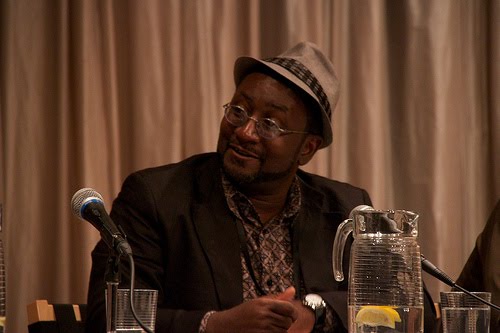
© PEN American Center/Susan Horgan. All rights reserved. Please contact media@pen.org for usage and rights.
May 16, 2008


May 10, 2008
Do you believe the world is flat or round?
While I am working on compiling that list of MFA and Ph. D in Creative Writing programs with my friend Lisa Shaw, I am going to share my response to one of the earliest questions I got on this blog but did not post because I had no idea how it fit in with everything. It is interesting, though.
Q: If you were a tree, what kind of tree would you be?
A: I don’t know how to answer that question. A willow? I am not afraid to weep. An oak? It’s hard to make me weep. I don’t know. Sorry. Thanks for emailing.
Q: It’s me again. Here’s a better question. I came up with it after reading your books “Churchboys and Other Sinners” and “All or Nothing,” especially the latter because P strikes me as an agnostic who will not believe that which he cannot see. Except when it comes to luck. With luck, he possesses faith to dangerous extremes. Here is the question:
If you were living in Europe in 1490, would you believe that the world was flat?
A: I like this question! It had me up all night.
If I were living in Europe in 1490, two years before Columbus journeyed east to discover the “New World,” I would have been taught that the world was flat, and because I am a good student I would have accepted it.
Now, if I were a child raised near the ocean and able to see day after day the approach of ships, the mast rising over the horizon before the actual ship appeared, I would have accepted that the world was flat as the answer to give in school, but I would hold out that maybe this school “fact” was not the actual truth.
On the other hand, I do not think that I would have leapt to the conclusion that the world was round. I would simply “doubt” the facts that I was taught in school and wait for the day when the truth, or a better theory, would eventually come out.
Even today, there are things I accept as “temporary stays against confusion” as Richard Abkarian and Marvin Klotz say in the intro to “Innocence and Experience” in their textbook Literature the Human Experience. For example, I accept the theory of evolution as scientifically sound—for today! I imagine that in the future there will be a better theory to explain how things came to be. I feel the same about the big-bang theory. I feel the same about flat earth in 1490—I accept it until something closer to the truth comes along.
Q: If you were living in Europe in 1493, would you believe the new theory that the world was round?
A: Yes. It would explain away some if the discrepancies that I had encountered with the old flat-earth theory. On the other hand, I would hold that new theory up to the same level of doubt that I had held the flat-earth theory up to. In other words, I believe it, but if something new comes along that makes more sense and can be supported through scientific reasoning and empirical observation and measure, then I will easily cease to believe it.
Q: Do you believe in God?
A: I do not discuss religion in public or with strangers. Sorry.
Q: Does Elwyn believe in God? [Churchboys and Other Sinners]
A: Yes he does. He has no problem with his faith. He is a true believer. His only problem is trying to bring the world in line with what he already believes. And, of course, he struggles to justify his sinful, clandestine affair with Sister Morrisohn so as to reconcile his value system.
Q: If Elwyn were living in 1490, would he believe that the world was flat?
A: Yes. And he would believe it despite the evidence he saw to the contrary.
Q: If Elwyn were living in 1493, would he believe the new theory that the world was round?
A: Not at first. He would accept it after everyone else began to accept it.
Q: Does P believe in God? [All or Nothing]
A: Yes. But he has doubts that he will not speak about publicly, nor do these doubts trouble him to any great degree. P believes that if there is a God, that God will do what God will do, and there is nothing that P, a mere human, can do about it—so there is no need for P to worry about it. P believes that religion, for the most part, is designed so that a few disingenuous people can distract you by getting you to start worrying about things that you really have no control over—death, life in the hereafter, invisible spirits. On the other hand, P believes that some sentient being or beings do govern the universe, and that perhaps they can be used from time to time to control “luck.” In fact, when P is down on his luck, he becomes very religious and superstitious. Thus, P is a contradiction.
Q: If P were living in 1490, would he believe that the world was flat?
A: Yes, but he would have doubts about it.
Q: If P were living in 1493, would he believe the new theory that the world was round?
A: Yes, but he would have doubts about it. He would like it better than he had the flat-earth theory, but he would still have his doubts. P accepts nothing without solid evidence.
Q: And yet he believes in luck with no evidence at all.
A: P is a contradiction.
_______________________________
I'd like to hear your responses to the question. Email me at prestonthewriterallen@gmail.com.
Respond to these questions:
1) If you were living in Europe in 1490, would you believe that the world was flat?
2) If you were living in Europe in 1493, would you believe the new theory that the world was round?
Thanks,
Preston
Q: If you were a tree, what kind of tree would you be?
A: I don’t know how to answer that question. A willow? I am not afraid to weep. An oak? It’s hard to make me weep. I don’t know. Sorry. Thanks for emailing.
Q: It’s me again. Here’s a better question. I came up with it after reading your books “Churchboys and Other Sinners” and “All or Nothing,” especially the latter because P strikes me as an agnostic who will not believe that which he cannot see. Except when it comes to luck. With luck, he possesses faith to dangerous extremes. Here is the question:
If you were living in Europe in 1490, would you believe that the world was flat?
A: I like this question! It had me up all night.
If I were living in Europe in 1490, two years before Columbus journeyed east to discover the “New World,” I would have been taught that the world was flat, and because I am a good student I would have accepted it.
Now, if I were a child raised near the ocean and able to see day after day the approach of ships, the mast rising over the horizon before the actual ship appeared, I would have accepted that the world was flat as the answer to give in school, but I would hold out that maybe this school “fact” was not the actual truth.
On the other hand, I do not think that I would have leapt to the conclusion that the world was round. I would simply “doubt” the facts that I was taught in school and wait for the day when the truth, or a better theory, would eventually come out.
Even today, there are things I accept as “temporary stays against confusion” as Richard Abkarian and Marvin Klotz say in the intro to “Innocence and Experience” in their textbook Literature the Human Experience. For example, I accept the theory of evolution as scientifically sound—for today! I imagine that in the future there will be a better theory to explain how things came to be. I feel the same about the big-bang theory. I feel the same about flat earth in 1490—I accept it until something closer to the truth comes along.
Q: If you were living in Europe in 1493, would you believe the new theory that the world was round?
A: Yes. It would explain away some if the discrepancies that I had encountered with the old flat-earth theory. On the other hand, I would hold that new theory up to the same level of doubt that I had held the flat-earth theory up to. In other words, I believe it, but if something new comes along that makes more sense and can be supported through scientific reasoning and empirical observation and measure, then I will easily cease to believe it.
Q: Do you believe in God?
A: I do not discuss religion in public or with strangers. Sorry.
Q: Does Elwyn believe in God? [Churchboys and Other Sinners]
A: Yes he does. He has no problem with his faith. He is a true believer. His only problem is trying to bring the world in line with what he already believes. And, of course, he struggles to justify his sinful, clandestine affair with Sister Morrisohn so as to reconcile his value system.
Q: If Elwyn were living in 1490, would he believe that the world was flat?
A: Yes. And he would believe it despite the evidence he saw to the contrary.
Q: If Elwyn were living in 1493, would he believe the new theory that the world was round?
A: Not at first. He would accept it after everyone else began to accept it.
Q: Does P believe in God? [All or Nothing]
A: Yes. But he has doubts that he will not speak about publicly, nor do these doubts trouble him to any great degree. P believes that if there is a God, that God will do what God will do, and there is nothing that P, a mere human, can do about it—so there is no need for P to worry about it. P believes that religion, for the most part, is designed so that a few disingenuous people can distract you by getting you to start worrying about things that you really have no control over—death, life in the hereafter, invisible spirits. On the other hand, P believes that some sentient being or beings do govern the universe, and that perhaps they can be used from time to time to control “luck.” In fact, when P is down on his luck, he becomes very religious and superstitious. Thus, P is a contradiction.
Q: If P were living in 1490, would he believe that the world was flat?
A: Yes, but he would have doubts about it.
Q: If P were living in 1493, would he believe the new theory that the world was round?
A: Yes, but he would have doubts about it. He would like it better than he had the flat-earth theory, but he would still have his doubts. P accepts nothing without solid evidence.
Q: And yet he believes in luck with no evidence at all.
A: P is a contradiction.
_______________________________
I'd like to hear your responses to the question. Email me at prestonthewriterallen@gmail.com.
Respond to these questions:
1) If you were living in Europe in 1490, would you believe that the world was flat?
2) If you were living in Europe in 1493, would you believe the new theory that the world was round?
Thanks,
Preston
They're Reading Me in New York
Q: I don’t really have a question but I just finished reading “All or Nothing” and I wanted to tell you that I thoroughly enjoyed the book. My favorite parts were how the protagonist seemed so real and how even though he loved his wife, he left her to go gamble. I also picked up on the fact that he really loved C.L. too, but when the chips were down he left C.L. because she was barred from Las Vegas for her crime against the casinos; in other words, she could not gamble now either. I think what sets your book apart from other books on this subject is that it is a story first and foremost—it is not really about gambling, it is about the man P and his family and loved ones. It is also a story that is unpredictable. I kept thinking that the book would go in one direction, but then it went in another better one. You are great at creating characters and making us like them or understand them so easily! Every character in the book is memorable: the professor, P, the wife, the lucky son, C.L., E.V., S, U, the father, the mother, and the fat girl. I don’t know if this makes sense, but when the book was over, I wanted to keep on knowing these people.
Even though the book is about some dark things, it kept me smiling all the way through. You were able to tell a fairly frightening story because you are so good at humor. I read a copy of your book in the library here in Brooklyn, but now I am going out to purchase a copy of it. Great Job!!!! You rank up there with the great ones.
I saw that you did a reading up her in Brooklyn last year. Please keep us informed on your blog when you plan to come back to the NY area.
A: Thank you for that great feedback. Please go out and tell all of your friends who are reading it in the library to buy a copy of the book too.
Yes, I had a great time in NY. We did readings in Brooklyn and Manhattan. As Arnold said, “NY, I’ll be back.”
Thanks,
Preston
Even though the book is about some dark things, it kept me smiling all the way through. You were able to tell a fairly frightening story because you are so good at humor. I read a copy of your book in the library here in Brooklyn, but now I am going out to purchase a copy of it. Great Job!!!! You rank up there with the great ones.
I saw that you did a reading up her in Brooklyn last year. Please keep us informed on your blog when you plan to come back to the NY area.
A: Thank you for that great feedback. Please go out and tell all of your friends who are reading it in the library to buy a copy of the book too.
Yes, I had a great time in NY. We did readings in Brooklyn and Manhattan. As Arnold said, “NY, I’ll be back.”
Thanks,
Preston
May 6, 2008
How Long Does It Take to Get a Ph.D in Creative Writing?
Q: How long does it take to get a Ph.D in creative writing?
A: Wow! Boy, did I open up a can of worms with that last question. Okay, here is what I am going to do during my brief (6 days left) vacation. I am going to go through the various US CRW programs and begin compiling a list of MFA and Ph.D programs. I hope to have a substantial portion of it up by Thursday.
Thanks.
Preston
A: Wow! Boy, did I open up a can of worms with that last question. Okay, here is what I am going to do during my brief (6 days left) vacation. I am going to go through the various US CRW programs and begin compiling a list of MFA and Ph.D programs. I hope to have a substantial portion of it up by Thursday.
Thanks.
Preston
May 5, 2008
How Long Does It Take to Get an MFA in CRW?
Q: I enjoyed your book, ALL OR NOTHING, especially the gambling scenes in the Indian Casinos in Miami. I was very excited reading those thrilling scenes and it made me realize that gambling is the same no matter where you live. I lived in New Jersey back in the 80s and those scenes brought back a lot of Atlantic City memories for me. I have a granddaughter in high school who is a good writer and she has spoken about wanting to be a novelist. I notice that you have an MFA. About how much does it cost to get an MFA and about how long does it take?
A: Thanks for reading the book. About the MFA, well, the cost and time will all depend on what school she gets into. My friend Lisa Shaw has allowed me to borrow a list she recently compiled of the credit requirements of about three dozen MFA programs.
MFA Credit Requirements: A Sampling
36-40 Credit Hours
Bowling Green S. U.
Brooklyn College
New School
North Carolina State
Notre Dame University
Queens College (CUNY)
University of Georgia
University of Maryland
University of Southern California
University of Wisconsin (Madison)
University of Wyoming
42-48 Credit Hours
Arizona State
Boise State
Florida International University
Naropa
Oregon State
Syracuse
University of Miami
University of Baltimore
University of Florida
University of Iowa
University of Massachusetts
University of Pennsylvania
University of South Florida
50-60 Credit Hours
American University
Columbia University
Indiana University
Virginia Tech
Iowa State
San Francisco State
University of Idaho
University of Nevada Las Vegas
You know what? This list is a good idea. I am going to be updating and adding to this list periodically, so come back and check it from time to time--I am personally interested in the other state of Florida schools like UCF, FAU, FSU and so on, but eventually I hope to compile a list of all North American MFA programs.
Thanks for the question. You've given me a mission.
Preston
A: Thanks for reading the book. About the MFA, well, the cost and time will all depend on what school she gets into. My friend Lisa Shaw has allowed me to borrow a list she recently compiled of the credit requirements of about three dozen MFA programs.
MFA Credit Requirements: A Sampling
36-40 Credit Hours
Bowling Green S. U.
Brooklyn College
New School
North Carolina State
Notre Dame University
Queens College (CUNY)
University of Georgia
University of Maryland
University of Southern California
University of Wisconsin (Madison)
University of Wyoming
42-48 Credit Hours
Arizona State
Boise State
Florida International University
Naropa
Oregon State
Syracuse
University of Miami
University of Baltimore
University of Florida
University of Iowa
University of Massachusetts
University of Pennsylvania
University of South Florida
50-60 Credit Hours
American University
Columbia University
Indiana University
Virginia Tech
Iowa State
San Francisco State
University of Idaho
University of Nevada Las Vegas
You know what? This list is a good idea. I am going to be updating and adding to this list periodically, so come back and check it from time to time--I am personally interested in the other state of Florida schools like UCF, FAU, FSU and so on, but eventually I hope to compile a list of all North American MFA programs.
Thanks for the question. You've given me a mission.
Preston
May 2, 2008
Skin and Genitals
I am so back logged with emails to answer because of my unexpected hiatus, but it is amazing how many people keep asking me Obama, Clinton, McCain?
People, get a grip. I am a novelist. I write stories. I can't and won't tell you for whom you should vote--although I will tell you that I am proud of my student Lazaro Coralles for taking 3rd Prize in a contest sponsored by Bedford/St. Martins that posed the prompt: "What Barack Obama's candidacy has taught us about race relations in America."
The complete list of winners is as follows.
First place winner: Jessica Arias, Wolfson Campus
Second place: Dinkinish O'Connor, North Campus
Third place: Lazaro Corrales, North Campus
Congrats Lazaro--it was great having you as a student.
Congrats Dinkinish--who is also one heck of a poet--she may not know it, but her "War" poem was submitted as the North Campus entry to the League for Innovation Prize.
Congrats to Jessica--I do not know you, but if you beat Lazaro and Dinkinish in a writing contest, you are formidable.
Now, for the rest of you around the globe and your Obama, Clinton, McCain questions--I do have something to say to you.
Shame on you. Grow up.
It is the year 2008 and we finally have a serious African American, female, and elderly presidential candidate. Why did it take so long? Why is it such a big deal?
I can't wait for the day when we have had seven women presidents, six African American presidents, four elderly presidents, five Jewish presidents, five Catholic presidents, six Asian presidents, five Latino presidents, nine native American Presidents, four gay presidents (openly gay, that is--who knows--we may already have had ten gay presidents, and at least four who were bi-curious), three transgender presidents, four Mormon presidents, seven Jehovah's Witness presidents, four Muslim presidents, five Hindu presidents, six atheist presidents (openly), seven Inuit presidents, and ten presidents who have to list themselves as "Other."
I can't wait for that great day to come when we can vote for people because they are qualified, and not because they have a color that we like. Color? Color? What are we, still in kindergarten?
My dad's whiter than your dad, my dad's whiter than yours
Shame on us--we are the leaders of the free world. Let's act like it.
As a child (and then again as an adult), I won many awards that had the words "black," "Negro," or "African American" on them. Thanks, thanks, thanks for the awards, guys--they helped to make me the man I am today, I am truly grateful--but the cataloguing always gave me pause.
As a child (and then again as an adult) I was often told, you are the first black this, or the first black that, or you're the first black we've ever had working here, or doing this, or holding this position, or sitting in this seat, or chairing this committee. Once again, thanks, thanks, thanks, I love you all, thanks for giving me the many opportunities that I have had and continue to have in this great country--but what's all this about being the first black?
I know that you think you are honoring me when you say that, but can't you see how self-serving your placement of the superlative "first black" is on anything that I have achieved?
When you say, "Preston, you are the first black to work for this company," what you are really saying is this: "Preston, you are the first black that we have allowed to work for this company. See how great we are for allowing you to work here? See how much we have changed? Once upon a time we didn't allow any blacks to work here, but now we are changing and you are the first to benefit from the change. Aren't we cool for doing that? And don't you feel fortunate for being the first?"
When I was in college, I was told after a job interview for a part-time job delivering pizzas, "You got the job--you've got a lot of experiene doing this kind of thing and whatnot--but I think I need to warn you that there are a lot of people who work here in this store who may not be happy with you working here. And there are a lot of families in the neighborhoods we serve that might not be happy to open up and find you knocking on their doors."
I said, "Am I still going to get paid?"
The interviewer said, "Well, yes, of course."
I said, "Then I would rather get paid by people who dislike me than not get paid by people who like me. I have a family to feed. I've got school fees to pay. I am black. I'm used to being disliked."
That's sort of how the conversation went, and I got the job and became the first black pizza man to work for that company and deliver in that exclusive part of town.
So what?
How juvenile. How shallow.
What kind of achievement is that? The first black?
People, you have to understand that achievements of that sort are only important in a country that admits that it has a history of racism. If you are racist, then it is significant when someone from the targeted minority is able to break through the discriminatory barriers that you have placed to hold them back. In other words, "Preston L. Allen is the first black writer to publish a book with us because as you know we are fairly racist in our attitudes toward blacks, but his book is so good that . . ."
Now if they are not racist, then they might say, "We have just published a new book by Preston L. Allen on such and such a subject . . ." The end.
In other words, if you truly want to stop being perceived as discriminatory, then stop making such (loud) note of the first black this and the first black that, the first female this, and the first female that.
I mean, who is the first left-handed president? Who is the first blood type AB positive president? Who is the first president to have excelled at football? Who is the first president to have worn an odd-sized pair of shoes? Who is the first brown-eyed president?
We don't know--because we do not discriminate for, or against, those qualities.
But who was the first president with black skin? And who was the first president with a vagina?
Now every hand in the classroom shoots up.
Do your civic duty and vote, people. But don't vote for skin and genitals--and don't vote against them either.
Grow up. Get out of that superficial kindergarten mentality.
Vote for the candidate that is going to move the country in the direction you think it ought to go.
No more political questions, please. They wear me out.
Thanks,
Preston
People, get a grip. I am a novelist. I write stories. I can't and won't tell you for whom you should vote--although I will tell you that I am proud of my student Lazaro Coralles for taking 3rd Prize in a contest sponsored by Bedford/St. Martins that posed the prompt: "What Barack Obama's candidacy has taught us about race relations in America."
The complete list of winners is as follows.
First place winner: Jessica Arias, Wolfson Campus
Second place: Dinkinish O'Connor, North Campus
Third place: Lazaro Corrales, North Campus
Congrats Lazaro--it was great having you as a student.
Congrats Dinkinish--who is also one heck of a poet--she may not know it, but her "War" poem was submitted as the North Campus entry to the League for Innovation Prize.
Congrats to Jessica--I do not know you, but if you beat Lazaro and Dinkinish in a writing contest, you are formidable.
Now, for the rest of you around the globe and your Obama, Clinton, McCain questions--I do have something to say to you.
Shame on you. Grow up.
It is the year 2008 and we finally have a serious African American, female, and elderly presidential candidate. Why did it take so long? Why is it such a big deal?
I can't wait for the day when we have had seven women presidents, six African American presidents, four elderly presidents, five Jewish presidents, five Catholic presidents, six Asian presidents, five Latino presidents, nine native American Presidents, four gay presidents (openly gay, that is--who knows--we may already have had ten gay presidents, and at least four who were bi-curious), three transgender presidents, four Mormon presidents, seven Jehovah's Witness presidents, four Muslim presidents, five Hindu presidents, six atheist presidents (openly), seven Inuit presidents, and ten presidents who have to list themselves as "Other."
I can't wait for that great day to come when we can vote for people because they are qualified, and not because they have a color that we like. Color? Color? What are we, still in kindergarten?
My dad's whiter than your dad, my dad's whiter than yours
Shame on us--we are the leaders of the free world. Let's act like it.
As a child (and then again as an adult), I won many awards that had the words "black," "Negro," or "African American" on them. Thanks, thanks, thanks for the awards, guys--they helped to make me the man I am today, I am truly grateful--but the cataloguing always gave me pause.
As a child (and then again as an adult) I was often told, you are the first black this, or the first black that, or you're the first black we've ever had working here, or doing this, or holding this position, or sitting in this seat, or chairing this committee. Once again, thanks, thanks, thanks, I love you all, thanks for giving me the many opportunities that I have had and continue to have in this great country--but what's all this about being the first black?
I know that you think you are honoring me when you say that, but can't you see how self-serving your placement of the superlative "first black" is on anything that I have achieved?
When you say, "Preston, you are the first black to work for this company," what you are really saying is this: "Preston, you are the first black that we have allowed to work for this company. See how great we are for allowing you to work here? See how much we have changed? Once upon a time we didn't allow any blacks to work here, but now we are changing and you are the first to benefit from the change. Aren't we cool for doing that? And don't you feel fortunate for being the first?"
When I was in college, I was told after a job interview for a part-time job delivering pizzas, "You got the job--you've got a lot of experiene doing this kind of thing and whatnot--but I think I need to warn you that there are a lot of people who work here in this store who may not be happy with you working here. And there are a lot of families in the neighborhoods we serve that might not be happy to open up and find you knocking on their doors."
I said, "Am I still going to get paid?"
The interviewer said, "Well, yes, of course."
I said, "Then I would rather get paid by people who dislike me than not get paid by people who like me. I have a family to feed. I've got school fees to pay. I am black. I'm used to being disliked."
That's sort of how the conversation went, and I got the job and became the first black pizza man to work for that company and deliver in that exclusive part of town.
So what?
How juvenile. How shallow.
What kind of achievement is that? The first black?
People, you have to understand that achievements of that sort are only important in a country that admits that it has a history of racism. If you are racist, then it is significant when someone from the targeted minority is able to break through the discriminatory barriers that you have placed to hold them back. In other words, "Preston L. Allen is the first black writer to publish a book with us because as you know we are fairly racist in our attitudes toward blacks, but his book is so good that . . ."
Now if they are not racist, then they might say, "We have just published a new book by Preston L. Allen on such and such a subject . . ." The end.
In other words, if you truly want to stop being perceived as discriminatory, then stop making such (loud) note of the first black this and the first black that, the first female this, and the first female that.
I mean, who is the first left-handed president? Who is the first blood type AB positive president? Who is the first president to have excelled at football? Who is the first president to have worn an odd-sized pair of shoes? Who is the first brown-eyed president?
We don't know--because we do not discriminate for, or against, those qualities.
But who was the first president with black skin? And who was the first president with a vagina?
Now every hand in the classroom shoots up.
Do your civic duty and vote, people. But don't vote for skin and genitals--and don't vote against them either.
Grow up. Get out of that superficial kindergarten mentality.
Vote for the candidate that is going to move the country in the direction you think it ought to go.
No more political questions, please. They wear me out.
Thanks,
Preston
April 30, 2008
Astonishing
Q: Loved your book. What is the most astonishing thing you have ever seen in a casino?
A: Hmmm. Good question.
I think I may have told this story before on another post, but here goes.
An elderly couple (Canadian, I think) were new to the casino's four-screen build-your-own-lotto machine. So they were complaing and grumbling and asking for help, but no floor person was nearby and none of us regulars would help them.
He was saying, "How does this thing work? How do you get it to play a quarter? Are zeroes the only number that it can play?" The machine showed six zeroes on all four screens.
She was saying, "Let's get someone to help us. Where is everybody? Why will no one help up? I think the machine is stuck on forty. How do you change it? We don't want to bet forty dollars at a time. That's too much."
And they're pushing buttons and grumbling and fiddling with the machine, and I am about to offer my assistance, when all of a sudden I hear their machine pinging like crazy. Ping-ping-ping-ping!
Accidentally, one of them had pushed the PLAY button and six zeroes came out. Six Zeroes!!! They hit on all four screens.
And since their machine was stuck on forty dollars (ten dollaras a screen), they hit $50,000 on each screen--in other words, they hit $200,000 without even knowing what they were doing.
Astonishing.
I was at a table and a guy hit a Royal Flush. So we paused the game so that the Indians could pay him his jackpot ($5,000). Fifteen minutes later, we got back to playing the game, and the guy's eyes grew big again. When he laid down his cards, he had hit another Royal Flush! He hit two Flushes not only at the same table, but in consecutive hands.
Astonishing.
I sat down at a poker table in my favorite seat--seat 3. And I told the dealer, "This is my lucky seat. I have hit 7 Royals in seat 3 so far, so deal me Royal number 8, dealer." On the next hand, he dealt me a spade Royal Flush. The jackpot was $2500.
Astonishing.
A dealer snuck a quarter from the till. This was one of the best dealers in the house. Everybody liked her. She was attractive, humorous, she controlled her table, and she dealt a fast accurate hand. Perhaps she did not sneak the quarter from the till--perhaps she just made an honest mistake. It did not matter. Against the protests of the players, they fired her on the spot for swiping that quarter.
Astonishing.
Preston
A: Hmmm. Good question.
I think I may have told this story before on another post, but here goes.
An elderly couple (Canadian, I think) were new to the casino's four-screen build-your-own-lotto machine. So they were complaing and grumbling and asking for help, but no floor person was nearby and none of us regulars would help them.
He was saying, "How does this thing work? How do you get it to play a quarter? Are zeroes the only number that it can play?" The machine showed six zeroes on all four screens.
She was saying, "Let's get someone to help us. Where is everybody? Why will no one help up? I think the machine is stuck on forty. How do you change it? We don't want to bet forty dollars at a time. That's too much."
And they're pushing buttons and grumbling and fiddling with the machine, and I am about to offer my assistance, when all of a sudden I hear their machine pinging like crazy. Ping-ping-ping-ping!
Accidentally, one of them had pushed the PLAY button and six zeroes came out. Six Zeroes!!! They hit on all four screens.
And since their machine was stuck on forty dollars (ten dollaras a screen), they hit $50,000 on each screen--in other words, they hit $200,000 without even knowing what they were doing.
Astonishing.
I was at a table and a guy hit a Royal Flush. So we paused the game so that the Indians could pay him his jackpot ($5,000). Fifteen minutes later, we got back to playing the game, and the guy's eyes grew big again. When he laid down his cards, he had hit another Royal Flush! He hit two Flushes not only at the same table, but in consecutive hands.
Astonishing.
I sat down at a poker table in my favorite seat--seat 3. And I told the dealer, "This is my lucky seat. I have hit 7 Royals in seat 3 so far, so deal me Royal number 8, dealer." On the next hand, he dealt me a spade Royal Flush. The jackpot was $2500.
Astonishing.
A dealer snuck a quarter from the till. This was one of the best dealers in the house. Everybody liked her. She was attractive, humorous, she controlled her table, and she dealt a fast accurate hand. Perhaps she did not sneak the quarter from the till--perhaps she just made an honest mistake. It did not matter. Against the protests of the players, they fired her on the spot for swiping that quarter.
Astonishing.
Preston
Queen of Spades
Q: I am curious about the story by Pushkin that you refer to in the novel. You refer to it as the "Queen of Spades." I'm not finding it.
A: It is a translation from the Russian, so depending on whose translation you have it might have a slightly different title. I don't have the collection of Pushkin stories in front of me right now, but I am 100% certain my translation had it titled "The Queen of Spades."
Thanks,
Preston
A: It is a translation from the Russian, so depending on whose translation you have it might have a slightly different title. I don't have the collection of Pushkin stories in front of me right now, but I am 100% certain my translation had it titled "The Queen of Spades."
Thanks,
Preston
Sex in Gambling
Q: Is there a lot of sex in gambling?
A: I wouldn't know because I am a virgin. I'll pass your question on to one of my three children, however.
Seriously, though, I have seen some things in the casinos that make me shudder. First, there are the professionals, the prostitutes. Second, there are the gamblers who fall in love with each other. Third, there are those who have fallen on hard times and whose bodies are the final thing they can sell, or exchange, for money to gamble with.
Here's some advice for you non-gambling husbands out there. Always go to the casino with your gambling wife. I you cannot go with her, send her with a lot of money. When she calls you on the phone for more money, do not berate her--send her more money. Remember, there are WAYS for her to make money to gamble with in a casino.
Thanks,
Preston
A: I wouldn't know because I am a virgin. I'll pass your question on to one of my three children, however.
Seriously, though, I have seen some things in the casinos that make me shudder. First, there are the professionals, the prostitutes. Second, there are the gamblers who fall in love with each other. Third, there are those who have fallen on hard times and whose bodies are the final thing they can sell, or exchange, for money to gamble with.
Here's some advice for you non-gambling husbands out there. Always go to the casino with your gambling wife. I you cannot go with her, send her with a lot of money. When she calls you on the phone for more money, do not berate her--send her more money. Remember, there are WAYS for her to make money to gamble with in a casino.
Thanks,
Preston
April 21, 2008
Short Story Collections
Q: I just read your Churchboys book. What short story collections inspired you? What short story collections did you read growing up, or did you?
A: I am so backed up right now with old emails to respond to. Thanks for your patience. Your email is fairly new, and I know I should go back and respond to some of the older ones, but I like your question.
Well, the first short story collection I remember reading was Rudyard Kipling’s Just So Stories. I was very impressed with that book. I believe I was about nine or so, and what I liked was that the stories stood on their own but they were also related through theme, setting, and repetition of certain characters. Not too long after that, I read the 1001 Arabian Nights and Aesop’s Fables; I got the same fuzzy feeling when I recognized the connectedness of the stories as well as their independence. Of course, I read many novels and story collections before I had finished high school, but the collections that I prized almost always had that same dual quality—the short list of the remaining books is familiar, I am sure, but here it is in roughly the order and grade level I encountered each work: Martian Chronicles (10th), I, Robot (10th), 18 Stories by Heinrich Boll (12th), Winesburg, Ohio (12th), Goodbye, Columbus (Freshman year), The Collected Stories of John Cheever (Freshman Year)—and there may very well be others that I have left off the list. Later on in life (when I grew up) I too wanted to write short stories that were connected in some way and yet had the ability to stand on their own. The problem is always which stories to leave in, which stories to leave out. I think poets have this same problem when putting a collection of poetry together.
With the collection Churchboys, except for the Elwyn stories, the religious themes are fairly well muted. It is a religious world—the world of these characters in these stories—but religion is not “the point,” if you know what I mean. In the Elwyn stories, however, religion is the point, and there are four Elwyn stories, which is a lot. I knew I wanted the Elwyn stories to be the focus, but I did not want them to dominate the collection so much so that they would predict the direction of the other pieces—some of which, like I said, are not overtly religious. I solved my problem with placement and omission. First, I started the collection with stories that had strong, first person narrators that were distinctly secular, and only introduced the Elwyn pieces after I had set the tone for the book. Second, though I had written about 12 Elwyn stories up to that point, I only included four in the collection.
I am currently assembling stories for a new collection, and I am encountering a similar problem. The pieces are mostly noirish, so they all kind of work together in that sense, but three of them (of a total of 19) take place in cities other than Miami, five of them have linked characters, and one seems to want to be a novella. We’ll see what happens.
Thanks for the question.
A: I am so backed up right now with old emails to respond to. Thanks for your patience. Your email is fairly new, and I know I should go back and respond to some of the older ones, but I like your question.
Well, the first short story collection I remember reading was Rudyard Kipling’s Just So Stories. I was very impressed with that book. I believe I was about nine or so, and what I liked was that the stories stood on their own but they were also related through theme, setting, and repetition of certain characters. Not too long after that, I read the 1001 Arabian Nights and Aesop’s Fables; I got the same fuzzy feeling when I recognized the connectedness of the stories as well as their independence. Of course, I read many novels and story collections before I had finished high school, but the collections that I prized almost always had that same dual quality—the short list of the remaining books is familiar, I am sure, but here it is in roughly the order and grade level I encountered each work: Martian Chronicles (10th), I, Robot (10th), 18 Stories by Heinrich Boll (12th), Winesburg, Ohio (12th), Goodbye, Columbus (Freshman year), The Collected Stories of John Cheever (Freshman Year)—and there may very well be others that I have left off the list. Later on in life (when I grew up) I too wanted to write short stories that were connected in some way and yet had the ability to stand on their own. The problem is always which stories to leave in, which stories to leave out. I think poets have this same problem when putting a collection of poetry together.
With the collection Churchboys, except for the Elwyn stories, the religious themes are fairly well muted. It is a religious world—the world of these characters in these stories—but religion is not “the point,” if you know what I mean. In the Elwyn stories, however, religion is the point, and there are four Elwyn stories, which is a lot. I knew I wanted the Elwyn stories to be the focus, but I did not want them to dominate the collection so much so that they would predict the direction of the other pieces—some of which, like I said, are not overtly religious. I solved my problem with placement and omission. First, I started the collection with stories that had strong, first person narrators that were distinctly secular, and only introduced the Elwyn pieces after I had set the tone for the book. Second, though I had written about 12 Elwyn stories up to that point, I only included four in the collection.
I am currently assembling stories for a new collection, and I am encountering a similar problem. The pieces are mostly noirish, so they all kind of work together in that sense, but three of them (of a total of 19) take place in cities other than Miami, five of them have linked characters, and one seems to want to be a novella. We’ll see what happens.
Thanks for the question.
Subscribe to:
Comments (Atom)