Q: Who is going to be the next president, Obama or McCain?
A: Your mama.
Stop asking me political questions! I will not post them. Call me, if you want to discuss politics. I do not discuss sex, politics, or religion in public.
Thanks,
Preston
At the Pen Festival 2010
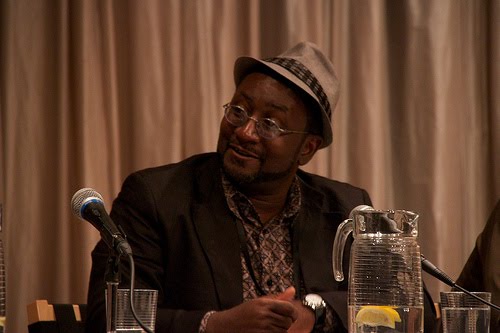
© PEN American Center/Susan Horgan. All rights reserved. Please contact media@pen.org for usage and rights.
October 3, 2008


Black Jack
Q: Do you know anything about Black Jack? I noticed that there wasn't much about Black Jack in your novel ALL OR NOTHING. I have recently started playing and I was wondering if there is a reason the dealer wins so much. Have you noticed that she hits the great numbers 19, 20, 21 and beats you with them so often that it looks like she is cheating? Do you think they are cheating? I have lost about $2000 so far and I am thinking about giving up the game. I can't seem to win a hand, even the goood hands.
A: Yes, Texas Hold'em is very dear to the protagonist's heart in my novel, but Black Jack, if you recall, is the downfall of his girlfriend C.L. That is the game she cheats at to get thrown out of Las Vegas.
I am no expert on Black Jack, but I have played it enough to know what you are talking about--the dealer's uncanny ability to draw 19, 20, and 21--just when you get a really good hand like a 19 or 20 or 21, creating an unsatisfying "push" or worse yet, a loss, or your part.
But actually, there is a mathematical reason for this tendency to hit great hands on the dealer's part.
What a lot of newcomers to the Black Jack game do not immediately realize is that the Black Jack deck is over-stacked with 10s. Ten is the most commmon card in the deck. In the deck there are more 10s than any other card. What am I talking about?
Take 6, for example. There are 4 sixes per deck: six of diamonds, six of clubs, six of hearts, six of spades. Therefore if the dealer needs a six to beat you, she is unlikely to get it because sixes are rare; or, looked at this way, she only has a one in 52 chance, roughly, of getting it because there are only four of them in the deck.
How many 10s are there in the deck? Answer: 16!
Yes, 16.
See, there are four 10s, four Jacks (counted as 10 points), four queens (counted as 10 points), and four kings counted as 10 points).
So there are 16 chances out of 52 for the dealer who needs a ten to get it.
This also means that when the dealer is showing an ACE, that there is about a little over 30% chance (one in three) that her other card is a ten, a black jack, perfect 21, and that she will beat you.
It follows then, that the dealer showing a 10, likely has another 10 hidden and she may beat you with 20.
And the dealer showing a 9, likely has a hidden 10, which will be a great hand with 19.
And the dealer showing an 8, likely has a hidden 10, which will be an 18.
And so on.
Black Jack is a great game, the only game in the casino that gives the player a slight edge over the house. But if you play it, expect your GOOD hand to be beaten time and again (at least 1 out of 3 times) by the dealer's GREAT hand.
Getting beat like that is just part of the game.
Thanks,
Preston
A: Yes, Texas Hold'em is very dear to the protagonist's heart in my novel, but Black Jack, if you recall, is the downfall of his girlfriend C.L. That is the game she cheats at to get thrown out of Las Vegas.
I am no expert on Black Jack, but I have played it enough to know what you are talking about--the dealer's uncanny ability to draw 19, 20, and 21--just when you get a really good hand like a 19 or 20 or 21, creating an unsatisfying "push" or worse yet, a loss, or your part.
But actually, there is a mathematical reason for this tendency to hit great hands on the dealer's part.
What a lot of newcomers to the Black Jack game do not immediately realize is that the Black Jack deck is over-stacked with 10s. Ten is the most commmon card in the deck. In the deck there are more 10s than any other card. What am I talking about?
Take 6, for example. There are 4 sixes per deck: six of diamonds, six of clubs, six of hearts, six of spades. Therefore if the dealer needs a six to beat you, she is unlikely to get it because sixes are rare; or, looked at this way, she only has a one in 52 chance, roughly, of getting it because there are only four of them in the deck.
How many 10s are there in the deck? Answer: 16!
Yes, 16.
See, there are four 10s, four Jacks (counted as 10 points), four queens (counted as 10 points), and four kings counted as 10 points).
So there are 16 chances out of 52 for the dealer who needs a ten to get it.
This also means that when the dealer is showing an ACE, that there is about a little over 30% chance (one in three) that her other card is a ten, a black jack, perfect 21, and that she will beat you.
It follows then, that the dealer showing a 10, likely has another 10 hidden and she may beat you with 20.
And the dealer showing a 9, likely has a hidden 10, which will be a great hand with 19.
And the dealer showing an 8, likely has a hidden 10, which will be an 18.
And so on.
Black Jack is a great game, the only game in the casino that gives the player a slight edge over the house. But if you play it, expect your GOOD hand to be beaten time and again (at least 1 out of 3 times) by the dealer's GREAT hand.
Getting beat like that is just part of the game.
Thanks,
Preston
October 2, 2008
I May Have to Return to the Casinos
Okay, this precognition thing is getting worse. Or better. I am now beginning to see a way that I can control it. Maybe. I still have no way to figure out what my dreams mean, but the other powers are becoming more manageable.
This morning I went to court--but first I went to the school to drop off materials for the person who would be subbing my class. My court appointment was at a courthouse downtown, so I thought it might be wise to stop off at an ATM and get some cash for parking. Across from the school there was a Walgreens--with an ATM!--but something told me, a voice in my head, don't worry about taking out money--leave it in the bank.
In fact, traffic would not let me get into the lane to get to the Walgreen's. I was forced by the traffic to go through the light and then make a U-turn to get to Walgreen's. Then when I got there, the ATM machine was broken. Okay, so I would buy a pack of gum and ask for $20 back in cash. This plan had problems, too. The woman working the register was new and inexperienced and kept voiding out the transaction. Finally, she got it right and I had my $20 in cash.
I got into my car, running late now because of the delays at the Walgreen's, and realized that the address of the courthouse (though I did not know exactly where it was) was near the downtown campus of my college; in other words, parking for me was free--all I had to do was park in a faculty slot at the college and ride the free people mover over to the courthouse. Duh.
So I parked in a faculty slot and got out of my car--forgetting my cell phone in the car. I was running late, but I never go anywhere without my cellphone. As I ran back to get it, a voice popped into my head again--it said, "Just leave your cellphone in the car. It's not like they're going to let you use it in court. You're going to have to turn it off anyway."
I said to myself, "Yeah, that's true, but I might need it afterwards."
So I got on the elevator to take me back upstairs to the faculty parking, but the elevator went down instead of up. So I had to wait for it to go all the way to the bottom floor before going back up to where my car was parked. More delays. Running late. It was close to 10:00. My court time was 10:00.
Finally, phone in hand, I ran to the people mover, got off at Government Center, entered the courthouse and dropped my keys, belt, and cellphone into the metal detector, picked them up on the other side, got on the elevator, rode it up to the 14th floor, got to another metal detector outside the courtroom and was told by the marshall guarding the door: "No, you can't bring that cellphone in here. No--abosultely, no--electronic devices are allowed in the courtroom."
Crap! I should have listened to that voice in my head. So now what was I going to do? I had 5 minutes before my court appointment. Crap!
I got on the elevator and rode it back to the first floor. I was frantic. I pleaded with the guards down there: "What am I going to do? I need to go to court, but I can't enter the courtroom with a cellphone. Do you guys have lockers or something where I can stash my phone for an hour or two?"
They shook their heads no, some of them cracking smiles. They had seen it all before.
There were two other guards there who were guarding the door to the outside: one was a friendly black man who had welcomed me in upon my arrival; the other was an elderly hispanic man, who spoke very little English--I had overheard him "trying" to direct an English-speaking woman to the restroom in broken English. His English was very poor.
But something told me to talk to him.
So I went to him instead of the friendly black man.
When I got up real close to him, I noticed he had a Honduran flag tattoed on his wrist. Interesting. I was born in Honduras, though I speak absolutely no Spanish. I come from the English-speaking side of the country--I'll explain more in a later blog.
So I went up to this guy and told him my problem.
He nodded his head and told me in broken English: "Go e-next door. Photo e-shop. A girl, a nice girl. Virginia. She will e-hold e-phone for you. Maybe give her some money."
Bingo!
I ran next door to the photo shop beside the courthouse, and the nice girl Virginia was not only nice enough to hold the phone for me, but she refused to take any money.
I ran back inside the courthouse and made it to my appointment, at most, 30 seconds late.
Afterwards, I got my phone from nice girl Virginia. Again I offered money, and again she refused.
I was going to get on the people mover to go retrieve my car, but a voice in my head said: "It is not too far. Walk."
So I walked back to the parking garage.
When I got there, there was a crowd waiting to get on at that end of the people mover. They were not happy. I over head them saying:
"It broke down again."
"This damn thing. I wish they would fix it."
"I need to get to court."
"Maybe we should walk to court. It's not too far."
"This damn machine. They should fix it."
Again, I had listened to the voice in my head and come out AHEAD.
Now if I can only figure out how to do that in the casino.
Thanks,
Preston
This morning I went to court--but first I went to the school to drop off materials for the person who would be subbing my class. My court appointment was at a courthouse downtown, so I thought it might be wise to stop off at an ATM and get some cash for parking. Across from the school there was a Walgreens--with an ATM!--but something told me, a voice in my head, don't worry about taking out money--leave it in the bank.
In fact, traffic would not let me get into the lane to get to the Walgreen's. I was forced by the traffic to go through the light and then make a U-turn to get to Walgreen's. Then when I got there, the ATM machine was broken. Okay, so I would buy a pack of gum and ask for $20 back in cash. This plan had problems, too. The woman working the register was new and inexperienced and kept voiding out the transaction. Finally, she got it right and I had my $20 in cash.
I got into my car, running late now because of the delays at the Walgreen's, and realized that the address of the courthouse (though I did not know exactly where it was) was near the downtown campus of my college; in other words, parking for me was free--all I had to do was park in a faculty slot at the college and ride the free people mover over to the courthouse. Duh.
So I parked in a faculty slot and got out of my car--forgetting my cell phone in the car. I was running late, but I never go anywhere without my cellphone. As I ran back to get it, a voice popped into my head again--it said, "Just leave your cellphone in the car. It's not like they're going to let you use it in court. You're going to have to turn it off anyway."
I said to myself, "Yeah, that's true, but I might need it afterwards."
So I got on the elevator to take me back upstairs to the faculty parking, but the elevator went down instead of up. So I had to wait for it to go all the way to the bottom floor before going back up to where my car was parked. More delays. Running late. It was close to 10:00. My court time was 10:00.
Finally, phone in hand, I ran to the people mover, got off at Government Center, entered the courthouse and dropped my keys, belt, and cellphone into the metal detector, picked them up on the other side, got on the elevator, rode it up to the 14th floor, got to another metal detector outside the courtroom and was told by the marshall guarding the door: "No, you can't bring that cellphone in here. No--abosultely, no--electronic devices are allowed in the courtroom."
Crap! I should have listened to that voice in my head. So now what was I going to do? I had 5 minutes before my court appointment. Crap!
I got on the elevator and rode it back to the first floor. I was frantic. I pleaded with the guards down there: "What am I going to do? I need to go to court, but I can't enter the courtroom with a cellphone. Do you guys have lockers or something where I can stash my phone for an hour or two?"
They shook their heads no, some of them cracking smiles. They had seen it all before.
There were two other guards there who were guarding the door to the outside: one was a friendly black man who had welcomed me in upon my arrival; the other was an elderly hispanic man, who spoke very little English--I had overheard him "trying" to direct an English-speaking woman to the restroom in broken English. His English was very poor.
But something told me to talk to him.
So I went to him instead of the friendly black man.
When I got up real close to him, I noticed he had a Honduran flag tattoed on his wrist. Interesting. I was born in Honduras, though I speak absolutely no Spanish. I come from the English-speaking side of the country--I'll explain more in a later blog.
So I went up to this guy and told him my problem.
He nodded his head and told me in broken English: "Go e-next door. Photo e-shop. A girl, a nice girl. Virginia. She will e-hold e-phone for you. Maybe give her some money."
Bingo!
I ran next door to the photo shop beside the courthouse, and the nice girl Virginia was not only nice enough to hold the phone for me, but she refused to take any money.
I ran back inside the courthouse and made it to my appointment, at most, 30 seconds late.
Afterwards, I got my phone from nice girl Virginia. Again I offered money, and again she refused.
I was going to get on the people mover to go retrieve my car, but a voice in my head said: "It is not too far. Walk."
So I walked back to the parking garage.
When I got there, there was a crowd waiting to get on at that end of the people mover. They were not happy. I over head them saying:
"It broke down again."
"This damn thing. I wish they would fix it."
"I need to get to court."
"Maybe we should walk to court. It's not too far."
"This damn machine. They should fix it."
Again, I had listened to the voice in my head and come out AHEAD.
Now if I can only figure out how to do that in the casino.
Thanks,
Preston
October 1, 2008
Don't Make It Political, Please
Q: I'm not asking you whether you support Obama or McCain, I'm just asking why you think that Clinton supporters, for a while there, were splitting off and going to McCain. Is it racially motivated?
A: I don't know. I cannot and will not speak for the motivations of other people, except for the characters in my novel, which is what you should be asking me questions about. I do, however, have my opinions and feelings on the subject. Meet me in private and we'll talk.
Or maybe, I'll just pose without answering it this question that has been running through my brain.
If I am a Democrat and a Clinton supporter, but Clinton loses to Obama, do I cease to support the ideals of the Democratic party and suddenly become a Republican? How do I all of a sudden become a Republican? Was I ever really a Democrat or was I just supporting a particular candidate?
Well, that's my question, and I do not need an answer to it. Just asking. That's all.
Like Leonard Cohen says, "I'm neither left nor right/ I'm just staying home tonight/ getting lost in this hopeless little screen."
No more politics. Time to pay your 700 billion dollar bar tab and head on home.
Thanks,
Preston
A: I don't know. I cannot and will not speak for the motivations of other people, except for the characters in my novel, which is what you should be asking me questions about. I do, however, have my opinions and feelings on the subject. Meet me in private and we'll talk.
Or maybe, I'll just pose without answering it this question that has been running through my brain.
If I am a Democrat and a Clinton supporter, but Clinton loses to Obama, do I cease to support the ideals of the Democratic party and suddenly become a Republican? How do I all of a sudden become a Republican? Was I ever really a Democrat or was I just supporting a particular candidate?
Well, that's my question, and I do not need an answer to it. Just asking. That's all.
Like Leonard Cohen says, "I'm neither left nor right/ I'm just staying home tonight/ getting lost in this hopeless little screen."
No more politics. Time to pay your 700 billion dollar bar tab and head on home.
Thanks,
Preston
September 25, 2008
Now the Fun Begins
Here's a shout out to my old Professor John Dufresne for his great new book REQUIEM MASS.: A NOVEL, and for getting me started on a routine that is crucial to my career as a novelist. I get up every morning at 4 or 5 a.m. and write for one hour almost every day of the year.
Last week, I finished my prison novella FAMILY BLOOD--I'm still not comfortable with it, so I'm going to work on it a bit more before I shop it.
This morning I put the finishing touches on my collection, FACES IN THE WALL. I'm done with it. Finished. At last! Romance, philosophy, and serial killers. Yum!
In 4 (or 5) more days my novel FACE OF EVIL will be completed--so those of you who have been waiting almost ten years for the sequel to HOOCHIE MAMA, get ready to line up at your local bookstore. M Gantry is back and she is one baaaaaad muthaf--shut yo mouth--I'm talkin' bout M. Her crew is with her too, Sosa and Lambert (yes, I brought Michael Lambert back from the grave--he was too good to give up; actually this story takes place before the adventure in HOOCHIE MAMA, so it's actually a prequel).
One hour a day--it works, people. I highly recommend it.
Of course I don't always "write" every morning that I get up--sometimes I spend my hour proofreading, sometimes re-reading stuff I've written, sometimes reading someone else's work--the point is to spend at least one hour a day devoted to the craft.
For me, one hour a day produces about 3 pages a day; about 90 pages a month; about 1000 pages a year; about three book length works a year. As you can see, this year has been a good year. Two Face Books and a Blood.
Now the fun begins.
Thanks,
Preston
Last week, I finished my prison novella FAMILY BLOOD--I'm still not comfortable with it, so I'm going to work on it a bit more before I shop it.
This morning I put the finishing touches on my collection, FACES IN THE WALL. I'm done with it. Finished. At last! Romance, philosophy, and serial killers. Yum!
In 4 (or 5) more days my novel FACE OF EVIL will be completed--so those of you who have been waiting almost ten years for the sequel to HOOCHIE MAMA, get ready to line up at your local bookstore. M Gantry is back and she is one baaaaaad muthaf--shut yo mouth--I'm talkin' bout M. Her crew is with her too, Sosa and Lambert (yes, I brought Michael Lambert back from the grave--he was too good to give up; actually this story takes place before the adventure in HOOCHIE MAMA, so it's actually a prequel).
One hour a day--it works, people. I highly recommend it.
Of course I don't always "write" every morning that I get up--sometimes I spend my hour proofreading, sometimes re-reading stuff I've written, sometimes reading someone else's work--the point is to spend at least one hour a day devoted to the craft.
For me, one hour a day produces about 3 pages a day; about 90 pages a month; about 1000 pages a year; about three book length works a year. As you can see, this year has been a good year. Two Face Books and a Blood.
Now the fun begins.
Thanks,
Preston
September 20, 2008
Can Someone Who Does Not Like to Read Become a Great Writer?
Q: I saw your performance today at MDC. I think I have a book in me, I would like to write a novel, but I have to admit that I do not read books except those I must read for school. Can someone like myself who does not like to read become a great writer, or should I just give up and do something else?
A: I think I have answered this question before, or something pretty close to it. I find it to be a very annoying question and find that it shows up all too frequently.
My simple answer is this: give up and do something else.
People learn to speak, by listening to others (their mothers and fathers, their close household kin).
If no one speaks to you, then you will not learn to speak. It is as simple as that. And if you do speak, you will have no sense of how horrible you sound to other people.
So it is with writing. Writers learn to writer by reading.
Before we write, we must first read.
And if we write, without first having read, we will have no idea how horribly our books read to other people.
"But I don't like to read," you argue, "and I don't want my style to be influenced by anyone else's. I want to be original in my poetry and fiction."
Sigh. You're so young.
But, dear emailer, believe it or not, you have already been exposed to reading if you grew up in this country. You read nursery rhymes and Dr. Seuss, right? You read birthday cards, right? And that is exactly what your so-called original poetry is going to sound like--if you don't start reading lots of good poetry.
And whether you like reading novels or not, you have already been exposed to a very powerful storytelling influence: film and TV. And that is exactly what your so-called original fiction is going to sound like--if you don't start reading lots of good books.
In the beginning, your work may be (and sound) a bit derivitive of the good poets and writers that you are reading. That is to be expected as you are evolving into a creature with its own original voice. Think about the child who repeats the words and expressions of his/her parents and older siblings; ah, but in a few short years, the child is speaking his/her own original thoughts with his/her own original voice.
Writing is like that.
You can't help but to be original because you are you, and you are the only you there is.
But neither can you learn to talk, or to write, unless you begin by mimicking someone else's words.
This is as gentle as I can be in responding to this annoying question, but I sense that you are genuine in your search for an answer. If you ask me again, I promise not to be so nice.
People who do not read . . . groan . . . suffice it to say that writers are not fond of people who do not read.
Why in the heck would you want to write if you yourself do not like to read?
Why paint a picture if you do not like to look?
Why sing songs if you do not like to listen?
I am baffled by emails such as this.
Thanks,
Preston
A: I think I have answered this question before, or something pretty close to it. I find it to be a very annoying question and find that it shows up all too frequently.
My simple answer is this: give up and do something else.
People learn to speak, by listening to others (their mothers and fathers, their close household kin).
If no one speaks to you, then you will not learn to speak. It is as simple as that. And if you do speak, you will have no sense of how horrible you sound to other people.
So it is with writing. Writers learn to writer by reading.
Before we write, we must first read.
And if we write, without first having read, we will have no idea how horribly our books read to other people.
"But I don't like to read," you argue, "and I don't want my style to be influenced by anyone else's. I want to be original in my poetry and fiction."
Sigh. You're so young.
But, dear emailer, believe it or not, you have already been exposed to reading if you grew up in this country. You read nursery rhymes and Dr. Seuss, right? You read birthday cards, right? And that is exactly what your so-called original poetry is going to sound like--if you don't start reading lots of good poetry.
And whether you like reading novels or not, you have already been exposed to a very powerful storytelling influence: film and TV. And that is exactly what your so-called original fiction is going to sound like--if you don't start reading lots of good books.
In the beginning, your work may be (and sound) a bit derivitive of the good poets and writers that you are reading. That is to be expected as you are evolving into a creature with its own original voice. Think about the child who repeats the words and expressions of his/her parents and older siblings; ah, but in a few short years, the child is speaking his/her own original thoughts with his/her own original voice.
Writing is like that.
You can't help but to be original because you are you, and you are the only you there is.
But neither can you learn to talk, or to write, unless you begin by mimicking someone else's words.
This is as gentle as I can be in responding to this annoying question, but I sense that you are genuine in your search for an answer. If you ask me again, I promise not to be so nice.
People who do not read . . . groan . . . suffice it to say that writers are not fond of people who do not read.
Why in the heck would you want to write if you yourself do not like to read?
Why paint a picture if you do not like to look?
Why sing songs if you do not like to listen?
I am baffled by emails such as this.
Thanks,
Preston
September 13, 2008
Politics and Religion
A typical question that I usually do not answer, but this time I will . . .
Sort of . . .
In fact, I'm not even going to say whether the question was about politics or religion . . .
It's getting annoying, people . . .
This, I hope, shall put it to rest . . .
________________________
Q: Far be it from me, Mr. Allen, to ask what side of the debate you are on, but do you not feel a need to guide those who are on the wrong path, especially the younger ones?
A: If a young (or old) person is on the "wrong" path and he/she encounters me and I perceive that he/she is not someone's blind, mindless follower out to convert me or to argue pointlessly with me so as to grandstand in the name of his/her religion/political party, then I shall be more than happy to offer my guidance on any matter, even religion and politics.
"When they differ on the issue, they cannot both be right. But they can both be wrong."
--Preston L. Allen, Sunday School 1976
"The first lie is that there are two sides to the argument. Age has taught me that where politics is concerned, there are seldom two sides to the argument. Usually what we have is a debate between reason and someone else's self-interest, and self-interest, because it is unafraid to continue to deceive its base, usually wins. Thus, in politics, the odds are roughly equal in a debate between the mental giant and the mental idiot."
--Preston L. Allen, Miramar barber shop 2005
"I am bothered as much by the atheist as by the true-believer. If the true-believer is wrong, then he/she is a child still believing in Santa Claus, but why write entire books, script entire speeches, and build entire arguments to prove that Santa does not exist? When I meet children who still believe in Santa, I smile at them and say, 'Merry Christmas!' Remember, Christmas is a useful holiday whether Santa is real or not."
--Preston L. Allen, Christmas shopping 2001
"So you want to be a witch? You are now into Wicca? Good luck, young man, and enjoy the miseries that will ensue. I hold nothing against Wicca, as I hold nothing against Christianity or any other religion. However, you are in college and one day you will hold a degree and be a job seeker in a largely Christian, Jewish, and Muslim world--these religions all perceive themselves to be on the light side and perceive Wicca to be on the dark. I think you are deliberately giving yourself a disadvantage, perhaps to prove a point--young people are always out to prove points, and that in and of itself is not a bad thing, the real problem being that the young have a great deal of passion and very little discretion, and therefore they often rebel, so to speak, 'without a cause.' If you are genuine and passionate in your unusual belief, why wear it on your sleeve? I have my doubts about you, young man. Now, we both know that no Christian, Jewish, or Muslim god is going to come down and strike you if you make this decision; but no Wiccan god is going to protect you either. All of the gods, both light and dark, are too busy for that--at least the gods have been too busy for that for the last 10,000 years. Perhaps they have been sleeping. But man is neither too busy, nor sleeping. Man is wide awake. Man has idle time. Man has idle hands. Man will strike you down in the name of his god of light. If you're looking for a fight, then join the dark side. If you're truly looking for spiritual enlightenment--it's not on the outside, it's within. It's not in a religion or an anti-religion--it's in the heart and the mind. Be a good person. Be good to people, please. Don't let a god or a devil or a witch or a warlock tell you how to be good. Goodness is already in your heart. Just be good, cuz. And when you find a real cause to fight for, you know that you can count on me."
--Preston L. Allen, to a young cousin 1992
________________________
Now please, no more religious and political questions.
Thanks,
Preston
Sort of . . .
In fact, I'm not even going to say whether the question was about politics or religion . . .
It's getting annoying, people . . .
This, I hope, shall put it to rest . . .
________________________
Q: Far be it from me, Mr. Allen, to ask what side of the debate you are on, but do you not feel a need to guide those who are on the wrong path, especially the younger ones?
A: If a young (or old) person is on the "wrong" path and he/she encounters me and I perceive that he/she is not someone's blind, mindless follower out to convert me or to argue pointlessly with me so as to grandstand in the name of his/her religion/political party, then I shall be more than happy to offer my guidance on any matter, even religion and politics.
"When they differ on the issue, they cannot both be right. But they can both be wrong."
--Preston L. Allen, Sunday School 1976
"The first lie is that there are two sides to the argument. Age has taught me that where politics is concerned, there are seldom two sides to the argument. Usually what we have is a debate between reason and someone else's self-interest, and self-interest, because it is unafraid to continue to deceive its base, usually wins. Thus, in politics, the odds are roughly equal in a debate between the mental giant and the mental idiot."
--Preston L. Allen, Miramar barber shop 2005
"I am bothered as much by the atheist as by the true-believer. If the true-believer is wrong, then he/she is a child still believing in Santa Claus, but why write entire books, script entire speeches, and build entire arguments to prove that Santa does not exist? When I meet children who still believe in Santa, I smile at them and say, 'Merry Christmas!' Remember, Christmas is a useful holiday whether Santa is real or not."
--Preston L. Allen, Christmas shopping 2001
"So you want to be a witch? You are now into Wicca? Good luck, young man, and enjoy the miseries that will ensue. I hold nothing against Wicca, as I hold nothing against Christianity or any other religion. However, you are in college and one day you will hold a degree and be a job seeker in a largely Christian, Jewish, and Muslim world--these religions all perceive themselves to be on the light side and perceive Wicca to be on the dark. I think you are deliberately giving yourself a disadvantage, perhaps to prove a point--young people are always out to prove points, and that in and of itself is not a bad thing, the real problem being that the young have a great deal of passion and very little discretion, and therefore they often rebel, so to speak, 'without a cause.' If you are genuine and passionate in your unusual belief, why wear it on your sleeve? I have my doubts about you, young man. Now, we both know that no Christian, Jewish, or Muslim god is going to come down and strike you if you make this decision; but no Wiccan god is going to protect you either. All of the gods, both light and dark, are too busy for that--at least the gods have been too busy for that for the last 10,000 years. Perhaps they have been sleeping. But man is neither too busy, nor sleeping. Man is wide awake. Man has idle time. Man has idle hands. Man will strike you down in the name of his god of light. If you're looking for a fight, then join the dark side. If you're truly looking for spiritual enlightenment--it's not on the outside, it's within. It's not in a religion or an anti-religion--it's in the heart and the mind. Be a good person. Be good to people, please. Don't let a god or a devil or a witch or a warlock tell you how to be good. Goodness is already in your heart. Just be good, cuz. And when you find a real cause to fight for, you know that you can count on me."
--Preston L. Allen, to a young cousin 1992
________________________
Now please, no more religious and political questions.
Thanks,
Preston
September 12, 2008
A Gambler Dreams
Wow, this new semester is taxing me mightily with work.
I've got tons of papers to grade and I am almost finished with my latest novel, so instead of writing for my usual one hour a day, I have been writing 3 or 4, which leaves me little or no time to blog.
Sorry about that, guys.
Instead of answering emails this time, I am going to post a few weird dreams I have had and maybe you can tell me what they mean . . . maybe they represent winning lotto numbers or something.
When I finish the new book (in the next few days), I will be able to start blogging again with regularity.
____________________________
Dreams
1. I needed money to gamble and my account only had $200 in it, so I went to my youngest son, age 5 or 6 it looked like, and asked him for $400.
He said, "Okay, papa," and hopped on his bike and came back with $400.
When I saw the money, I decided to press my luck and said, "Really, son, I need another $1000."
He said, "Okay, papa," and hopped on his bike and came back with $1000.
When I saw this, I said, "Son, I really need $10,000 . . . is that okay?"
The 5-year old (who in real life is 14) said, "Okay, papa," and hopped on his bike and came back with a bag full of money. $10,000!
So I put the money in my wallet and noticing that he disapeared to use the bathroom, I snuck into his bedroom and took out his bank pass book (which no one uses these days). To my astonishment, his balance read, $300,000,000! My 5-year old was a millionaire.
Now I became very exited.
When he came out of the bathroom, I said to him, "Really, son, I need $100,000."
He said, "Okay, papa," and when he came back from the bank this time, I put the hundred grand in my wallet and headed for my car to go to the casino and gamble.
My wife stopped me at the door.
She said, "Do you not even want to know where he got the money from?"
I hadn't thought about that. "Where?" I said.
She said, "From his father."
"But I am his father."
She said, "No! Tommy is his father, and you don't even care!"
She stormed off loudly weeping and shedding big tears, and I shrugged and headed for my car. Whoever Tommy was, I would deal with that when I came back from the casino. For now it was time to gamble.
2. My father and I were on an island. I think we were stranded there. I was sooooo hungry. Somehow it came to my attention that my father was not as hungry as I was. Somehow I noticed that he was gaining weight despite being stranded on the island along with me. I begged him to tell me his secret.
He refused at first, but finally broke down and told me.
He said, "I learned this trick from years of sailing on the high seas as a merchant marine. Sometimes on the ship, we run out of food for weeks. When there is no other food, we prepare and eat our feces. But you have to do it the right way. Here, let me show you."
He took me to a tree, reached up into its leafy branches, and pulled down a square, brown cake of his feces that had been hidden up there. He handed it to me. It didn't smell so bad, but it felt heavy and solid like a rock in my hands.
"Eat up," he said. "It's not as bad as it looks."
I took a bite. It was nasty. Now inside my mouth felt like it was full of spiderwebs. And there was something crunchy in my mouth, too.
When I looked down at the cake of my father's feces, it was oozing bloody human fingers. I tried to spit it out, but the stuff was sticking to the inside of my mouth. My mouth was oozing blood.
3. I had a dream about my mother, who passed recently, and I don't remember whether she was actually in the dream or whether she was just a ghostlike voice, but she ordered me to read her journal out loud. So I read it out loud. I don't remember what I read, but she shouted very angrily, "No, don't read it in order. Read it backwards in the mirror."
I took it to the mirror and read it out loud backwards.
It read, "Hop home on your one foot, demon day. Hop home on your one foot, demon day."
I said, "Mommy, what does it mean?"
These were the words to a silly tune she used to sing to us, playfully teasing us (her sons), whenever we lost to her at checkers or some other game. I never understood these words, though as a child I used to squeal with delight when she sang them.
"What does it mean?" I pleaded.
She said, "Look in the mirror again."
I looked in the mirror again.
The mirror was cracked.
4. My daughter was in the backyard with my mother-in-law. My daughter, who is now 18, was a toddler of maybe 2 or 3 in the dream. She was wearing a little blue jeans overall dress set and a deep red shirt underneath. My daughter was lying on her back, and my mother-in-law Was trying to teach her how to pee on the grass. I heard my daughter crying pitifully and my mother-in-law shouting commands like "Shame on you," "Do it right now," "You're a big girl now, you should be able to do this."
When I looked between my daughter's legs, she had a big, black, bushy vagina, like an adult woman's vagina, and instead of urine coming out of her, she was dripping white semen.
My first impulse was to run and help her, but I slunk away in shame, hiding my eyes from her nakedness.
When I was safely inside the house, I screamed, "Leave her alone! Leave her alone!"
I listened with all my might, but I didn't hear any sounds coming from outside.
I woke up sobbing and shivering.
5. This one is the most recent. Last night I dreamt I was walking across a mattress upon which slept a large black jungle cat--a panther or something. A voice told me, "Be careful," but too late--I shook the mattress and the large predator awoke and pounced on me. He bit me hard on the hand, and having no other way to fight him, I bit him hard on the head. I don't know how I did it, but I put his entire head into my mouth and bit it, as though he were no bigger than a house cat.
Then I awoke.
___________________
Thanks,
Preston
I've got tons of papers to grade and I am almost finished with my latest novel, so instead of writing for my usual one hour a day, I have been writing 3 or 4, which leaves me little or no time to blog.
Sorry about that, guys.
Instead of answering emails this time, I am going to post a few weird dreams I have had and maybe you can tell me what they mean . . . maybe they represent winning lotto numbers or something.
When I finish the new book (in the next few days), I will be able to start blogging again with regularity.
____________________________
Dreams
1. I needed money to gamble and my account only had $200 in it, so I went to my youngest son, age 5 or 6 it looked like, and asked him for $400.
He said, "Okay, papa," and hopped on his bike and came back with $400.
When I saw the money, I decided to press my luck and said, "Really, son, I need another $1000."
He said, "Okay, papa," and hopped on his bike and came back with $1000.
When I saw this, I said, "Son, I really need $10,000 . . . is that okay?"
The 5-year old (who in real life is 14) said, "Okay, papa," and hopped on his bike and came back with a bag full of money. $10,000!
So I put the money in my wallet and noticing that he disapeared to use the bathroom, I snuck into his bedroom and took out his bank pass book (which no one uses these days). To my astonishment, his balance read, $300,000,000! My 5-year old was a millionaire.
Now I became very exited.
When he came out of the bathroom, I said to him, "Really, son, I need $100,000."
He said, "Okay, papa," and when he came back from the bank this time, I put the hundred grand in my wallet and headed for my car to go to the casino and gamble.
My wife stopped me at the door.
She said, "Do you not even want to know where he got the money from?"
I hadn't thought about that. "Where?" I said.
She said, "From his father."
"But I am his father."
She said, "No! Tommy is his father, and you don't even care!"
She stormed off loudly weeping and shedding big tears, and I shrugged and headed for my car. Whoever Tommy was, I would deal with that when I came back from the casino. For now it was time to gamble.
2. My father and I were on an island. I think we were stranded there. I was sooooo hungry. Somehow it came to my attention that my father was not as hungry as I was. Somehow I noticed that he was gaining weight despite being stranded on the island along with me. I begged him to tell me his secret.
He refused at first, but finally broke down and told me.
He said, "I learned this trick from years of sailing on the high seas as a merchant marine. Sometimes on the ship, we run out of food for weeks. When there is no other food, we prepare and eat our feces. But you have to do it the right way. Here, let me show you."
He took me to a tree, reached up into its leafy branches, and pulled down a square, brown cake of his feces that had been hidden up there. He handed it to me. It didn't smell so bad, but it felt heavy and solid like a rock in my hands.
"Eat up," he said. "It's not as bad as it looks."
I took a bite. It was nasty. Now inside my mouth felt like it was full of spiderwebs. And there was something crunchy in my mouth, too.
When I looked down at the cake of my father's feces, it was oozing bloody human fingers. I tried to spit it out, but the stuff was sticking to the inside of my mouth. My mouth was oozing blood.
3. I had a dream about my mother, who passed recently, and I don't remember whether she was actually in the dream or whether she was just a ghostlike voice, but she ordered me to read her journal out loud. So I read it out loud. I don't remember what I read, but she shouted very angrily, "No, don't read it in order. Read it backwards in the mirror."
I took it to the mirror and read it out loud backwards.
It read, "Hop home on your one foot, demon day. Hop home on your one foot, demon day."
I said, "Mommy, what does it mean?"
These were the words to a silly tune she used to sing to us, playfully teasing us (her sons), whenever we lost to her at checkers or some other game. I never understood these words, though as a child I used to squeal with delight when she sang them.
"What does it mean?" I pleaded.
She said, "Look in the mirror again."
I looked in the mirror again.
The mirror was cracked.
4. My daughter was in the backyard with my mother-in-law. My daughter, who is now 18, was a toddler of maybe 2 or 3 in the dream. She was wearing a little blue jeans overall dress set and a deep red shirt underneath. My daughter was lying on her back, and my mother-in-law Was trying to teach her how to pee on the grass. I heard my daughter crying pitifully and my mother-in-law shouting commands like "Shame on you," "Do it right now," "You're a big girl now, you should be able to do this."
When I looked between my daughter's legs, she had a big, black, bushy vagina, like an adult woman's vagina, and instead of urine coming out of her, she was dripping white semen.
My first impulse was to run and help her, but I slunk away in shame, hiding my eyes from her nakedness.
When I was safely inside the house, I screamed, "Leave her alone! Leave her alone!"
I listened with all my might, but I didn't hear any sounds coming from outside.
I woke up sobbing and shivering.
5. This one is the most recent. Last night I dreamt I was walking across a mattress upon which slept a large black jungle cat--a panther or something. A voice told me, "Be careful," but too late--I shook the mattress and the large predator awoke and pounced on me. He bit me hard on the hand, and having no other way to fight him, I bit him hard on the head. I don't know how I did it, but I put his entire head into my mouth and bit it, as though he were no bigger than a house cat.
Then I awoke.
___________________
Thanks,
Preston
September 1, 2008
My Politics
Dear loyal emailers, thanks for the emails, but as I have stated many times, politics is one of three things that I do not discuss in public, religion and sex being the other two.
I do not publicly discuss politics even in the era of Obama and Palin--though I am tempted.
But if I were one who discussed politics, I might tell you to go out and vote--vote your conscience.
Thanks,
Preston
I do not publicly discuss politics even in the era of Obama and Palin--though I am tempted.
But if I were one who discussed politics, I might tell you to go out and vote--vote your conscience.
Thanks,
Preston
August 26, 2008
Write What You Know
Q: I took an honors creative writing class last year and I have read lots of books on writing, but what do they mean by write what you know? They all say that but I don't really understand. My English teacher gave me some good feedback but I'd like to hear what you think.
A: Yes, we always say that--write what you know.
Write what you know, but what do you know? You are still young, a high school student, right?
Well, let's try to understand it this way--write what you don't know . . . . Now think about that for a while. Think of all the things you don't know--how interesting would those things be to write about? How difficult? How much research would you have to do? How interesting would it be to read? Write about nuclear physics, for example, something that neither you (I presume) nor I know very much about.
But you do know what it means to be you (among other things). So now let's go back to that nuclear physics assignment. What if a kid like you, say, found out that his new stepfather was a nuclear physicist . . . after a little research on nuclear physics, you would find that story a lot more natural for you to write, and a lot more authentic feeling for the reader to read.
The best stories are always in one way or another about human truths--and you, because of who you are, know the truth about being a teen--or maybe you know the truth about getting a new stepfather that is out of your league--it is that truth that will make the story worthy of reading--even though it is, for the most part, a complete fabrication.
"Writers have to know how to tell the truth before they know how to tell a lie."
--some guy whose name I don't recall
"Fiction is the lie that tells the truth."
--John Dufresne
"Authenticity comes from personal truth. Speak your personal truth and you have found your voice as a writer."
--Some guy named Preston L. Allen
Now don't confuse "write what you know" with "limit yourself to writing from your limited, peronal vantage point." Study. Research. Learn things. Engage the world. Live life. Study people. Learn people. Then tell the truth disguised as a lie.
I often tell people that BOUNCE, my novel written from the point of view of a black hispanic female who is still in love with an abusive ex-husband, is my most autobiographical novel. And it is. Cindique is me, but so is her lover Roderick Redd . . . I will not explain further.
At a reading once, a woman asked me, "How can you presume to write from the point of view of a woman?"
My answer was a challnege, something like: "Because no one knows THIS woman better than me, not even another woman. In other words, you may know women, but I know Cindique. I also know my mother--who do you think could write more effectively about her, you or me? Writers must learn to write the personal truth of all of the characters that they create. Writers can't be afraid to write out of their sex, or out of their race and ethnicity, if that is where the personal truth leads them."
Read these two interesting novels by writers writing out of their sex: MEMOIRS OF A GEISHA (written by a man); Damage (written by a woman).
As a CRW teacher, I have noticed a couple things about young/beginning writers.
Thing 1) They tend to write a great deal of science fiction and fantasy stories and stories involving dreams or dream sequences. I think that the reason for this is that, when we are young and our knowledge of human nature is till limited, we write such fabulist fiction so that no one can point a finger at us and say, "You don't know what you're talking about." If they point their finger thus in criticism, we can simply answer, "Yeah, but I made it up, so anything can happen. It's not real. It's science fiction." (As though good science fiction or fantasy is any less real to the reader than any other genre of writing.)
Thing 2) The best young/beginning writers tend to be those who have suffered a great deal of pain and thus have a personal well of painful truth to pull from. Thus, some of the best writings we find in CRW classes is from students writing about abuse, rape, poverty, homelessness, and the consequences of any number of bad choices they have made.
I had a friend in grad school I hadn't heard from in a while. When I did, I said to him, "Hey man, are you still writing? Are you getting anything published?"
He said, "No. After I graduated, I married a beautiful woman and we had three great kids. My life improved. I made up with my horrible father. I'm not sad anymore. I am happy now. I guess now I have nothing to write about."
I guess.
Here's something else to ponder: Although there are many exceptions, most writers write their best stuff AFTER the age of forty,
(After they have lived life a bit?
Hmmmmmm.
Thanks,
Preston
A: Yes, we always say that--write what you know.
Write what you know, but what do you know? You are still young, a high school student, right?
Well, let's try to understand it this way--write what you don't know . . . . Now think about that for a while. Think of all the things you don't know--how interesting would those things be to write about? How difficult? How much research would you have to do? How interesting would it be to read? Write about nuclear physics, for example, something that neither you (I presume) nor I know very much about.
But you do know what it means to be you (among other things). So now let's go back to that nuclear physics assignment. What if a kid like you, say, found out that his new stepfather was a nuclear physicist . . . after a little research on nuclear physics, you would find that story a lot more natural for you to write, and a lot more authentic feeling for the reader to read.
The best stories are always in one way or another about human truths--and you, because of who you are, know the truth about being a teen--or maybe you know the truth about getting a new stepfather that is out of your league--it is that truth that will make the story worthy of reading--even though it is, for the most part, a complete fabrication.
"Writers have to know how to tell the truth before they know how to tell a lie."
--some guy whose name I don't recall
"Fiction is the lie that tells the truth."
--John Dufresne
"Authenticity comes from personal truth. Speak your personal truth and you have found your voice as a writer."
--Some guy named Preston L. Allen
Now don't confuse "write what you know" with "limit yourself to writing from your limited, peronal vantage point." Study. Research. Learn things. Engage the world. Live life. Study people. Learn people. Then tell the truth disguised as a lie.
I often tell people that BOUNCE, my novel written from the point of view of a black hispanic female who is still in love with an abusive ex-husband, is my most autobiographical novel. And it is. Cindique is me, but so is her lover Roderick Redd . . . I will not explain further.
At a reading once, a woman asked me, "How can you presume to write from the point of view of a woman?"
My answer was a challnege, something like: "Because no one knows THIS woman better than me, not even another woman. In other words, you may know women, but I know Cindique. I also know my mother--who do you think could write more effectively about her, you or me? Writers must learn to write the personal truth of all of the characters that they create. Writers can't be afraid to write out of their sex, or out of their race and ethnicity, if that is where the personal truth leads them."
Read these two interesting novels by writers writing out of their sex: MEMOIRS OF A GEISHA (written by a man); Damage (written by a woman).
As a CRW teacher, I have noticed a couple things about young/beginning writers.
Thing 1) They tend to write a great deal of science fiction and fantasy stories and stories involving dreams or dream sequences. I think that the reason for this is that, when we are young and our knowledge of human nature is till limited, we write such fabulist fiction so that no one can point a finger at us and say, "You don't know what you're talking about." If they point their finger thus in criticism, we can simply answer, "Yeah, but I made it up, so anything can happen. It's not real. It's science fiction." (As though good science fiction or fantasy is any less real to the reader than any other genre of writing.)
Thing 2) The best young/beginning writers tend to be those who have suffered a great deal of pain and thus have a personal well of painful truth to pull from. Thus, some of the best writings we find in CRW classes is from students writing about abuse, rape, poverty, homelessness, and the consequences of any number of bad choices they have made.
I had a friend in grad school I hadn't heard from in a while. When I did, I said to him, "Hey man, are you still writing? Are you getting anything published?"
He said, "No. After I graduated, I married a beautiful woman and we had three great kids. My life improved. I made up with my horrible father. I'm not sad anymore. I am happy now. I guess now I have nothing to write about."
I guess.
Here's something else to ponder: Although there are many exceptions, most writers write their best stuff AFTER the age of forty,
(After they have lived life a bit?
Hmmmmmm.
Thanks,
Preston
Subscribe to:
Comments (Atom)