Q: I haven't bought your book yet but I read the Times review. That was a great review and I hope it helps with sales! Your blogs are very interesting. I will not ask you whether you are left or right because I read in one of your older posts that you do not discuss sex, religion, or politics with strangers. Can I ask what book you're working on now?
A: Thanks for your support. Let's see . . . I am working on a couple of things right now: a short story collection about serial killers; and an insider's novel about the car sales business.
All or Nothing is an important novel for me because it represents one of the Four books I Was Born to Write: the daddy book; the car salesman book; the church book; and the gambling book.
So I wrote the gambling book. That one is out of the way.
I'm working on the car salesman book now. I'm not going to make too many friends with that book. I'll make it humorous so maybe they don't kill me.
I wrote the church book, sort of, with Churchboys and Other Sinners, a collection of stories--but I am on the verge of completing the church NOVEL, The Faithful.
The daddy book--that one I can't write just yet. I'll write that one when I grow up.
At the Pen Festival 2010
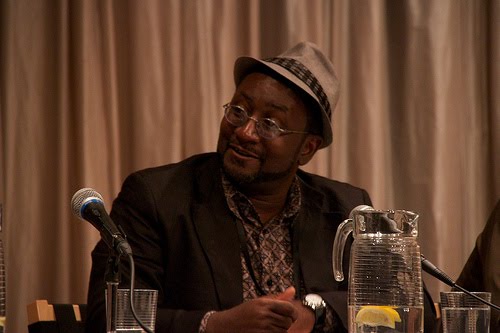
© PEN American Center/Susan Horgan. All rights reserved. Please contact media@pen.org for usage and rights.
June 18, 2008


June 16, 2008
Las Vegas Noir
Q: I just read your amazing story "Crip" in Las Vegas Noir and now I am ordering your novel All or Nothing at Amazon! What a great story! It is monstrous and beautiful at the same time and some of the lines in it are so true. How do you go about writing stories? Where does your creativity come from? Tell me how you wrote that story. Is it based on a true story? It seems so real.
A: Okay, "Crip," hmmm. . . well, that story was written shortly after my mother passed away last year. I got the call for the story while she was sick and started working on it while we were making funeral arrangements and going through that whole process. But I was in too much pain, and so I called the editor and asked for an extension because of the circumstances.
What I was trying to do was write a story about a little boy who witnesses brutality and is badly scarred internally and externally by it, but the narrative voice in my head after my mother's passing was rather dark, due to my depression--too dark to tell a child's story. So I made the child grow up, and he became Crip, the Mustard Man, and the voice worked better now. I wanted him to live in his adult present, but be haunted by the childhood of brutality, and I wanted that haunting memory to help him somehow, or help somebody, in his present. I am a gambler and I know a lot about gambling, so I know of the suffering children of gamblers go through--so here came the innocent little girl and her weak (gambler) father. After that, the story just flowed out--I had the voice, I had the characters, I had the setting--like that.
What I like best about that story is the ending. The ending was done in honor of my mother, a woman who loved stories with a sad, but heroic ending followed by a denouement, or a moral, that put a little sunshine back in.
Thanks,
Preston
A: Okay, "Crip," hmmm. . . well, that story was written shortly after my mother passed away last year. I got the call for the story while she was sick and started working on it while we were making funeral arrangements and going through that whole process. But I was in too much pain, and so I called the editor and asked for an extension because of the circumstances.
What I was trying to do was write a story about a little boy who witnesses brutality and is badly scarred internally and externally by it, but the narrative voice in my head after my mother's passing was rather dark, due to my depression--too dark to tell a child's story. So I made the child grow up, and he became Crip, the Mustard Man, and the voice worked better now. I wanted him to live in his adult present, but be haunted by the childhood of brutality, and I wanted that haunting memory to help him somehow, or help somebody, in his present. I am a gambler and I know a lot about gambling, so I know of the suffering children of gamblers go through--so here came the innocent little girl and her weak (gambler) father. After that, the story just flowed out--I had the voice, I had the characters, I had the setting--like that.
What I like best about that story is the ending. The ending was done in honor of my mother, a woman who loved stories with a sad, but heroic ending followed by a denouement, or a moral, that put a little sunshine back in.
Thanks,
Preston
June 15, 2008
Like a Rush Without the Risk
Q: I read your book a few months ago and really enjoyed it, but now I see you have a New York Times review. You should be very proud. Your book is great. Reading your book is like getting all the rush of gambling without having to lose any money. I can relate to almost everything in it. I am a gambler and have gambled in the Florida casinos, though now I live overseas (military). I think I remember you from the casinos. My name is ___ . I am Haitian, very tall, and have a shaven head. I was a school teacher for a while and I think we talked about that a few times? Your photograph looks very familiar and some of the adventures in the book are very familiar. Do you remember the tall transvestite M_____ who used to gamble there all the time? She was a trip. How come you did not use her in the book? I read an episode you wrote about her or someone very similar to her on another website. The website is asili and the story was called "Pretty Birdy". It was a great gambling story, why didn't you use it in the book?
A: No, I cannot say that I remember you. I'm scratching my head thinking, but your name and description do not ring a bell. Sorry. But I do remember M____! I believe that she was a transsexual, not a transvestite--though I have no hard proof. The story you are talking about was only loosely based on her, and I did not use it in the book because my editor and I decided that it did not fit the book's overall direction. There were many such episodes that had to be cut, a few of which were published elsewhere.
I like what you said about the book. "All the rush of gambling without having to lose any money."
Why don't you write me a review on Amazon?
Thanks,
Preston
A: No, I cannot say that I remember you. I'm scratching my head thinking, but your name and description do not ring a bell. Sorry. But I do remember M____! I believe that she was a transsexual, not a transvestite--though I have no hard proof. The story you are talking about was only loosely based on her, and I did not use it in the book because my editor and I decided that it did not fit the book's overall direction. There were many such episodes that had to be cut, a few of which were published elsewhere.
I like what you said about the book. "All the rush of gambling without having to lose any money."
Why don't you write me a review on Amazon?
Thanks,
Preston
June 12, 2008
Roaming Beyond the Ethnic Thing
Q: I enjoyed your book tremendously, which I read just before reading the first two stories in Nam Le’s collection THE BOAT. He is a good writer, excellent, actually, as are you, but I am noticing that the New York Times is correct in its review when it says that he is asserting “his right to roam beyond the Vietnamese thing.” As a writer of color (if I may call you that), do you ever feel that you must write about issues connected with your ethnicity or are you free to roam beyond the “African American thing” and explore other topics? Would you write a book that does not have an African-American protagonist and that does not touch on African American themes? If you did so, would you feel as though you had sold out? If you do not do so, do you feel that you are limited somehow by your ethnicity?
A: I have a feeling that I answered a similar question (questions) already, or maybe this is the question (s) that I am always being asked. Before I answer it (them), let me post some random things that popped into my head after reading your email.
1) I caught Trey Ellis being interviewed on NPR today. He’s got a new book out called Bedtime Stories: Dispatches from the Frontlines of Single-Fatherhood. Check it out at Amazon.com-- http://www.amazon.com/Bedtime-Stories-Adventures-Land-Single-Fatherhood/dp/1594865299/ref=pd_bbs_sr_1?ie=UTF8&s=books&qid=1213318953&sr=1-1
He and the interviewer are going back and forth about the book when the interviewer says something like this, which I am paraphrasing: “Your father was a psychiatrist. Your mother, a psychologist. You’re African American. Your mother committed suicide. That must have been hard at such a young age for you . . .”
My ears picked up “You’re African American,” and I wondered at it. Trey Ellis speaks like what he is, a well educated man, an assistant professor at Columbia, a novelist, a filmmaker. It is not possible for the audience to detect from Ellis’ voice over the radio that he is African American, so the interviewer must tell them. From the discussion of the book, which seems to be about a single father rearing two children, it is not possible for the audience to tell that Ellis is African American, so the interviewer must tell them.
It got me to thinking . . . it seems important for the audience to know that Ellis is African American, even though the book itself is not really about being black, or about the black experience (as far as I can tell from the interview).
2) My first published short story was “The Lord of Travel,” which shows up in my collection CHURCHBOYS AND OTHER SINNERS (Carolina Wren Press, 2003). Before it was eventually accepted by the Seattle Review, the story received a few handwritten rejection letters. (A handwritten rejection is a ray of hope for all beginning writers—it means your story was rejected, but at least they liked it enough to give you feedback about it.)
One rejection letter said something like (again, I paraphrase) “Why is the protagonist black? He doesn’t do anything black, so you might as well make him regular.”
3) Several publishers and agents rejected an earlier novel I had written with a similar comment: Your characters don’t act black enough. One of them added, “--and I have many black friends so I know what I am talking about.”
4) When I visit the bookstore, I note that my book (All or Nothing) is never shelved in the African American section. It is always shelved in the “regular” section.
Churchboys and Other Sinners is always shelved in the “regular” section.
My novels Hoochie Mama, Bounce, and Come With Me Sheba have been shelved in both the African American Section and the “regular” section, but usually the “regular” section.
Do these people not know that I am black? Would I sell more books if they knew?
I visited Barnes and Noble today. The African American section has books with scantily clad sexy men and women on the covers. The section looks . . . sultry. It arouses me sometimes to visit. I like that a lot. This way I don’t have to go to the sex and psychology section, where the erotic books are to get my groove on. The African American section looks like the sex and psychology section. It was startling finding Roots, Their Eyes Were Watching God, and Beloved in that crowd. I felt kind of embarrassed to see them there, but I can’t say exactly why.
My novel Hoochie Mama was in that crowd too. It fit right in, but there was only one copy left, which means that it is selling. Good.
5) James Haskins (author of over 100 books) was one of my professors at the University of Florida. When he learned that I wanted to be a novelist, he gave me this bit of advice, which I paraphrase: “Never put your photograph on the book, Allen. If you leave it off, you’ll sell more books.”
But it was 1985. And he was the most cynical man I ever met. He always called me Allen. I wonder if he thought that was my first name. A lot of people do. My name is Preston L. Allen.
My picture has appeared on the cover of every book I have ever written, except for Hoochie Mama.
5) I’m not sure that All or Nothing is an African American novel, but its protagonist is definitely black. People seem to like him, black or not. They seem to regard him as a gambler who happens to be black, not as a black gambler. His girlfriend, C.L., is white. I don’t think I have gotten one single email referring to them as an interracial couple. Have I succeeded in writing a black book that is not about blackness or the black experience? And is that really a success? I said “succeeded,” but is that really a success, to write a black book that is not about blackness? Is that kind of like a white book wearing black face?
Should I have made him “regular”? If I had made him white, would it have changed the impact of the book on the reader? P is more of a gambler than he is a father, than he is a bus driver, than he is black, than he is a man. That’s what I think. What’s his race? Gambler. What’s his sex? Gambler. What’s his religion? Gambler. What does he do for a living? He’s a gambler.
I made him black because, as we all know, black represents the darkness of the soul. Thus, his skin color and race symbolize the dark place to which we sink when we allow a vice, such as gambling, to deprive us of our moral selves . . . NOT!
I made him black because I wanted him to represent all black people, and I wanted this book to rescue black people from the vices that white people have created since reconstruction to destroy us. NOT!
I made him black because it would match his hat. NOT!
I made him black because when I used to gamble, I was black. Thank god I had that surgery and I am white now. NOT!
I made him black because P is me, and this confessional which grew into a novel was originally intended to be a 100-page suicide note trying its best to explain the unexplainable to those I left behind: how this addiction drove me to take my own life. My plan was to just tell the truth to everybody in this long letter and then end it all. I was tired, real tired, believe me. Fortunately, I had a writing workshop the coming weekend and my writer’s ego looked down upon what I had written and said, “Hey, this is pretty good. You’re onto something here, Presty. Why don’t you fictionalize it and give it to your buddies in the workshop?” And then the next day, I won a big jackpot at the casino—five grand; the numbers on the machine were 371737; the Play-4 the night before was 3717, I was imitating it because it struck me as similar to my usual number 373737; and I was only playing it for a quarter because I needed to save up the rest of my money to buy the gun. Well, no self-respecting gambler is going to kill himself when he is on a winning streak . . . so that weekend, I was still alive and I went to the workshop with my buddies Leejay, Gonzalo, Elizabeth, and David, who gave me great feedback on the piece. The rest is history. To this day, I am not sure which of the two was more responsible for stopping me from going through with the suicide, my ego or the lucky five grand. At any rate, my buddies in the workshop liked the book, I got my gambling under control (again, for the third time, fourth?), and then I got the book published. And that’s the truth. Not!
. . . well, maybe some of it's true--but I won't say which because I am a writer of fiction, not of memoir.
6) Yes, I feel the need to write stories that reflect the black community, and I do. My award-winning Churchboys and Other Sinners (Carolina Wren Press 2003), for example, is a collection of stories with mostly African-American protagonists.
But mostly I just write the story that the muse gifts me--and the ethnicity of the protagonist will be whatever the muse says it should be. I don’t much worry about betraying the black community because I am black, so my awareness as a black person will inform the work even if its protagonist is white. My awareness as a Honduran will inform it too. My awareness as a man will inform it too. My awareness as a father will inform it too. My awareness as a Floridian will inform it too. Etc., Etc.
Yes, when I was a young writer, I used to feel self-imposed pressure when I did not write black stories. I had stuff that I wrote for myself, and then I had “serious” stuff that I wrote for the black community. Like I said, I was young. At the same time, I was very much interested in science fiction, thrillers, and classic American lit 101, most of which did not have much to do, thematically, with African Americans. Thus, many of my stories were already “roaming beyond the African American thing,” but I felt a little bit guilty about it. Like I was selling out my race. I was young. So young. When I grew up, I said, “I am going to write what I write and let the chips fall where they may. I will master my craft and become the best writer that I can be. Readers will like me because I am a good storyteller, not because I have a certain color skin.”
I think all writers feel this sort of pressure at some point and/or to some degree because every writer identifies with one group or another—should I write only about Boston, about women’s issues, about the gay community, about the disabled, about sports, about rural Alabama, about an evangelical upbringing?
Members of a racial or social minority, however, feel the additional pressure of having to defend the group. Thus, they feel that they are betraying the group when they don’t use their art to uplift it. And then they may feel that they are limiting their art when they do nothing save write about their group.
Furthermore, every writer wants to be taken seriously. Which of the two sounds more “serious” to you—(A) my story about a sleazy car salesman who falls in love with one of his customers and has her double cross him the way he has double crossed so many others, or (B) my story, confessional, about a black man who struggles against racism to earn a living as a car salesman in an upscale white neighborhood? The answer is B. Duh. The added benefit is that people will look at your black skin, learn that you were once a car salesman, and conclude that the story is based on real life. Voila. Now you are a serious writer. Your writing is genuine. Your writing is legitimate.
But if you make the protagonist white, it is merely a cute exercise on your part. Furthermore, you are a sell out.
Or so they say.
7) I’m glad I do not subscribe to that philosophy anymore.
Has Oprah roamed beyond the black thing?
Has Spielberg roamed beyond the Jewish thing?
Has Louise Erdrich roamed beyond the Native American thing?
Have Francis Ford Coppola (Apocalypse Now) and Martin Scorsese (Gangs of New York) roamed beyond the Italian American thing?
Has Spike Lee (25th Hour) roamed beyond the African American thing?
Has Tim Story (directed Fantastic Four) roamed beyond the African American thing?
Has M. Night Shyamalan (Sixth Sense) roamed beyond the Indian thing?
In fact, is Shyamalan ever going to make a movie that features Indian people/culture (ala Bollywood)?
You do realize that if M Night Shylamalan decided to take his international fame and superstar status back to India and produced/directed a feature film there that his potential audience is close to a billion? A billion!
Shyamalan's case is very interesting in this regards: many ethnic and social minorities roam beyond their "thing" in order to grow as artists and to gain a wider readership/audience, but Bollywood's audience actually dwarfs Hollywood's because of India's great population.
Bollywood films, of course, don't have much of an international audience outside of India, England, parts of the West Indies and parts of the US, while Hollywood films do--I'm sure RAMBO and the MATRIX are very popular even in Yakutsk.*
Thus, you can argue that M. Night Shyamalan is the "biggest" Indian film personality/name in the world, but the most "popular" is actually somebody you have never heard of and who has never bothered to direct/produce films outside his/her native India.
But, I digress.
The point is this: when in Roam, do as the Roamers do.
If you are a lesbian, for example, there is nothing wrong with writing a great/bestselling lesbian themed book. Awesome. Do it!
On the other hand, you are not a sellout to the lesbian community if you write a bestselling thriller with a heterosexual male protagonist. What you are is a writer. Lesbians will, and should, embrace you because you are good at what you do. Furthermore, I am sure that your sensibilities as a lesbian will inform the book in surprising and refreshing ways.
Further-furthermore, you could make your big splash writing scripts for "CSI:Miami"--I know, I know, it's not as fulfilling as writing scripts for "The 'L' Word," but that job has already been taken and a splash is a splash, and your community will and should be proud if you. They should be walking around saying things like, "You know that woman who is the lead writer for CSI? I knew her back in college at UF. She was president of UFLAGS, the University of Florida Lesbian and Gay Society. She's always been a real good writer. I'm proud of her."
The point that I am trying to get at, is that once you get beyond your infancy as a writer/artist is that you will find your own voice, your own style, your own audience; and the particular group that you come from will be proud of you because now they have a representative in that genre.
You are not a sellout. You are a representative.
You are an example that talent defies the pigeonhole.
It is a writer's job to write the best story that he/she is capable of writing.
That's what I always try to do. Sometimes that story is about my ethnic thing--sometimes it is not. But regardless of what it is about, the reader is going to love it.
8) Get a copy of the New York Times this Sunday (June 15th, 2008) and find a review of my novel All or Nothing. Then purhchase a copy of "All or Nothing" and judge whether or not I "Roamed" beyond my "ethnic thing."
I gambled a lot. I won a lot. I lost a lot. Maybe gambling is my ethnic thing!
Thanks for the question,
Preston
*Yakutsk--You've never heard of Yakutsk? You've never played the boardgame Risk? Yakutsk, Irkutsk, and Kamchatka? Oh you sad generation of Wii players--you have never lived, if you have never played Risk.
Preston
A: I have a feeling that I answered a similar question (questions) already, or maybe this is the question (s) that I am always being asked. Before I answer it (them), let me post some random things that popped into my head after reading your email.
1) I caught Trey Ellis being interviewed on NPR today. He’s got a new book out called Bedtime Stories: Dispatches from the Frontlines of Single-Fatherhood. Check it out at Amazon.com-- http://www.amazon.com/Bedtime-Stories-Adventures-Land-Single-Fatherhood/dp/1594865299/ref=pd_bbs_sr_1?ie=UTF8&s=books&qid=1213318953&sr=1-1
He and the interviewer are going back and forth about the book when the interviewer says something like this, which I am paraphrasing: “Your father was a psychiatrist. Your mother, a psychologist. You’re African American. Your mother committed suicide. That must have been hard at such a young age for you . . .”
My ears picked up “You’re African American,” and I wondered at it. Trey Ellis speaks like what he is, a well educated man, an assistant professor at Columbia, a novelist, a filmmaker. It is not possible for the audience to detect from Ellis’ voice over the radio that he is African American, so the interviewer must tell them. From the discussion of the book, which seems to be about a single father rearing two children, it is not possible for the audience to tell that Ellis is African American, so the interviewer must tell them.
It got me to thinking . . . it seems important for the audience to know that Ellis is African American, even though the book itself is not really about being black, or about the black experience (as far as I can tell from the interview).
2) My first published short story was “The Lord of Travel,” which shows up in my collection CHURCHBOYS AND OTHER SINNERS (Carolina Wren Press, 2003). Before it was eventually accepted by the Seattle Review, the story received a few handwritten rejection letters. (A handwritten rejection is a ray of hope for all beginning writers—it means your story was rejected, but at least they liked it enough to give you feedback about it.)
One rejection letter said something like (again, I paraphrase) “Why is the protagonist black? He doesn’t do anything black, so you might as well make him regular.”
3) Several publishers and agents rejected an earlier novel I had written with a similar comment: Your characters don’t act black enough. One of them added, “--and I have many black friends so I know what I am talking about.”
4) When I visit the bookstore, I note that my book (All or Nothing) is never shelved in the African American section. It is always shelved in the “regular” section.
Churchboys and Other Sinners is always shelved in the “regular” section.
My novels Hoochie Mama, Bounce, and Come With Me Sheba have been shelved in both the African American Section and the “regular” section, but usually the “regular” section.
Do these people not know that I am black? Would I sell more books if they knew?
I visited Barnes and Noble today. The African American section has books with scantily clad sexy men and women on the covers. The section looks . . . sultry. It arouses me sometimes to visit. I like that a lot. This way I don’t have to go to the sex and psychology section, where the erotic books are to get my groove on. The African American section looks like the sex and psychology section. It was startling finding Roots, Their Eyes Were Watching God, and Beloved in that crowd. I felt kind of embarrassed to see them there, but I can’t say exactly why.
My novel Hoochie Mama was in that crowd too. It fit right in, but there was only one copy left, which means that it is selling. Good.
5) James Haskins (author of over 100 books) was one of my professors at the University of Florida. When he learned that I wanted to be a novelist, he gave me this bit of advice, which I paraphrase: “Never put your photograph on the book, Allen. If you leave it off, you’ll sell more books.”
But it was 1985. And he was the most cynical man I ever met. He always called me Allen. I wonder if he thought that was my first name. A lot of people do. My name is Preston L. Allen.
My picture has appeared on the cover of every book I have ever written, except for Hoochie Mama.
5) I’m not sure that All or Nothing is an African American novel, but its protagonist is definitely black. People seem to like him, black or not. They seem to regard him as a gambler who happens to be black, not as a black gambler. His girlfriend, C.L., is white. I don’t think I have gotten one single email referring to them as an interracial couple. Have I succeeded in writing a black book that is not about blackness or the black experience? And is that really a success? I said “succeeded,” but is that really a success, to write a black book that is not about blackness? Is that kind of like a white book wearing black face?
Should I have made him “regular”? If I had made him white, would it have changed the impact of the book on the reader? P is more of a gambler than he is a father, than he is a bus driver, than he is black, than he is a man. That’s what I think. What’s his race? Gambler. What’s his sex? Gambler. What’s his religion? Gambler. What does he do for a living? He’s a gambler.
I made him black because, as we all know, black represents the darkness of the soul. Thus, his skin color and race symbolize the dark place to which we sink when we allow a vice, such as gambling, to deprive us of our moral selves . . . NOT!
I made him black because I wanted him to represent all black people, and I wanted this book to rescue black people from the vices that white people have created since reconstruction to destroy us. NOT!
I made him black because it would match his hat. NOT!
I made him black because when I used to gamble, I was black. Thank god I had that surgery and I am white now. NOT!
I made him black because P is me, and this confessional which grew into a novel was originally intended to be a 100-page suicide note trying its best to explain the unexplainable to those I left behind: how this addiction drove me to take my own life. My plan was to just tell the truth to everybody in this long letter and then end it all. I was tired, real tired, believe me. Fortunately, I had a writing workshop the coming weekend and my writer’s ego looked down upon what I had written and said, “Hey, this is pretty good. You’re onto something here, Presty. Why don’t you fictionalize it and give it to your buddies in the workshop?” And then the next day, I won a big jackpot at the casino—five grand; the numbers on the machine were 371737; the Play-4 the night before was 3717, I was imitating it because it struck me as similar to my usual number 373737; and I was only playing it for a quarter because I needed to save up the rest of my money to buy the gun. Well, no self-respecting gambler is going to kill himself when he is on a winning streak . . . so that weekend, I was still alive and I went to the workshop with my buddies Leejay, Gonzalo, Elizabeth, and David, who gave me great feedback on the piece. The rest is history. To this day, I am not sure which of the two was more responsible for stopping me from going through with the suicide, my ego or the lucky five grand. At any rate, my buddies in the workshop liked the book, I got my gambling under control (again, for the third time, fourth?), and then I got the book published. And that’s the truth. Not!
. . . well, maybe some of it's true--but I won't say which because I am a writer of fiction, not of memoir.
6) Yes, I feel the need to write stories that reflect the black community, and I do. My award-winning Churchboys and Other Sinners (Carolina Wren Press 2003), for example, is a collection of stories with mostly African-American protagonists.
But mostly I just write the story that the muse gifts me--and the ethnicity of the protagonist will be whatever the muse says it should be. I don’t much worry about betraying the black community because I am black, so my awareness as a black person will inform the work even if its protagonist is white. My awareness as a Honduran will inform it too. My awareness as a man will inform it too. My awareness as a father will inform it too. My awareness as a Floridian will inform it too. Etc., Etc.
Yes, when I was a young writer, I used to feel self-imposed pressure when I did not write black stories. I had stuff that I wrote for myself, and then I had “serious” stuff that I wrote for the black community. Like I said, I was young. At the same time, I was very much interested in science fiction, thrillers, and classic American lit 101, most of which did not have much to do, thematically, with African Americans. Thus, many of my stories were already “roaming beyond the African American thing,” but I felt a little bit guilty about it. Like I was selling out my race. I was young. So young. When I grew up, I said, “I am going to write what I write and let the chips fall where they may. I will master my craft and become the best writer that I can be. Readers will like me because I am a good storyteller, not because I have a certain color skin.”
I think all writers feel this sort of pressure at some point and/or to some degree because every writer identifies with one group or another—should I write only about Boston, about women’s issues, about the gay community, about the disabled, about sports, about rural Alabama, about an evangelical upbringing?
Members of a racial or social minority, however, feel the additional pressure of having to defend the group. Thus, they feel that they are betraying the group when they don’t use their art to uplift it. And then they may feel that they are limiting their art when they do nothing save write about their group.
Furthermore, every writer wants to be taken seriously. Which of the two sounds more “serious” to you—(A) my story about a sleazy car salesman who falls in love with one of his customers and has her double cross him the way he has double crossed so many others, or (B) my story, confessional, about a black man who struggles against racism to earn a living as a car salesman in an upscale white neighborhood? The answer is B. Duh. The added benefit is that people will look at your black skin, learn that you were once a car salesman, and conclude that the story is based on real life. Voila. Now you are a serious writer. Your writing is genuine. Your writing is legitimate.
But if you make the protagonist white, it is merely a cute exercise on your part. Furthermore, you are a sell out.
Or so they say.
7) I’m glad I do not subscribe to that philosophy anymore.
Has Oprah roamed beyond the black thing?
Has Spielberg roamed beyond the Jewish thing?
Has Louise Erdrich roamed beyond the Native American thing?
Have Francis Ford Coppola (Apocalypse Now) and Martin Scorsese (Gangs of New York) roamed beyond the Italian American thing?
Has Spike Lee (25th Hour) roamed beyond the African American thing?
Has Tim Story (directed Fantastic Four) roamed beyond the African American thing?
Has M. Night Shyamalan (Sixth Sense) roamed beyond the Indian thing?
In fact, is Shyamalan ever going to make a movie that features Indian people/culture (ala Bollywood)?
You do realize that if M Night Shylamalan decided to take his international fame and superstar status back to India and produced/directed a feature film there that his potential audience is close to a billion? A billion!
Shyamalan's case is very interesting in this regards: many ethnic and social minorities roam beyond their "thing" in order to grow as artists and to gain a wider readership/audience, but Bollywood's audience actually dwarfs Hollywood's because of India's great population.
Bollywood films, of course, don't have much of an international audience outside of India, England, parts of the West Indies and parts of the US, while Hollywood films do--I'm sure RAMBO and the MATRIX are very popular even in Yakutsk.*
Thus, you can argue that M. Night Shyamalan is the "biggest" Indian film personality/name in the world, but the most "popular" is actually somebody you have never heard of and who has never bothered to direct/produce films outside his/her native India.
But, I digress.
The point is this: when in Roam, do as the Roamers do.
If you are a lesbian, for example, there is nothing wrong with writing a great/bestselling lesbian themed book. Awesome. Do it!
On the other hand, you are not a sellout to the lesbian community if you write a bestselling thriller with a heterosexual male protagonist. What you are is a writer. Lesbians will, and should, embrace you because you are good at what you do. Furthermore, I am sure that your sensibilities as a lesbian will inform the book in surprising and refreshing ways.
Further-furthermore, you could make your big splash writing scripts for "CSI:Miami"--I know, I know, it's not as fulfilling as writing scripts for "The 'L' Word," but that job has already been taken and a splash is a splash, and your community will and should be proud if you. They should be walking around saying things like, "You know that woman who is the lead writer for CSI? I knew her back in college at UF. She was president of UFLAGS, the University of Florida Lesbian and Gay Society. She's always been a real good writer. I'm proud of her."
The point that I am trying to get at, is that once you get beyond your infancy as a writer/artist is that you will find your own voice, your own style, your own audience; and the particular group that you come from will be proud of you because now they have a representative in that genre.
You are not a sellout. You are a representative.
You are an example that talent defies the pigeonhole.
It is a writer's job to write the best story that he/she is capable of writing.
That's what I always try to do. Sometimes that story is about my ethnic thing--sometimes it is not. But regardless of what it is about, the reader is going to love it.
8) Get a copy of the New York Times this Sunday (June 15th, 2008) and find a review of my novel All or Nothing. Then purhchase a copy of "All or Nothing" and judge whether or not I "Roamed" beyond my "ethnic thing."
I gambled a lot. I won a lot. I lost a lot. Maybe gambling is my ethnic thing!
Thanks for the question,
Preston
*Yakutsk--You've never heard of Yakutsk? You've never played the boardgame Risk? Yakutsk, Irkutsk, and Kamchatka? Oh you sad generation of Wii players--you have never lived, if you have never played Risk.
Preston
June 8, 2008
Oprah's Empire Is Not in Trouble
I hope her empire is not in trouble. A good review from Oprah is one of those things that we writers dream of. . . I am still dreaming.
Preston
________________________________________________________
http://www.blackvoices.com/blogs/2008/06/05/oprahs-empire-can-it-strike-back/?icid=100214839x1203624758x1200144545
Posted Jun 5th 2008 5:00AM by Jeff DouglasFiled under: BlackSpin
“Oprah’s Empire Will Strike Back”
Don't believe the haters over at Fox News and The New York Times who've reported that Oprah Winfrey's media empire is in trouble. It's just not true.Claims that Oprah has "lost touch" with her audience are just as foolish as the rumors that her presidential endorsement of Sen. Barack Obama set off a chain reaction that sunk her talk show's ratings.
Love her or hate her, know this: Oprah is one of the richest and smartest business women in the world. Her empire is strong and will strike back and silence her critics. ...
There's strength in numbers. And Oprah's worth an estimated $1.5 billion (probably more). No
African school scandal or regrettable book club endorsement can change that. Oprah is the highest-paid TV personality out there, earning $260 million a year. Jay Leno makes just $32 million a year in comparison.
Her show's ratings have dipped some 7 percent since last year? So what? "Fair and Balanced" Fox News and The New York Times forgot to mention Oprah has had the No. 1 talk show on TV for a decade. Sure, her viewer numbers are down a bit, but the same is true for ALL daytime talk shows, from Ellen to Dr. Phil. And don't forget who's bankrolling the good doctor's show, which is ranked No. 2 in daytime ratings: Oprah!
But wait, there's even more faux fuel that threatens to burn down Oprah's empire.
The daytime diva's recent approval ratings are somewhere around 60 percent. Wow! That's still about 59 percent better than our current president's approval ratings. And since when did pollsters start doing approval ratings for talk-show hosts anyway? What's Tyra Bank's approval rating?
Then there's the argument that circulation for her "O" magazine is down 10 percent. The fact is, most startup magazines don't even make it past their first year. O Magazine has been on the newsstands for a eight years and is STILL ranked in the top ten of home and lifestyle magazines, according to Media Distribution Services., right behind Martha's Stewart's magazine.
What a great day it would be for Oprah haters, to legitimately report that such a successful and powerful woman has met the same fate that so many rich and famous do.
But when you take a closer look at the numbers, it's just not true.
Preston
________________________________________________________
http://www.blackvoices.com/blogs/2008/06/05/oprahs-empire-can-it-strike-back/?icid=100214839x1203624758x1200144545
Posted Jun 5th 2008 5:00AM by Jeff DouglasFiled under: BlackSpin
“Oprah’s Empire Will Strike Back”
Don't believe the haters over at Fox News and The New York Times who've reported that Oprah Winfrey's media empire is in trouble. It's just not true.Claims that Oprah has "lost touch" with her audience are just as foolish as the rumors that her presidential endorsement of Sen. Barack Obama set off a chain reaction that sunk her talk show's ratings.
Love her or hate her, know this: Oprah is one of the richest and smartest business women in the world. Her empire is strong and will strike back and silence her critics. ...
There's strength in numbers. And Oprah's worth an estimated $1.5 billion (probably more). No
African school scandal or regrettable book club endorsement can change that. Oprah is the highest-paid TV personality out there, earning $260 million a year. Jay Leno makes just $32 million a year in comparison.
Her show's ratings have dipped some 7 percent since last year? So what? "Fair and Balanced" Fox News and The New York Times forgot to mention Oprah has had the No. 1 talk show on TV for a decade. Sure, her viewer numbers are down a bit, but the same is true for ALL daytime talk shows, from Ellen to Dr. Phil. And don't forget who's bankrolling the good doctor's show, which is ranked No. 2 in daytime ratings: Oprah!
But wait, there's even more faux fuel that threatens to burn down Oprah's empire.
The daytime diva's recent approval ratings are somewhere around 60 percent. Wow! That's still about 59 percent better than our current president's approval ratings. And since when did pollsters start doing approval ratings for talk-show hosts anyway? What's Tyra Bank's approval rating?
Then there's the argument that circulation for her "O" magazine is down 10 percent. The fact is, most startup magazines don't even make it past their first year. O Magazine has been on the newsstands for a eight years and is STILL ranked in the top ten of home and lifestyle magazines, according to Media Distribution Services., right behind Martha's Stewart's magazine.
What a great day it would be for Oprah haters, to legitimately report that such a successful and powerful woman has met the same fate that so many rich and famous do.
But when you take a closer look at the numbers, it's just not true.
May 28, 2008
Children and Gambling 2
Q: I read the answer to your last question and read that you have seen children waiting for their parents in parking lots and non-carpeted casino floors. I am a 14 year old daughter whose father has/had gambling problems and HAS left me and younger siblings in a parking lot. Have you ever thought of seeing or listening from a child's prospective? My blog is basically from a child's view:
http://www.sramirez93.blogspot.com/
A: Thanks for your question. Yes, I have thought of gambling from a child's point of view. In fact, the sequel to the book (Son of a P) is written from the point of view of P's son--but he is an adult telling the story.
I have a story called "Crip" in the collection LAS VEGAS NOIR (Akashic 2008) that features a little girl who is the child of a gambler. She suffers a lot because of her gambling father--she gets kidnapped and ransomed and then even the threat of sexual abuse arises.
Around 2003-4 there was a memoir I heard about on NPR called something like . . . I wish I could remember the title . . . it was called something like "THE THINGS WE LOST THROUGH OUR FATHER's GAMBLING." From the excerpts, it seems to have been written from the point of view of an adult child of a gambler--recalling her childhood with the gambling father. I wish I had written down the title, but I was on my way to the casino to go gamble and I didn't want to be late.
Your question has given me an idea--I am going to write another short story from the point of view of a gambler's child and focus just on the adventures of the child.
I will visit your site.
Thanks,
Preston
http://www.sramirez93.blogspot.com/
A: Thanks for your question. Yes, I have thought of gambling from a child's point of view. In fact, the sequel to the book (Son of a P) is written from the point of view of P's son--but he is an adult telling the story.
I have a story called "Crip" in the collection LAS VEGAS NOIR (Akashic 2008) that features a little girl who is the child of a gambler. She suffers a lot because of her gambling father--she gets kidnapped and ransomed and then even the threat of sexual abuse arises.
Around 2003-4 there was a memoir I heard about on NPR called something like . . . I wish I could remember the title . . . it was called something like "THE THINGS WE LOST THROUGH OUR FATHER's GAMBLING." From the excerpts, it seems to have been written from the point of view of an adult child of a gambler--recalling her childhood with the gambling father. I wish I had written down the title, but I was on my way to the casino to go gamble and I didn't want to be late.
Your question has given me an idea--I am going to write another short story from the point of view of a gambler's child and focus just on the adventures of the child.
I will visit your site.
Thanks,
Preston
May 20, 2008
Children and Gambling
Q: I am enjoying your book. I have a question about children. Is it realistic that P would abandon his wife and children? He clearly loves them.
A: Good question, and the answer is yes. It all depends on the gambler, of course, and the level of addiction to which he/she has sunk. But I have seen very young children waiting on their gambling parent for hours on the non-carpeted areas of the casino (Florida law forbids minors to step on the carpeted areas where the gambling occurs). I have seen them waiting outside in parked cars. I imagine many of them must be waiting upstairs in the hotel rooms, too. I have known of gamblers who have divorced most likely due to their addiction--and there are children involved whom they almost never see, and to whom they give little financial support because their money goes into the casino. In other words, they cannot afford child support (and are not there for emotional support) and yet they are in the casino every day blowing hundreds and thousands.
In that respect, P is fictional, but typical. He loves his children, but he will push them aside if they interfere with his gambling.
Go to this site for more information--Gambling Addiction Questions and Answers.
http://www.addictionrecov.org/qandagam.htm
Thanks,
Preston
A: Good question, and the answer is yes. It all depends on the gambler, of course, and the level of addiction to which he/she has sunk. But I have seen very young children waiting on their gambling parent for hours on the non-carpeted areas of the casino (Florida law forbids minors to step on the carpeted areas where the gambling occurs). I have seen them waiting outside in parked cars. I imagine many of them must be waiting upstairs in the hotel rooms, too. I have known of gamblers who have divorced most likely due to their addiction--and there are children involved whom they almost never see, and to whom they give little financial support because their money goes into the casino. In other words, they cannot afford child support (and are not there for emotional support) and yet they are in the casino every day blowing hundreds and thousands.
In that respect, P is fictional, but typical. He loves his children, but he will push them aside if they interfere with his gambling.
Go to this site for more information--Gambling Addiction Questions and Answers.
http://www.addictionrecov.org/qandagam.htm
Thanks,
Preston
May 19, 2008
Why Do You Like Stephen King?
Q: Going through your favorite books on your websites, I spotted among the mostly literary list several titles by horror novelist Stephen King. King is a genre writer and you seem to have literary aspirations. Would you explain why you count him as one of your favorites.
A: King is not the only genre writer on my list, first of all.
But to answer the question, King is one of my favorite writers because unlike many genre writers, he has excellent writing skills; and unlike many literary writers, he does not let his writing interfere with his storytelling.
When I read "genre" fiction, I am hooked by the story but usually find myself skipping through sentences, paragraphs, and as I near the end of the book entire chapters because the WRITING itself is not engaging.
When I read "literary" fiction, I am hooked by the writing but sometimes find myself abandoning the book halfway through because the STORY itself is not engaging--or I finish the work but have trouble fully enjoying it because the writing is so dense that it becomes more interesting than the actual story.
The works I love (be they literary or genre) are those that have an engaging story and writing that is polished.
King's stories, of course, are enagining, for that is the strength of the genre writer, right? But his prose is also always polished and at times masterful. Furthermore, he has a great sense of humor, excellent timing, a knowledge of all the "tricks," and a flawless instinct for when to use them.
In short, his books are readable without being dumb. It's more than that actually. His books are highly enjoyable.
Finally, King is an "important" writer--as important to our times as Edgar Allan Poe (good writer, but not considered literary in his day), James Fennimore Cooper (not a very good writer at all), and Shakespeare (good writer, but not considered literary in his day) were to their times.
Imagine you are a college student in the year, say, 2090, and you take a course in 20th Century Horror--and on the syllabus there are no works by Stephen King. Drop the course.
By the way, King is already being taught in college classrooms around the country.
Thanks,
Preston
A: King is not the only genre writer on my list, first of all.
But to answer the question, King is one of my favorite writers because unlike many genre writers, he has excellent writing skills; and unlike many literary writers, he does not let his writing interfere with his storytelling.
When I read "genre" fiction, I am hooked by the story but usually find myself skipping through sentences, paragraphs, and as I near the end of the book entire chapters because the WRITING itself is not engaging.
When I read "literary" fiction, I am hooked by the writing but sometimes find myself abandoning the book halfway through because the STORY itself is not engaging--or I finish the work but have trouble fully enjoying it because the writing is so dense that it becomes more interesting than the actual story.
The works I love (be they literary or genre) are those that have an engaging story and writing that is polished.
King's stories, of course, are enagining, for that is the strength of the genre writer, right? But his prose is also always polished and at times masterful. Furthermore, he has a great sense of humor, excellent timing, a knowledge of all the "tricks," and a flawless instinct for when to use them.
In short, his books are readable without being dumb. It's more than that actually. His books are highly enjoyable.
Finally, King is an "important" writer--as important to our times as Edgar Allan Poe (good writer, but not considered literary in his day), James Fennimore Cooper (not a very good writer at all), and Shakespeare (good writer, but not considered literary in his day) were to their times.
Imagine you are a college student in the year, say, 2090, and you take a course in 20th Century Horror--and on the syllabus there are no works by Stephen King. Drop the course.
By the way, King is already being taught in college classrooms around the country.
Thanks,
Preston
May 16, 2008
A New Review
The best fiction book I have read in years!
Mr. Allen’s “All or Nothing” is the story of P and his gambling addiction. “All or Nothing” is an extremely powerful and simply told story. If I hadn’t needed sleep I would have read this in one sitting.
The character P, we’re never told anyone’s full name, is an honest man. Honest, in that he knows he’s a gambler. He knows he is addicted to gambling. He knows he lies to those around him. He doesn’t apologize for who and what he is. P allows us to see into the mind of a gambler and that the meaning of money has many interpretations.
I agreed to read “All or Nothing” because I thought it would be a basic story about a gambler. A straightforward fiction book.
I was unprepared for the emotional intensity of Mr. Allen’s writing.
I was unprepared for the stillness and soft bluntness of Mr. Allen’s writing.
“All or Nothing” is one hell of a book. Thank you Mr. Allen.
(Christine Speakman, four out of four Roses, The Muse Book Reviews)
http://themusebookreviews.tripod.com/id143.html
Mr. Allen’s “All or Nothing” is the story of P and his gambling addiction. “All or Nothing” is an extremely powerful and simply told story. If I hadn’t needed sleep I would have read this in one sitting.
The character P, we’re never told anyone’s full name, is an honest man. Honest, in that he knows he’s a gambler. He knows he is addicted to gambling. He knows he lies to those around him. He doesn’t apologize for who and what he is. P allows us to see into the mind of a gambler and that the meaning of money has many interpretations.
I agreed to read “All or Nothing” because I thought it would be a basic story about a gambler. A straightforward fiction book.
I was unprepared for the emotional intensity of Mr. Allen’s writing.
I was unprepared for the stillness and soft bluntness of Mr. Allen’s writing.
“All or Nothing” is one hell of a book. Thank you Mr. Allen.
(Christine Speakman, four out of four Roses, The Muse Book Reviews)
http://themusebookreviews.tripod.com/id143.html
May 10, 2008
Do you believe the world is flat or round?
While I am working on compiling that list of MFA and Ph. D in Creative Writing programs with my friend Lisa Shaw, I am going to share my response to one of the earliest questions I got on this blog but did not post because I had no idea how it fit in with everything. It is interesting, though.
Q: If you were a tree, what kind of tree would you be?
A: I don’t know how to answer that question. A willow? I am not afraid to weep. An oak? It’s hard to make me weep. I don’t know. Sorry. Thanks for emailing.
Q: It’s me again. Here’s a better question. I came up with it after reading your books “Churchboys and Other Sinners” and “All or Nothing,” especially the latter because P strikes me as an agnostic who will not believe that which he cannot see. Except when it comes to luck. With luck, he possesses faith to dangerous extremes. Here is the question:
If you were living in Europe in 1490, would you believe that the world was flat?
A: I like this question! It had me up all night.
If I were living in Europe in 1490, two years before Columbus journeyed east to discover the “New World,” I would have been taught that the world was flat, and because I am a good student I would have accepted it.
Now, if I were a child raised near the ocean and able to see day after day the approach of ships, the mast rising over the horizon before the actual ship appeared, I would have accepted that the world was flat as the answer to give in school, but I would hold out that maybe this school “fact” was not the actual truth.
On the other hand, I do not think that I would have leapt to the conclusion that the world was round. I would simply “doubt” the facts that I was taught in school and wait for the day when the truth, or a better theory, would eventually come out.
Even today, there are things I accept as “temporary stays against confusion” as Richard Abkarian and Marvin Klotz say in the intro to “Innocence and Experience” in their textbook Literature the Human Experience. For example, I accept the theory of evolution as scientifically sound—for today! I imagine that in the future there will be a better theory to explain how things came to be. I feel the same about the big-bang theory. I feel the same about flat earth in 1490—I accept it until something closer to the truth comes along.
Q: If you were living in Europe in 1493, would you believe the new theory that the world was round?
A: Yes. It would explain away some if the discrepancies that I had encountered with the old flat-earth theory. On the other hand, I would hold that new theory up to the same level of doubt that I had held the flat-earth theory up to. In other words, I believe it, but if something new comes along that makes more sense and can be supported through scientific reasoning and empirical observation and measure, then I will easily cease to believe it.
Q: Do you believe in God?
A: I do not discuss religion in public or with strangers. Sorry.
Q: Does Elwyn believe in God? [Churchboys and Other Sinners]
A: Yes he does. He has no problem with his faith. He is a true believer. His only problem is trying to bring the world in line with what he already believes. And, of course, he struggles to justify his sinful, clandestine affair with Sister Morrisohn so as to reconcile his value system.
Q: If Elwyn were living in 1490, would he believe that the world was flat?
A: Yes. And he would believe it despite the evidence he saw to the contrary.
Q: If Elwyn were living in 1493, would he believe the new theory that the world was round?
A: Not at first. He would accept it after everyone else began to accept it.
Q: Does P believe in God? [All or Nothing]
A: Yes. But he has doubts that he will not speak about publicly, nor do these doubts trouble him to any great degree. P believes that if there is a God, that God will do what God will do, and there is nothing that P, a mere human, can do about it—so there is no need for P to worry about it. P believes that religion, for the most part, is designed so that a few disingenuous people can distract you by getting you to start worrying about things that you really have no control over—death, life in the hereafter, invisible spirits. On the other hand, P believes that some sentient being or beings do govern the universe, and that perhaps they can be used from time to time to control “luck.” In fact, when P is down on his luck, he becomes very religious and superstitious. Thus, P is a contradiction.
Q: If P were living in 1490, would he believe that the world was flat?
A: Yes, but he would have doubts about it.
Q: If P were living in 1493, would he believe the new theory that the world was round?
A: Yes, but he would have doubts about it. He would like it better than he had the flat-earth theory, but he would still have his doubts. P accepts nothing without solid evidence.
Q: And yet he believes in luck with no evidence at all.
A: P is a contradiction.
_______________________________
I'd like to hear your responses to the question. Email me at prestonthewriterallen@gmail.com.
Respond to these questions:
1) If you were living in Europe in 1490, would you believe that the world was flat?
2) If you were living in Europe in 1493, would you believe the new theory that the world was round?
Thanks,
Preston
Q: If you were a tree, what kind of tree would you be?
A: I don’t know how to answer that question. A willow? I am not afraid to weep. An oak? It’s hard to make me weep. I don’t know. Sorry. Thanks for emailing.
Q: It’s me again. Here’s a better question. I came up with it after reading your books “Churchboys and Other Sinners” and “All or Nothing,” especially the latter because P strikes me as an agnostic who will not believe that which he cannot see. Except when it comes to luck. With luck, he possesses faith to dangerous extremes. Here is the question:
If you were living in Europe in 1490, would you believe that the world was flat?
A: I like this question! It had me up all night.
If I were living in Europe in 1490, two years before Columbus journeyed east to discover the “New World,” I would have been taught that the world was flat, and because I am a good student I would have accepted it.
Now, if I were a child raised near the ocean and able to see day after day the approach of ships, the mast rising over the horizon before the actual ship appeared, I would have accepted that the world was flat as the answer to give in school, but I would hold out that maybe this school “fact” was not the actual truth.
On the other hand, I do not think that I would have leapt to the conclusion that the world was round. I would simply “doubt” the facts that I was taught in school and wait for the day when the truth, or a better theory, would eventually come out.
Even today, there are things I accept as “temporary stays against confusion” as Richard Abkarian and Marvin Klotz say in the intro to “Innocence and Experience” in their textbook Literature the Human Experience. For example, I accept the theory of evolution as scientifically sound—for today! I imagine that in the future there will be a better theory to explain how things came to be. I feel the same about the big-bang theory. I feel the same about flat earth in 1490—I accept it until something closer to the truth comes along.
Q: If you were living in Europe in 1493, would you believe the new theory that the world was round?
A: Yes. It would explain away some if the discrepancies that I had encountered with the old flat-earth theory. On the other hand, I would hold that new theory up to the same level of doubt that I had held the flat-earth theory up to. In other words, I believe it, but if something new comes along that makes more sense and can be supported through scientific reasoning and empirical observation and measure, then I will easily cease to believe it.
Q: Do you believe in God?
A: I do not discuss religion in public or with strangers. Sorry.
Q: Does Elwyn believe in God? [Churchboys and Other Sinners]
A: Yes he does. He has no problem with his faith. He is a true believer. His only problem is trying to bring the world in line with what he already believes. And, of course, he struggles to justify his sinful, clandestine affair with Sister Morrisohn so as to reconcile his value system.
Q: If Elwyn were living in 1490, would he believe that the world was flat?
A: Yes. And he would believe it despite the evidence he saw to the contrary.
Q: If Elwyn were living in 1493, would he believe the new theory that the world was round?
A: Not at first. He would accept it after everyone else began to accept it.
Q: Does P believe in God? [All or Nothing]
A: Yes. But he has doubts that he will not speak about publicly, nor do these doubts trouble him to any great degree. P believes that if there is a God, that God will do what God will do, and there is nothing that P, a mere human, can do about it—so there is no need for P to worry about it. P believes that religion, for the most part, is designed so that a few disingenuous people can distract you by getting you to start worrying about things that you really have no control over—death, life in the hereafter, invisible spirits. On the other hand, P believes that some sentient being or beings do govern the universe, and that perhaps they can be used from time to time to control “luck.” In fact, when P is down on his luck, he becomes very religious and superstitious. Thus, P is a contradiction.
Q: If P were living in 1490, would he believe that the world was flat?
A: Yes, but he would have doubts about it.
Q: If P were living in 1493, would he believe the new theory that the world was round?
A: Yes, but he would have doubts about it. He would like it better than he had the flat-earth theory, but he would still have his doubts. P accepts nothing without solid evidence.
Q: And yet he believes in luck with no evidence at all.
A: P is a contradiction.
_______________________________
I'd like to hear your responses to the question. Email me at prestonthewriterallen@gmail.com.
Respond to these questions:
1) If you were living in Europe in 1490, would you believe that the world was flat?
2) If you were living in Europe in 1493, would you believe the new theory that the world was round?
Thanks,
Preston
Subscribe to:
Posts (Atom)