Q: I just read your Churchboys book. What short story collections inspired you? What short story collections did you read growing up, or did you?
A: I am so backed up right now with old emails to respond to. Thanks for your patience. Your email is fairly new, and I know I should go back and respond to some of the older ones, but I like your question.
Well, the first short story collection I remember reading was Rudyard Kipling’s Just So Stories. I was very impressed with that book. I believe I was about nine or so, and what I liked was that the stories stood on their own but they were also related through theme, setting, and repetition of certain characters. Not too long after that, I read the 1001 Arabian Nights and Aesop’s Fables; I got the same fuzzy feeling when I recognized the connectedness of the stories as well as their independence. Of course, I read many novels and story collections before I had finished high school, but the collections that I prized almost always had that same dual quality—the short list of the remaining books is familiar, I am sure, but here it is in roughly the order and grade level I encountered each work: Martian Chronicles (10th), I, Robot (10th), 18 Stories by Heinrich Boll (12th), Winesburg, Ohio (12th), Goodbye, Columbus (Freshman year), The Collected Stories of John Cheever (Freshman Year)—and there may very well be others that I have left off the list. Later on in life (when I grew up) I too wanted to write short stories that were connected in some way and yet had the ability to stand on their own. The problem is always which stories to leave in, which stories to leave out. I think poets have this same problem when putting a collection of poetry together.
With the collection Churchboys, except for the Elwyn stories, the religious themes are fairly well muted. It is a religious world—the world of these characters in these stories—but religion is not “the point,” if you know what I mean. In the Elwyn stories, however, religion is the point, and there are four Elwyn stories, which is a lot. I knew I wanted the Elwyn stories to be the focus, but I did not want them to dominate the collection so much so that they would predict the direction of the other pieces—some of which, like I said, are not overtly religious. I solved my problem with placement and omission. First, I started the collection with stories that had strong, first person narrators that were distinctly secular, and only introduced the Elwyn pieces after I had set the tone for the book. Second, though I had written about 12 Elwyn stories up to that point, I only included four in the collection.
I am currently assembling stories for a new collection, and I am encountering a similar problem. The pieces are mostly noirish, so they all kind of work together in that sense, but three of them (of a total of 19) take place in cities other than Miami, five of them have linked characters, and one seems to want to be a novella. We’ll see what happens.
Thanks for the question.
At the Pen Festival 2010
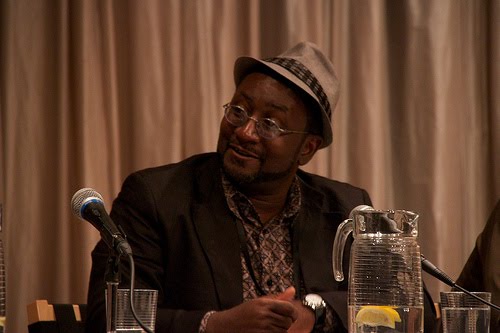
© PEN American Center/Susan Horgan. All rights reserved. Please contact media@pen.org for usage and rights.
April 21, 2008


April 4, 2008
What is the best writing advice anyone ever gave you?
Q: I hope that you're making lots and lots of money with this novel and I can't wait for your next book to come out. You're an amazing writer. What is the best advice on writing anyone ever gave you? Thanks.
A: Everytime I get this question I think I answer something different because I have received some pretty good advice from some pretty knowledgeable writers, but from now on I am going to stick to this answer. Write every day. Every day.
I get up every morning at about 5:00 a.m. and write for a half hour to an hour. I produce about two books per year this way.
Now here is something neat that has recently happened. On Good Friday of this year, I wrote pretty much all day and I produced an entire novella. I am calling it THE MAN FROM IOWA, and it's about the gruesome murder of a child and the murderer's plea for forgiveness.
On Good Friday of 2001, I also wrote all day and produced an entire novella, which I later revised and expanded into my full-length novel COME WITH ME SHEBA.
I've really been in a zone the last month or so; I finished up a short story collection LOG ON, SOCIOPATH--which is a collection of dark, noirish pieces featuring a group of real crazies that Edgar Allan Poe would have been proud of.
Here's my advice to you: write every day.
Thanks for the email.
Preston
By the way, I apologize to you all for not blogging for the last month or so. I've been busy writing. Duh.
Preston
A: Everytime I get this question I think I answer something different because I have received some pretty good advice from some pretty knowledgeable writers, but from now on I am going to stick to this answer. Write every day. Every day.
I get up every morning at about 5:00 a.m. and write for a half hour to an hour. I produce about two books per year this way.
Now here is something neat that has recently happened. On Good Friday of this year, I wrote pretty much all day and I produced an entire novella. I am calling it THE MAN FROM IOWA, and it's about the gruesome murder of a child and the murderer's plea for forgiveness.
On Good Friday of 2001, I also wrote all day and produced an entire novella, which I later revised and expanded into my full-length novel COME WITH ME SHEBA.
I've really been in a zone the last month or so; I finished up a short story collection LOG ON, SOCIOPATH--which is a collection of dark, noirish pieces featuring a group of real crazies that Edgar Allan Poe would have been proud of.
Here's my advice to you: write every day.
Thanks for the email.
Preston
By the way, I apologize to you all for not blogging for the last month or so. I've been busy writing. Duh.
Preston
My Interview with Ingrid Winston
v When were you born?
v I was born in 1964.
v I read that you were born on Roatan. How long did you live in Honduras, and is Roatan the only place you lived in Honduras?
v Roatan is the only place I have lived in Honduras, and I lived there until I was 3.
v Did you move straight from Honduras to the U.S., or did you live somewhere else also?
v We moved straight to the U.S., to Staten Island, New York.
v What was it like growing up in Honduras?
v I left at too young an age to have enough memories to answer that question. I grew up in the U.S., and I lived here as both an American (because of my neighbors and school friends) and as a Honduran (because of my family and the sizable Honduran communities in Staten Island, Roxbury, and Miami). What I know about life in Roatan I learned through my experiences here in this country with those from Roatan who had created a community here in the U.S.—the food, the music, the religion, the family histories, and so on.
v What was it like to transition from a Spanish speaking country to the U.S.? Was it difficult?
v For the people of Roatan, there is only a cultural transistion, not a linguistic one because Roatan is an English-speaking Island, though it belongs to Spanish-speaking Honduras. So the people of Roatan speak English at home first and then learn Spanish when they get old enough to go to school. When I first came to the U.S. in the 1960s, I had never seen a TV, an automobile, indoor toilets, and so on, but that was back then. Today, Roatan has all of those things and more. The big difference between Roatan and the U.S. these days is, as always, the pacing of things. Roatan is slow and familiar. Things move slowly and everyone knows you and your family—the island is not very large. The U.S. is fast-paced, of course, and somewhat impersonal.
v Why did you leave Honduras?
v My parents left for the economic and educational opportunities that America offered.
v When did you begin writing?
v I have always written because I have always read. Few things make me sadder than students who say, “I want to be a writer, but I hate to read.” My earliest memory of writing and of thinking about becoming a writer of books came somewhere around 3rd or 4th grade. In 6th grade, I wrote the school play. At home, I wrote stories for and with my four younger brothers—we all loved reading and writing. My first serious attempts at writing came around junior high when I met a generous English teacher who agreed to edit my work for me in exchange for reading the classics in literature, which she loaned me. By senior year I was hanging out with other students who wrote. In college, I had a shoe box filled with stories and half stories that I had written. I majored in English. Then, later on in grad school, I earned the MFA in Creative writing.
v How do you decide what to write about?
v I write to understand. When things trouble or confuse me, I write about them so that I have a better understanding of what is actually going on. My latest novel, ALL OR NOTHING (Akashic 2007), is about gambling addiction. Read that book and you will see what I mean. My first collection of stories, CHURCHBOYS AND OTHER SINNERS (Carolina Wren Press 2003), explored the relationship between man, God, and carnal desires.
v When I was researching Honduran writers of African or Caribbean descent, it was very difficult to find information. Do you have any idea why that might be?
v There are not many of us, and most of us young ones have not made our marks yet. It becomes easier to be researched when others have actually written essays or theses about your works. Furthermore, black Hondurans are pretty much invisible. You see, on the island of Roatan there is another and more famous group of Afro-Hondurans, who are called GARIFUNA—they speak an African language, not English or Spanish (of course, they learn both of those languages to survive on the island). There are many books written about the GARIFUNA, their language, and their traditions. I am not a GARIFUNA. I speak English. My people, former British slaves, are called BAY ISLANDERS and we live in Honduras on the bay islands of Roatan, Utilla, and Guanaja. There are relatively few books written about BAY ISLANDERS. There is another reason that, perhaps, we are not better known and researched—we do not write about the Latin American experience because we are not Latinos despite the Latino culture of the place where we are born—we write about the Caribbean experience in a fashion that is similar to the Jamaicans, Bahamians, and Trinidadians. Remember, our first language is English not Spanish.
v Do you think it’s difficult for Honduran writers of African decent to publish their work in Honduras? If so, why?
v I could not answer that question because I have never tried to do that. My feeling, however, is that it would not be too difficult to do. In fact, the Honduran Chamber of Commerce in Miami has contacted me several times to host events and whatnot.
v Have you ever faced any discrimination in your writing career?
v Racial discrimination? Sexual discrimination? Ethnic discrimination? I am not sure if I have experienced any of these because I am so good at what I do (a little bragging) that people tend to like my work—they focus on the work and not on me. Let’s see, I had a white agent tell me once that my characters were not “black” enough. I am still not sure what he meant by that. I have had editors tell me to change my characters from “black” to “normal.” I have had fans and editors question my sexuality because so many of my earlier stories (in Brown Sugar 1, Brown Sugar 2, Brown Sugar 3, Brown Sugar 4) were written from a woman’s point of view. One email said, “Are you a woman? Is ‘Preston’ like a name for a woman? Or are you a gay male? I am not trying to offend you, but you write very well as a woman. You seem to know what you are talking about.” I had trouble selling a story that I thought was great, so I changed the protagonist from a black male to a white male and sold it right away—now that is no sign that I had faced racism or discrimination because maybe the story just worked better with a white protagonist. At any rate, I didn’t worry about it. I just cashed the check. These days, I publish pretty much whatever I write because I am becoming better known, I have more connections in the writing world, and my skills as an artist are continuing to grow.
v Did you ever experience it while in Honduras, and how does it compare to racism in the U.S.?
v No.
v I read that you would like to become one of the most famous Honduras writers out there. How do you want to accomplish this goal?
v That was a joke that I told someone a long time ago and somehow it got printed on the internet, and now people take it seriously. That is not a goal. How could that be a goal? Now they’re even altering the wording. What I actually said was this: My goal is to become the most famous Afro-Honduran American writer ever to graduate from Florida International University with an MFA in creative writing. Get it? Get the joke? I already am the most famous Afro-Honduran American writer ever to graduate from Florida International University with an MFA in creative writing. No other Afro-Honduran American writer has ever attended the school, so that makes me # 1. Get the joke? How many Afro-Honduran American writers from Florida International University do you know? And if by chance you do know of another one, I am sure that I have published more than him/her so far.
v Where do you see your writing career going in the future?
v My goal is to become the most famous Afro-Honduran American writer ever to graduate from Florida International University with an MFA in creative writing. That is just a joke! Just a joke!!! Hahahaha. But to get back to the question, I imagine that my serious literary work is going to be read in colleges and high schools. Some of my work for popular audiences has already been optioned for film, so it is only a matter of time before you see my stories on TV or in the movie theaters. It would be nice to write a major bestseller and make lots of money. However, for a writer such as I, success is not measured in dollar bills, but in a job well done. In short, my writing career will see me taking on greater artistic challenges. Currently I have been shopping around an Edgar Allan Poe-like short story collection and the full-length novel THE FAITHFUL, which is the complete story of 16-year-old Elwyn and 40-year-old Sister Morrisohn, whose illicit affair began in CHURCHBOYS AND OTHER SINNERS. I have completed a novella called THE MAN FROM IOWA, which is the story of a murderer who gets religion, turns himself into the police, and then seeks forgiveness from society and the family of the boy her murdered. You can find my latest short story in a collection called LAS VEGAS NOIR (Akashic 2008)—the story is called “Crip.”
v I was born in 1964.
v I read that you were born on Roatan. How long did you live in Honduras, and is Roatan the only place you lived in Honduras?
v Roatan is the only place I have lived in Honduras, and I lived there until I was 3.
v Did you move straight from Honduras to the U.S., or did you live somewhere else also?
v We moved straight to the U.S., to Staten Island, New York.
v What was it like growing up in Honduras?
v I left at too young an age to have enough memories to answer that question. I grew up in the U.S., and I lived here as both an American (because of my neighbors and school friends) and as a Honduran (because of my family and the sizable Honduran communities in Staten Island, Roxbury, and Miami). What I know about life in Roatan I learned through my experiences here in this country with those from Roatan who had created a community here in the U.S.—the food, the music, the religion, the family histories, and so on.
v What was it like to transition from a Spanish speaking country to the U.S.? Was it difficult?
v For the people of Roatan, there is only a cultural transistion, not a linguistic one because Roatan is an English-speaking Island, though it belongs to Spanish-speaking Honduras. So the people of Roatan speak English at home first and then learn Spanish when they get old enough to go to school. When I first came to the U.S. in the 1960s, I had never seen a TV, an automobile, indoor toilets, and so on, but that was back then. Today, Roatan has all of those things and more. The big difference between Roatan and the U.S. these days is, as always, the pacing of things. Roatan is slow and familiar. Things move slowly and everyone knows you and your family—the island is not very large. The U.S. is fast-paced, of course, and somewhat impersonal.
v Why did you leave Honduras?
v My parents left for the economic and educational opportunities that America offered.
v When did you begin writing?
v I have always written because I have always read. Few things make me sadder than students who say, “I want to be a writer, but I hate to read.” My earliest memory of writing and of thinking about becoming a writer of books came somewhere around 3rd or 4th grade. In 6th grade, I wrote the school play. At home, I wrote stories for and with my four younger brothers—we all loved reading and writing. My first serious attempts at writing came around junior high when I met a generous English teacher who agreed to edit my work for me in exchange for reading the classics in literature, which she loaned me. By senior year I was hanging out with other students who wrote. In college, I had a shoe box filled with stories and half stories that I had written. I majored in English. Then, later on in grad school, I earned the MFA in Creative writing.
v How do you decide what to write about?
v I write to understand. When things trouble or confuse me, I write about them so that I have a better understanding of what is actually going on. My latest novel, ALL OR NOTHING (Akashic 2007), is about gambling addiction. Read that book and you will see what I mean. My first collection of stories, CHURCHBOYS AND OTHER SINNERS (Carolina Wren Press 2003), explored the relationship between man, God, and carnal desires.
v When I was researching Honduran writers of African or Caribbean descent, it was very difficult to find information. Do you have any idea why that might be?
v There are not many of us, and most of us young ones have not made our marks yet. It becomes easier to be researched when others have actually written essays or theses about your works. Furthermore, black Hondurans are pretty much invisible. You see, on the island of Roatan there is another and more famous group of Afro-Hondurans, who are called GARIFUNA—they speak an African language, not English or Spanish (of course, they learn both of those languages to survive on the island). There are many books written about the GARIFUNA, their language, and their traditions. I am not a GARIFUNA. I speak English. My people, former British slaves, are called BAY ISLANDERS and we live in Honduras on the bay islands of Roatan, Utilla, and Guanaja. There are relatively few books written about BAY ISLANDERS. There is another reason that, perhaps, we are not better known and researched—we do not write about the Latin American experience because we are not Latinos despite the Latino culture of the place where we are born—we write about the Caribbean experience in a fashion that is similar to the Jamaicans, Bahamians, and Trinidadians. Remember, our first language is English not Spanish.
v Do you think it’s difficult for Honduran writers of African decent to publish their work in Honduras? If so, why?
v I could not answer that question because I have never tried to do that. My feeling, however, is that it would not be too difficult to do. In fact, the Honduran Chamber of Commerce in Miami has contacted me several times to host events and whatnot.
v Have you ever faced any discrimination in your writing career?
v Racial discrimination? Sexual discrimination? Ethnic discrimination? I am not sure if I have experienced any of these because I am so good at what I do (a little bragging) that people tend to like my work—they focus on the work and not on me. Let’s see, I had a white agent tell me once that my characters were not “black” enough. I am still not sure what he meant by that. I have had editors tell me to change my characters from “black” to “normal.” I have had fans and editors question my sexuality because so many of my earlier stories (in Brown Sugar 1, Brown Sugar 2, Brown Sugar 3, Brown Sugar 4) were written from a woman’s point of view. One email said, “Are you a woman? Is ‘Preston’ like a name for a woman? Or are you a gay male? I am not trying to offend you, but you write very well as a woman. You seem to know what you are talking about.” I had trouble selling a story that I thought was great, so I changed the protagonist from a black male to a white male and sold it right away—now that is no sign that I had faced racism or discrimination because maybe the story just worked better with a white protagonist. At any rate, I didn’t worry about it. I just cashed the check. These days, I publish pretty much whatever I write because I am becoming better known, I have more connections in the writing world, and my skills as an artist are continuing to grow.
v Did you ever experience it while in Honduras, and how does it compare to racism in the U.S.?
v No.
v I read that you would like to become one of the most famous Honduras writers out there. How do you want to accomplish this goal?
v That was a joke that I told someone a long time ago and somehow it got printed on the internet, and now people take it seriously. That is not a goal. How could that be a goal? Now they’re even altering the wording. What I actually said was this: My goal is to become the most famous Afro-Honduran American writer ever to graduate from Florida International University with an MFA in creative writing. Get it? Get the joke? I already am the most famous Afro-Honduran American writer ever to graduate from Florida International University with an MFA in creative writing. No other Afro-Honduran American writer has ever attended the school, so that makes me # 1. Get the joke? How many Afro-Honduran American writers from Florida International University do you know? And if by chance you do know of another one, I am sure that I have published more than him/her so far.
v Where do you see your writing career going in the future?
v My goal is to become the most famous Afro-Honduran American writer ever to graduate from Florida International University with an MFA in creative writing. That is just a joke! Just a joke!!! Hahahaha. But to get back to the question, I imagine that my serious literary work is going to be read in colleges and high schools. Some of my work for popular audiences has already been optioned for film, so it is only a matter of time before you see my stories on TV or in the movie theaters. It would be nice to write a major bestseller and make lots of money. However, for a writer such as I, success is not measured in dollar bills, but in a job well done. In short, my writing career will see me taking on greater artistic challenges. Currently I have been shopping around an Edgar Allan Poe-like short story collection and the full-length novel THE FAITHFUL, which is the complete story of 16-year-old Elwyn and 40-year-old Sister Morrisohn, whose illicit affair began in CHURCHBOYS AND OTHER SINNERS. I have completed a novella called THE MAN FROM IOWA, which is the story of a murderer who gets religion, turns himself into the police, and then seeks forgiveness from society and the family of the boy her murdered. You can find my latest short story in a collection called LAS VEGAS NOIR (Akashic 2008)—the story is called “Crip.”
February 8, 2008
Great New Review from Florida Book Review
I have a couple good emails that I want to respond to, but I just got an outstanding review on ALL OR NOTHING by reviewer John Rodonis and the great people at FLORIDA BOOK REVIEW (http://www.floridabookreview.com/id1.html) that I'd like to share with you.
. . . Allen examines the flaming abyss compulsive gambling burns in its victims’ guts, self-esteem and bank accounts, the desperate, myopic immediacy it incites, the self-destructive need it feeds on, the families and relationships it destroys. For with gamblers, it really is all or nothing. Usually nothing. Take it from a reviewer who’s been there. Allen is right on the money here.
"If someone says, Buy some medicine for me with this $20, my life depends on it, and you go to the casino, you will blow all of your money, all of the money in your ATM up to the daily maximum, then dig around in your pockets for whatever spare change you have remaining, and blow the $20 your friend gave you, whether his life depends on it or not. You will leave with nothing. Every penny you have goes into the machines because you never know when lady luck is going to dance with you. Tonight, I blew all of my loose cash, blew my daily max on the ATM, then went out to the car and found three quarters and 26 pennies in the toll tray. That made a dollar. That was all I needed."
. . . Allen constructs his plot around wild, sometimes convenient, swings of fortune. P. befriends “C.L.,” a slot-crazed woman he employs to curb his own compulsivity. Soon after, just as casino security closes in on a disguised P who has been barred due to never elaborated on IRS problems, P makes one final desperation slot play and wins $160,000. When he brings his winnings home, his wife, sick of it all, dumps him, refusing the money. P and C.L. move on to Las Vegas where P. discovers—at least for a time—a heretofore unknown discipline and success.
After P. strikes it rich, women are more than willing to “barter” with him in his suite for money to scratch that indelible itch. “C.L.,” “E.V.,” “S.” and “Missy” (the “twelve-step” initialization of names reminds us that these people are addicts), are female characters so degenerately entrenched in “the game” they’ll do anything for another chance to “hit it hard” at the one-arm-bandits, chasing the “ping ping” payoff of hitting “the big one.” P.’s willingness to fund their addiction is their “luck.” As for what happens to his, you’ll have to read the book.
All or Nothing is a recommended read, one that weaves a world where people live and die waiting for “their numbers” to appear in ordered redemption. And if this place proves unrecognizable, then the reader has certainly had little experience gambling.
And my most earnest advice would be to keep it that way.
John Rodonis.
You can check out the complete review at the Florida Book Review's Website. It's worth a visit: http://www.floridabookreview.com/id1.html
. . . Allen examines the flaming abyss compulsive gambling burns in its victims’ guts, self-esteem and bank accounts, the desperate, myopic immediacy it incites, the self-destructive need it feeds on, the families and relationships it destroys. For with gamblers, it really is all or nothing. Usually nothing. Take it from a reviewer who’s been there. Allen is right on the money here.
"If someone says, Buy some medicine for me with this $20, my life depends on it, and you go to the casino, you will blow all of your money, all of the money in your ATM up to the daily maximum, then dig around in your pockets for whatever spare change you have remaining, and blow the $20 your friend gave you, whether his life depends on it or not. You will leave with nothing. Every penny you have goes into the machines because you never know when lady luck is going to dance with you. Tonight, I blew all of my loose cash, blew my daily max on the ATM, then went out to the car and found three quarters and 26 pennies in the toll tray. That made a dollar. That was all I needed."
. . . Allen constructs his plot around wild, sometimes convenient, swings of fortune. P. befriends “C.L.,” a slot-crazed woman he employs to curb his own compulsivity. Soon after, just as casino security closes in on a disguised P who has been barred due to never elaborated on IRS problems, P makes one final desperation slot play and wins $160,000. When he brings his winnings home, his wife, sick of it all, dumps him, refusing the money. P and C.L. move on to Las Vegas where P. discovers—at least for a time—a heretofore unknown discipline and success.
After P. strikes it rich, women are more than willing to “barter” with him in his suite for money to scratch that indelible itch. “C.L.,” “E.V.,” “S.” and “Missy” (the “twelve-step” initialization of names reminds us that these people are addicts), are female characters so degenerately entrenched in “the game” they’ll do anything for another chance to “hit it hard” at the one-arm-bandits, chasing the “ping ping” payoff of hitting “the big one.” P.’s willingness to fund their addiction is their “luck.” As for what happens to his, you’ll have to read the book.
All or Nothing is a recommended read, one that weaves a world where people live and die waiting for “their numbers” to appear in ordered redemption. And if this place proves unrecognizable, then the reader has certainly had little experience gambling.
And my most earnest advice would be to keep it that way.
John Rodonis.
You can check out the complete review at the Florida Book Review's Website. It's worth a visit: http://www.floridabookreview.com/id1.html
February 7, 2008
Is Writing for Everyone?
"Professor I am amazed at your gift. Not everyone can write, especially when it comes to putting words (not just any words) together. It is said that a writer has a profound imagination. I can truly relate. My imagination is interesting. Certain things that come to my mind are like, huh? I always wanted to write a book, but fear would always prevent me. What do you think? Should I? You are the perfect person to answer me honestly. May your imagination, produce more books for me and for everyone else! M.M."
Thanks for the question, M.M.
Is writing for everyone? That is a good question. I'm going to begin my answer by paraphrasing something I heard around the time I was in grad school, though I am not sure who said it, or where I heard it from. It is this: By the time you are 16, you have at least one book in you--your autobiography; by the time you are sixty, you have at least one other book in you, someone else's biography--your husband's, your child's.
I believe that we do have several books in us. Are we willing to do the work to get to the place where we are skilled enough to set these stories down? Do we have the drive (or endurance) to write 300 to 400 pages? I believe that it can be done. I believe that each of us can write that ONE book at least.
But does writing that one book make you a WRITER? Do you love words and sentences? Do you yourself love to read? Do you have many stories in your head? Are you constantly trying to phrase things more beautifully, more forcefully? Do you love the craft of writing and revision?
No, in that sense, I do not believe that writing is for everyone, or more correctly stated, not everyone is a writer.
Thus, everyone can write at least one book; but not everyone is a WRITER.
Everyone has at least one story to tell, but a writer is a storyTELLER, descended from a long, proud tradition of storytellers, extending back to a time before there was even such a thing as the written word.
In fact, go read this very brief but cool story by Spencer Holst, "The Zebra Storyteller," and you'll see what I'm talking about. It has me nodding my head everytime I read it.
http://www.archipelago.org/vol3-1/holst.htm
Thanks, MM, now go write that book. You have passed the landmark of 16. After you have finished that book, if you still have the drive to write then you are probably a writer. Welcome to the family.
Preston
Thanks for the question, M.M.
Is writing for everyone? That is a good question. I'm going to begin my answer by paraphrasing something I heard around the time I was in grad school, though I am not sure who said it, or where I heard it from. It is this: By the time you are 16, you have at least one book in you--your autobiography; by the time you are sixty, you have at least one other book in you, someone else's biography--your husband's, your child's.
I believe that we do have several books in us. Are we willing to do the work to get to the place where we are skilled enough to set these stories down? Do we have the drive (or endurance) to write 300 to 400 pages? I believe that it can be done. I believe that each of us can write that ONE book at least.
But does writing that one book make you a WRITER? Do you love words and sentences? Do you yourself love to read? Do you have many stories in your head? Are you constantly trying to phrase things more beautifully, more forcefully? Do you love the craft of writing and revision?
No, in that sense, I do not believe that writing is for everyone, or more correctly stated, not everyone is a writer.
Thus, everyone can write at least one book; but not everyone is a WRITER.
Everyone has at least one story to tell, but a writer is a storyTELLER, descended from a long, proud tradition of storytellers, extending back to a time before there was even such a thing as the written word.
In fact, go read this very brief but cool story by Spencer Holst, "The Zebra Storyteller," and you'll see what I'm talking about. It has me nodding my head everytime I read it.
http://www.archipelago.org/vol3-1/holst.htm
Thanks, MM, now go write that book. You have passed the landmark of 16. After you have finished that book, if you still have the drive to write then you are probably a writer. Welcome to the family.
Preston
February 5, 2008
How Do You Write a Lisp?
"Preston L. Allen, I loved ALL OR NOTHING. I'm glad I met you on Goodreads. I'm honored to have such a great writer to correspond with back and forth like this. Isn't technology wonderful? As you know, I am still working on my science fiction novel and I agreed with you and some others who have read it that the character [ ]'s lisp is not working. One of my readers even suggested that I get rid of it. But I like the lisp. It sets him apart from the other warriors and I think it adds humor. Any suggestions? Sci-fi guy."
Thanks for the email and for reading the novel, Sci-fi guy. Here's something you can do. I'd like you to go and buy a little novel called PUSH by Sapphire which was published a couple years ago. After you have read the first few chapters of that book, I want you to reflect on the severity of the main character's poor grammar and non-standard dialect. It is pretty bad, isn't it? Clarice Precious Jones is a child of the ghetto and she speaks like one.
Now I want you to reflect on how relatively easy it was for you to UNDERSTAND everything that Clarice was saying, despite her use of non-standard English. Does this surprise you?
Finally, I want you to go back and re-read Clarice's words, paying attention to how much non-standard stuff is actually there on the page.
Are you surprised that the actual stuff on the page is not as poorly written as you originally thought? It sounds worse in your head than it actually is on the page.
Remember this rule: More is less and less is more.
What writers do when they are creating dialogue for characters who speak with an accent, or who speak a non-standard English, or who are afflicted with speech impediments is that they SPRINKLE THE SOUND OF THE LANGUAGE in the reader's head: in other words, they give you a sampling of the way the speaker sounds and then your brain continues to hear it each time the character speaks.
For example, they may have a character say, "Zees is not so good. I zink that I will have to leave before your theater group arrives. Your director does not like me too mucho, I zink."
Your brain hears a heavy accent, but when you see the actual sentences, only the words this (zees), think (zink), and much (mucho) are non-standard. If you sprinkle the sound of the accent in strategic places, the reader's brain will hear the accent everywhere (less is more).
On the other hand, look at this passage: "Zees ees no so gut. I zink zet I weel hef to leef before jour zeater groupo will to arrives. Jour deerictor doos no to liki me too mucho, I zink."
This passage has more of the accent, but it is rather difficult to read--imagine trying to read an entire page of it. Instead of allowing the brain to HEAR the accent of the speaker, a passage with too much dialect sprinkled in creates a problem in comprehension (more is less). Furthermore, It may create humor where none is intended, or it may offend the speakers of that dialect (or speakers with that speech impediment) where no offense is intended.
So in the case of your character [ ]'s lisp, I think what we readers found when we reviewed it is that there was too much of a lisp. It became annoying after a while and didn't really add anything to the character, except a cheap laugh. Sprinkle in a little bit of the lisp, however, and the scene will read a lot better.
I hope this helps, Sci-fi guy. Keep on writing!
By the way, you didn't give me your interpretation of my dreams.
Thanks,
Preston
Thanks for the email and for reading the novel, Sci-fi guy. Here's something you can do. I'd like you to go and buy a little novel called PUSH by Sapphire which was published a couple years ago. After you have read the first few chapters of that book, I want you to reflect on the severity of the main character's poor grammar and non-standard dialect. It is pretty bad, isn't it? Clarice Precious Jones is a child of the ghetto and she speaks like one.
Now I want you to reflect on how relatively easy it was for you to UNDERSTAND everything that Clarice was saying, despite her use of non-standard English. Does this surprise you?
Finally, I want you to go back and re-read Clarice's words, paying attention to how much non-standard stuff is actually there on the page.
Are you surprised that the actual stuff on the page is not as poorly written as you originally thought? It sounds worse in your head than it actually is on the page.
Remember this rule: More is less and less is more.
What writers do when they are creating dialogue for characters who speak with an accent, or who speak a non-standard English, or who are afflicted with speech impediments is that they SPRINKLE THE SOUND OF THE LANGUAGE in the reader's head: in other words, they give you a sampling of the way the speaker sounds and then your brain continues to hear it each time the character speaks.
For example, they may have a character say, "Zees is not so good. I zink that I will have to leave before your theater group arrives. Your director does not like me too mucho, I zink."
Your brain hears a heavy accent, but when you see the actual sentences, only the words this (zees), think (zink), and much (mucho) are non-standard. If you sprinkle the sound of the accent in strategic places, the reader's brain will hear the accent everywhere (less is more).
On the other hand, look at this passage: "Zees ees no so gut. I zink zet I weel hef to leef before jour zeater groupo will to arrives. Jour deerictor doos no to liki me too mucho, I zink."
This passage has more of the accent, but it is rather difficult to read--imagine trying to read an entire page of it. Instead of allowing the brain to HEAR the accent of the speaker, a passage with too much dialect sprinkled in creates a problem in comprehension (more is less). Furthermore, It may create humor where none is intended, or it may offend the speakers of that dialect (or speakers with that speech impediment) where no offense is intended.
So in the case of your character [ ]'s lisp, I think what we readers found when we reviewed it is that there was too much of a lisp. It became annoying after a while and didn't really add anything to the character, except a cheap laugh. Sprinkle in a little bit of the lisp, however, and the scene will read a lot better.
I hope this helps, Sci-fi guy. Keep on writing!
By the way, you didn't give me your interpretation of my dreams.
Thanks,
Preston
February 3, 2008
The Interpretation of Dreams
Interpretation of dreams anyone?
I’ve been having some pretty strange dreams, so I am putting this up on both of my blogs to get some feedback.
My Aunt Exposed
In the first dream, I walk into my aunt’s room, mistaking it for the bathroom, and find her lying in bed with her breasts uncovered. She is an older woman and her breasts are very large and very black. She tries to cover them, but the sheets keep falling away from them. I am stunned, embarrassed, and I back out of her room apologizing profusely.
What does this mean?
Well, a good friend of mine, mostly in jest, provided an interpretation: “Subconsciously, you want your family to keep their secrets to themselves. They have been revealing things to you of late that you do not want to know. You wish they would not tell you these things. You do not want to know these things.”
Wow. My friend may have been kidding around, but his interpretation rang true for me. I have of late learned some dark family secrets that both saddened and angered me, and one of these secrets does in fact involve my aunt.
The second dream is even weirder.
My House Invaded
In the second dream, my wife and I are in our bathroom brushing our teeth as we do every morning when a tall, innocent-faced young man reaches over my shoulder for one of our toothbrushes to brush his own teeth. I react with shock and anger, telling him to get out of our bathroom.
As the young man retreats apologizing, I ask my wife: “Who is that guy?”
She jokes: “He is my boyfriend.”
I say, “You’re kidding, right?”
She says, “Of course. He looks twelve, if that.”
When we leave the bathroom and enter our own room, my mother-in-law is on our bed with our son, who is 13, but in the dream he is much young, maybe 6 or 7. I am alarmed that there are people crowded into the room, opening closet doors and looking through our things. As I recognize some of their faces, I realize what has gone wrong. The college where I teach is having some sort of event and the attendees got the wrong address and ended up at our house instead. I say to my son, “Get these people out of here. Show them how to get to the college.”
Then my little son gets up from his grandmother’s lap and begins to lead the people out of our room, out of our house and I suppose to the college.
Then I leave my house (I can’t remember the reason why) and I become disoriented when I try to find my way back. I can’t find my own house. Everything looks familiar, the neighborhood, the houses, the cars, but my memory lapse is so severe I can’t remember which street I must go down in order to get back to my own house. At that point in the dream, I say to myself, “If I were in my car I would know how to get back home, but not on foot. I am lost on foot.”
When I spy a familiar security guard from the college, I say to him, “Which direction are you going in? I need to get home.”
The guard, who is wearing his neatly-pressed black uniform, says, “I am going to the college. I can only take you as far as the college because I have to clock in.”
This sounds good to me. I am convinced that if I can get to the college, everything will look familiar and I can find my way home from the college as a starting point.
So I follow the security guard, who for some reason gets out of his car and leaves it behind. We are walking through another familiar looking neighborhood that I can feel in my bones is near where I live, but I cannot figure out how to get home from here. If I had my car, however, I could turn down each and every street until I found the one that was mine. But on foot like this, it is too much of an effort to go down every street one at a time. I am so weary for some reason, so exhausted.
The security guard stops at a tree-lined section of the neighborhood and lights a torch and begins to set the trees on fire. The fire leaps from one tree to the next. He stands back and asks, “Do you think they will all burn?”
I say, “No. The fire will stop after that tree.” I point to a gap in the trees behind the houses. “You are going to have to light that second row of trees.”
The guard says, “Okay. You’re going to have to wait until I am done. I have to do this before I clock in.” Then he leaves to go light the second row of trees.
As the trees around me burn, I am upset because my only chance of finding my way home is with the guard and I have no idea how long this new duty of his is going to take. Will I ever get home?
Then I spot another guard from the college, an older, heavy-set female guard who has a reputation for being chatty and friendly. She too is wearing the black uniform. I do not want to betray the first guard, but I have to get home. So I ask the female guard if she can help me find my home and she says, “Hop in.”
I get into her car with the feeling that she is not going to be any more successful in getting me home, but at least I am off my feet. I feel very tired, exhausted. It is good to rest my feet.
I think the dream ends there.
Thanks,
Preston
I’ve been having some pretty strange dreams, so I am putting this up on both of my blogs to get some feedback.
My Aunt Exposed
In the first dream, I walk into my aunt’s room, mistaking it for the bathroom, and find her lying in bed with her breasts uncovered. She is an older woman and her breasts are very large and very black. She tries to cover them, but the sheets keep falling away from them. I am stunned, embarrassed, and I back out of her room apologizing profusely.
What does this mean?
Well, a good friend of mine, mostly in jest, provided an interpretation: “Subconsciously, you want your family to keep their secrets to themselves. They have been revealing things to you of late that you do not want to know. You wish they would not tell you these things. You do not want to know these things.”
Wow. My friend may have been kidding around, but his interpretation rang true for me. I have of late learned some dark family secrets that both saddened and angered me, and one of these secrets does in fact involve my aunt.
The second dream is even weirder.
My House Invaded
In the second dream, my wife and I are in our bathroom brushing our teeth as we do every morning when a tall, innocent-faced young man reaches over my shoulder for one of our toothbrushes to brush his own teeth. I react with shock and anger, telling him to get out of our bathroom.
As the young man retreats apologizing, I ask my wife: “Who is that guy?”
She jokes: “He is my boyfriend.”
I say, “You’re kidding, right?”
She says, “Of course. He looks twelve, if that.”
When we leave the bathroom and enter our own room, my mother-in-law is on our bed with our son, who is 13, but in the dream he is much young, maybe 6 or 7. I am alarmed that there are people crowded into the room, opening closet doors and looking through our things. As I recognize some of their faces, I realize what has gone wrong. The college where I teach is having some sort of event and the attendees got the wrong address and ended up at our house instead. I say to my son, “Get these people out of here. Show them how to get to the college.”
Then my little son gets up from his grandmother’s lap and begins to lead the people out of our room, out of our house and I suppose to the college.
Then I leave my house (I can’t remember the reason why) and I become disoriented when I try to find my way back. I can’t find my own house. Everything looks familiar, the neighborhood, the houses, the cars, but my memory lapse is so severe I can’t remember which street I must go down in order to get back to my own house. At that point in the dream, I say to myself, “If I were in my car I would know how to get back home, but not on foot. I am lost on foot.”
When I spy a familiar security guard from the college, I say to him, “Which direction are you going in? I need to get home.”
The guard, who is wearing his neatly-pressed black uniform, says, “I am going to the college. I can only take you as far as the college because I have to clock in.”
This sounds good to me. I am convinced that if I can get to the college, everything will look familiar and I can find my way home from the college as a starting point.
So I follow the security guard, who for some reason gets out of his car and leaves it behind. We are walking through another familiar looking neighborhood that I can feel in my bones is near where I live, but I cannot figure out how to get home from here. If I had my car, however, I could turn down each and every street until I found the one that was mine. But on foot like this, it is too much of an effort to go down every street one at a time. I am so weary for some reason, so exhausted.
The security guard stops at a tree-lined section of the neighborhood and lights a torch and begins to set the trees on fire. The fire leaps from one tree to the next. He stands back and asks, “Do you think they will all burn?”
I say, “No. The fire will stop after that tree.” I point to a gap in the trees behind the houses. “You are going to have to light that second row of trees.”
The guard says, “Okay. You’re going to have to wait until I am done. I have to do this before I clock in.” Then he leaves to go light the second row of trees.
As the trees around me burn, I am upset because my only chance of finding my way home is with the guard and I have no idea how long this new duty of his is going to take. Will I ever get home?
Then I spot another guard from the college, an older, heavy-set female guard who has a reputation for being chatty and friendly. She too is wearing the black uniform. I do not want to betray the first guard, but I have to get home. So I ask the female guard if she can help me find my home and she says, “Hop in.”
I get into her car with the feeling that she is not going to be any more successful in getting me home, but at least I am off my feet. I feel very tired, exhausted. It is good to rest my feet.
I think the dream ends there.
Thanks,
Preston
January 26, 2008
Rules to Live By
Wow. This is supposed to be a Q and A blog, but I received so many emails about my advice not to discuss sex, religion, and politics in public that I decided to post the list of advice I received from my three mentors (Adolphus, Garvey, and Anderson) throughout the years--I can't give it all away because the longer version is in book proposal form and I am shopping it. So who knows? You may see it in book stores as soon as next year.
Thanks,
Preston
__________________________
Thanks,
Preston
__________________________
A gift list from the Experienced to the Innocent
By Preston L. Allen
From the forthcoming book
51 RULES FOR THE INNOCENT TO LIVE BY (© copyright 2008 Preston L. Allen)
Live by these rules, young people, and your life will have few regrets when you are 30.
--Preston
1) Do not learn to gamble or to play games of chance. It is a vexation to the spirit and the bank account. Learn to play games of skill instead. Games of skill build character and may even add to your bank account. Do all things in moderation. Don’t kid yourself. There is no way to gamble in moderation once you have become addicted.
2) Do not over eat. Do the math. A full year of your adult life will be spent trying to lose every two pounds that you gain now. If you do not want to spend your adult life on diets, this is the time to avoid gaining weight.
3) Master a skill. Learn to play the piano. Learn to play the violin. Learn to paint. Learn to rebuild an engine. If you do it now while you are young, you have time to master it. It will be hard to find time to master it if you begin when you are an adult. Yes, you can learn it in adulthood, but free time is a gift for the young. With enough free time, you can learn to do anything. Anything.
4) Do not over indulge in sleep. Life is lived while awake. Live life. Free time for young people like you should be spent with your eyes open. Do not become addicted to sleep. Sleep, like procrastination, is the thief of time. Watching TV, too much TV, is a kind of sleep. Do not over indulge in this TV sleep either.
5) Get a good night’s sleep. A proper amount of sleep restores the body. Do not rob the body of sleep. Do all things in moderation. You need not be awake all the time.
6) Never let your boss catch you sleepy or asleep. Always appear alert in the presence of your superiors. This is a key to wealth.
7) Do not smoke. There is no need to spend your adult life trying to kick the habit. Do not begin the habit. You have better things to do with your time and your money. But if you must smoke, smoke a pipe or a cigar, but then only once in a while to relax or to celebrate. Do all things in moderation.
8) Do not use illegal drugs. There is no need to spend your adult life trying to kick the habit—and hiding from the police AND your own children. If an illegal drug becomes legal, do not use it. That it was once an illegal drug should answer all of your questions about it. You have better things to do with your time and money.
9) Do not drink alcoholic beverages. There is no need to spend your adult life trying to kick the habit. Do not begin the habit. But if you must drink strong drink, drink wine or champagne and then only once in a while to relax or to celebrate. Do all things in moderation.
10) Join a gym and develop a regular habit of exercise. But do all things in moderation. Do not become a gym freak. Be normal. There are many young women who are attracted to the strong, but slender type of man. There are many young men who are attracted to the healthy, fit, but fleshy woman. Almost no one is attracted to excess. Do all things in moderation. To some, being too skinny or too muscular is as unattractive as being too fat or too soft and flabby.
11) Eat breakfast every day.
12) Go to the dentist. You do not want to lose your teeth. You will regret it forever. Teeth are a gift.
13) Go to the doctor. You have time for it. You do. Your good health is a gift.
14) The worst place to look for a job is in the newspaper. Consult the newspaper if you want to get a job in network marketing or selling plastic jewelry door to door. Ignore those ads that read “$5,000.00 a month guaranteed, no degree necessary.” It sounds good, but that ad is a lie. Go get a degree and get a real job. There are no short cuts in life.
15) A good way to get a job is to volunteer. Go to a company that you like or perhaps would like to work for and volunteer a few hours a week for a few months. If you do a good enough job, they will probably offer you a real job with pay. Furthermore, if you volunteer at a company, you get to know people; remember, often it is who you know, not what you know, that gets you the job. Finally, if you volunteer at the company, you are often privy to inside information about jobs that are not posted to the public. Or while at the company, you might see someone doing a job that you like but hadn’t ever heard of before. “What exactly is your job title?” you might ask her. “And what do you do? It seems interesting.” Conversations like this often lead to fun and interesting jobs that others might never even think of applying for.
16) You can have anything you want if you give enough other people what they want. This is a key to wealth.
17) Get your money out of the bank and into a solid investment program as soon as you possibly can. This is a key to wealth.
18) Before you pay your bills, pay yourself. Set aside a little money for fun. Have fun with your money. This is a key to happiness.
19) Purchase a house as soon as you possibly can. Renting makes no sense. If you rent, your money goes down the drain. A house is a money tree. In the future, after your equity has grown, your house will be worth much more than you owe on it. This equity will be the beginning of wealth for you. You will probably, and you should, purchase several more houses—not to live in, but to rent to others. Renting houses you own is not as hard as you think. It is quite easy, in fact. The fruit will continue to grow on your money tree. This is a key to wealth.
20) Beware of credit cards. Why do you need seven, ten, or even twenty credit cards? You need only three—a major credit card (Visa or Mastercard), an American Express, and one gas card. Credit cards are not money. Credit cards allow you to purchase mostly worthless trinkets today for all of the precious money you will make tomorrow. Credit cards can get you into a lot of trouble if you do not handle them responsibly. When you see yourself sinking into credit card debt, talk to your parents immediately and beg them to bale you out—I don’t care how deep in the hole you are. Ask them for help. It is better for them to bale you out before you ruin your credit. Turn to them. They will understand. Parents know more than you think they do. They have experienced more than you think they have. I am willing to bet that your parents have a bad credit story buried somewhere deep in their closet. They were young once too.
21) Do not ruin your credit rating. But be grateful that if you ruin your credit rating in our country that all is not lost. A bad credit rating does not last forever. If there are no more problems and you pay off your old debt, or make settlements with your lenders, you will be credit worthy again in 5 to 7 years. You are young. Five to seven years without credit will not kill you. Use those 5 to 7 years to ponder what you did wrong and to practice good credit habits so that when you are again able to borrow, you will borrow responsibly.
22) Purchase your first car with the help of a parent or older relative or friend. If it is a used car, have a trusted mechanic check it out first. If it is a new car, negotiate the best deal you can and then ask to see the rebate check. These days ninety percent of all new cars have some sort of rebate from the manufacturer. Don’t let the salesman (or saleswoman) fool you. Demand your rebate check.
23) Do not speed when you drive. There is no need to speed, ever. A car going a safe forty or fifty or fifty-five miles per is faster than any horse the minutemen ever rode, and they were always on time. You do not want ever to crash a car. You do not want to deal with insurance, police officers, courts, the other driver if there be another car involved, and you do not want to deal with death. Death is permanent. So is paralysis. The car is a great gift. Use it wisely.
24) Learn a sport, and practice it to the point where you become good at it. This is now your sport, should anyone ask you.
25) Learn to play golf, or racquetball, or tennis, or ping pong, or to shoot pool. You need not be good at it (unless it is your sport). You need only be competent. If it is your sport, then strive to be good at it.
26) Do not discuss sex, politics, or religion in public.
27) “But is there a God, Preston? The preacher says yes. The scientist says no.” Well, does He live in your heart? Yes? No? You have your answer. That’s all you need to know, young people. What is there to discuss? Why do we have to argue over this? And in public?
28) Do not use profanity in public, unless you absolutely have to, especially in front of the opposite sex. Use profanity only with your close friends and kin—though never with your parents, no matter your age or theirs. Profanity may be a part of your private face, if you like, but never with your parents.
29) To be an adult means that you must occasionally tell a lie. Find one person that you can always tell the truth to, and tell him/her the truth after you have told others the necessary lie.
30) Do not argue with fools. Do not do it—especially in public. The Bible says that He that argues with a fool is a fool himself. That makes sense to me.
31) Pay attention in your English classes. Read great books. Read more than you watch TV. When you do watch TV, in between the silliness, listen to and model people who speak well. Learn to be comfortable speaking in public. Join a school or college club and become an officer, preferably the club’s president. Enjoy your role as leader. Learn to give orders. Learn to fight for causes. Learn to motivate others. This is a key to wealth.
32) Pay attention in math classes. Math is not difficult. Math is philosophy. Math is a game. Learn the rules and learn to play the game. The great professions—medicine, law, business, engineering—do not require that you know math. The great professions require that you did well in math. So do well in it. Don’t depend on your teachers to teach it to you, either. Go out and do some study on your own. Math is really not hard at all. It just has a lot of rules.
33) Learn a trade while you are young. If your career does not kick in right away, you should be able to sustain yourself by cutting hair, doing hair, playing piano at churches, giving instrument and voice lessons to children, working as an electrician’s assistant, fixing leaky roofs, hanging closet doors, and so on. Such skills and trades can also help you to pay for your education when scholarships, loans, and fellowships fall short.
34) Learn a foreign language. Master a foreign language.
35) Smell nice. Spend money on cologne and perfume. The nose will get you in good with people. It is better for a young man to wear too much cologne than too little. Your scent will linger long after you have left. This is not a bad thing, unless you are wearing an obnoxious scent. A young woman should always smell nice. Make sure your breath smells nice, too. The better you smell, the closer people will get to you, the more they will like you. You will also become more attractive in their eyes because of your nice smell, believe it or not.
36) Be beautiful by your own standard. Don’t try to be beautiful by someone else’s standard. Be the most beautiful you that you can be, and never let that standard lag.
37) Have a public face and a private face. Be careful who you show your public face to. Do not insult your mother and father and siblings by showing them your public face unless you are in public.
38) Learn to say thank you. Learn to say you’re welcome. Spend some money on a nice set of thank you cards. People are so happy when you thank them. This is a key to wealth.
39) Give compliments. Give compliments for a job well done, or for a noble effort. Recognize those who do exceptional deeds with a compliment and they will continue to bless us with these deeds. People are so happy when they receive genuine compliments. This is a key to wealth.
40) Remember birthdays and anniversaries. Write them down in a book. People are so happy when you remember their special days. This is a key to wealth.
41) Smile. People like people who smile. This is a key to wealth.
42) Be friendly and conversational in public. People like a good conversationalist. Learn to bend a good conversation, but do not gossip. Avoid those who gossip.
43) Admire beauty, but put your faith in intelligence, experience, a good work ethic, and integrity. Beauty without intelligence, experience, a good work ethic, or integrity is one paycheck away from prostitution. This is a key to wealth. Likewise, admire talent, but put your faith in intelligence, experience, a good work ethic, and integrity. Talent without intelligence, experience, a good work ethic, or integrity is one paycheck away from bankruptcy. This is a key to weath.
44) Do not make a baby too soon, unless you come from an independently wealthy family. A baby you make too soon can’t help but hinder your progress in life, unless you are independently wealthy. A baby is a joy. A baby is supposed to be a source of much love and a recipient of much love. But a baby made too soon often impoverishes the mother and the mother’s parents. A baby made too soon often turns the father, who is much too young for a father’s responsibilities, into a shirker and a deadbeat. Resentments abound on both sides. In the best of situations, a baby made too soon is a harsh lesson about the burden of responsibility for the young parents, who struggle against amazing odds to make it work. More often than not, their ideal vision of love cannot fix the problems they create by making a baby too soon. This is a key to wealth.
45) But take heart, a baby you make too soon does not remain a baby forever. The young father who turns his back on a baby he made too soon will soon grow to regret it. The young mother who bore a baby too soon quickly learns that the hardest parts come at the beginning when the baby first arrives, then they get easier as the baby develops into a young child, and they become mostly bearable and mostly routine when the baby starts going to school. Finally, when the baby grows into adulthood, the mother has lost all of the disadvantages of making a baby too soon and is now seeing the advantages. In fact, she may look all around her and see the interesting ironies: women her age (mid to late 30s) trying with the help of medical professionals to get pregnant, for sometimes it is difficult at that age to get pregnant; and women her age changing the diapers of children they recently bore. The woman who bore a baby too soon is still a relatively young woman and with her child out of the way, she can devote all of her energies to her education, her career, and her social life without “toddling” interference. Thus, if she is ambitious and is willing to work hard and has the help and support of her own parents (if not the support of her baby’s father), the mother who made a baby too soon eventually finds herself on a par with her peers who did not make a baby too soon, and then sometimes she finds herself having the advantage over them because she made a baby too soon. Life is funny in that way. The lesson is this: a baby born to us is a blessing, no matter how or when it comes to us; never give up on that blessing, especially if you got it too soon.
46) A baby made too soon is an act of ill advised passion, a common but forgivable error of the passionate young heart. A second baby made too soon is evidence of slackness, or perhaps a flaw in your capacity to reason, unless you are independently wealthy. Seek professional help.
47) Learn to listen. Listen to your heart. Do not lie to yourself about what you hear. He may not be the right man for you, but you do love him. Everyone says that you two are perfect for each other, but you know in your heart that you do not love her. Listen to your heart. But remember this: marry with the heart; divorce with the head. Listen to your parents. Listen to them even when they are wrong. Listen. Listen. What are they really saying? Listen to the wise. When you are around someone with genuine wisdom or intelligence, listen more than you speak. Shut your mouth. Learn as much as you can from the experience. Wisdom is a rare and precious commodity. Do not waste your time in the presence of a wise one by discussing your opinions on who will win this year’s World Series. Learn to listen. Learn to ask good questions, then listen to the answer, as it comes from the wise. More than anything, listen to the voice of experience. You do not have to put your hand in the fire to know that it burns. Too many have already burned their hand for you. Learn from their pain. Be wise, not redundant. There is no need to burn your hand. I have done it. I have burned my hand. And let me tell you, young people, it was not worth it. Learn from my pain.
48) Study first. Play later.
49) Work first. Play later.
50) Don’t over work.
51) Don’t over play, but don’t forget to play. Life is fun. Life is good. Life is about play. Life is not about work or study. We work so that we can play. We study so that we can play. Work and study hard so that you can play hard. Do all things in moderation. You will have a good life. Enjoy it.
By Preston L. Allen
From the forthcoming book
51 RULES FOR THE INNOCENT TO LIVE BY (© copyright 2008 Preston L. Allen)
Live by these rules, young people, and your life will have few regrets when you are 30.
--Preston
1) Do not learn to gamble or to play games of chance. It is a vexation to the spirit and the bank account. Learn to play games of skill instead. Games of skill build character and may even add to your bank account. Do all things in moderation. Don’t kid yourself. There is no way to gamble in moderation once you have become addicted.
2) Do not over eat. Do the math. A full year of your adult life will be spent trying to lose every two pounds that you gain now. If you do not want to spend your adult life on diets, this is the time to avoid gaining weight.
3) Master a skill. Learn to play the piano. Learn to play the violin. Learn to paint. Learn to rebuild an engine. If you do it now while you are young, you have time to master it. It will be hard to find time to master it if you begin when you are an adult. Yes, you can learn it in adulthood, but free time is a gift for the young. With enough free time, you can learn to do anything. Anything.
4) Do not over indulge in sleep. Life is lived while awake. Live life. Free time for young people like you should be spent with your eyes open. Do not become addicted to sleep. Sleep, like procrastination, is the thief of time. Watching TV, too much TV, is a kind of sleep. Do not over indulge in this TV sleep either.
5) Get a good night’s sleep. A proper amount of sleep restores the body. Do not rob the body of sleep. Do all things in moderation. You need not be awake all the time.
6) Never let your boss catch you sleepy or asleep. Always appear alert in the presence of your superiors. This is a key to wealth.
7) Do not smoke. There is no need to spend your adult life trying to kick the habit. Do not begin the habit. You have better things to do with your time and your money. But if you must smoke, smoke a pipe or a cigar, but then only once in a while to relax or to celebrate. Do all things in moderation.
8) Do not use illegal drugs. There is no need to spend your adult life trying to kick the habit—and hiding from the police AND your own children. If an illegal drug becomes legal, do not use it. That it was once an illegal drug should answer all of your questions about it. You have better things to do with your time and money.
9) Do not drink alcoholic beverages. There is no need to spend your adult life trying to kick the habit. Do not begin the habit. But if you must drink strong drink, drink wine or champagne and then only once in a while to relax or to celebrate. Do all things in moderation.
10) Join a gym and develop a regular habit of exercise. But do all things in moderation. Do not become a gym freak. Be normal. There are many young women who are attracted to the strong, but slender type of man. There are many young men who are attracted to the healthy, fit, but fleshy woman. Almost no one is attracted to excess. Do all things in moderation. To some, being too skinny or too muscular is as unattractive as being too fat or too soft and flabby.
11) Eat breakfast every day.
12) Go to the dentist. You do not want to lose your teeth. You will regret it forever. Teeth are a gift.
13) Go to the doctor. You have time for it. You do. Your good health is a gift.
14) The worst place to look for a job is in the newspaper. Consult the newspaper if you want to get a job in network marketing or selling plastic jewelry door to door. Ignore those ads that read “$5,000.00 a month guaranteed, no degree necessary.” It sounds good, but that ad is a lie. Go get a degree and get a real job. There are no short cuts in life.
15) A good way to get a job is to volunteer. Go to a company that you like or perhaps would like to work for and volunteer a few hours a week for a few months. If you do a good enough job, they will probably offer you a real job with pay. Furthermore, if you volunteer at a company, you get to know people; remember, often it is who you know, not what you know, that gets you the job. Finally, if you volunteer at the company, you are often privy to inside information about jobs that are not posted to the public. Or while at the company, you might see someone doing a job that you like but hadn’t ever heard of before. “What exactly is your job title?” you might ask her. “And what do you do? It seems interesting.” Conversations like this often lead to fun and interesting jobs that others might never even think of applying for.
16) You can have anything you want if you give enough other people what they want. This is a key to wealth.
17) Get your money out of the bank and into a solid investment program as soon as you possibly can. This is a key to wealth.
18) Before you pay your bills, pay yourself. Set aside a little money for fun. Have fun with your money. This is a key to happiness.
19) Purchase a house as soon as you possibly can. Renting makes no sense. If you rent, your money goes down the drain. A house is a money tree. In the future, after your equity has grown, your house will be worth much more than you owe on it. This equity will be the beginning of wealth for you. You will probably, and you should, purchase several more houses—not to live in, but to rent to others. Renting houses you own is not as hard as you think. It is quite easy, in fact. The fruit will continue to grow on your money tree. This is a key to wealth.
20) Beware of credit cards. Why do you need seven, ten, or even twenty credit cards? You need only three—a major credit card (Visa or Mastercard), an American Express, and one gas card. Credit cards are not money. Credit cards allow you to purchase mostly worthless trinkets today for all of the precious money you will make tomorrow. Credit cards can get you into a lot of trouble if you do not handle them responsibly. When you see yourself sinking into credit card debt, talk to your parents immediately and beg them to bale you out—I don’t care how deep in the hole you are. Ask them for help. It is better for them to bale you out before you ruin your credit. Turn to them. They will understand. Parents know more than you think they do. They have experienced more than you think they have. I am willing to bet that your parents have a bad credit story buried somewhere deep in their closet. They were young once too.
21) Do not ruin your credit rating. But be grateful that if you ruin your credit rating in our country that all is not lost. A bad credit rating does not last forever. If there are no more problems and you pay off your old debt, or make settlements with your lenders, you will be credit worthy again in 5 to 7 years. You are young. Five to seven years without credit will not kill you. Use those 5 to 7 years to ponder what you did wrong and to practice good credit habits so that when you are again able to borrow, you will borrow responsibly.
22) Purchase your first car with the help of a parent or older relative or friend. If it is a used car, have a trusted mechanic check it out first. If it is a new car, negotiate the best deal you can and then ask to see the rebate check. These days ninety percent of all new cars have some sort of rebate from the manufacturer. Don’t let the salesman (or saleswoman) fool you. Demand your rebate check.
23) Do not speed when you drive. There is no need to speed, ever. A car going a safe forty or fifty or fifty-five miles per is faster than any horse the minutemen ever rode, and they were always on time. You do not want ever to crash a car. You do not want to deal with insurance, police officers, courts, the other driver if there be another car involved, and you do not want to deal with death. Death is permanent. So is paralysis. The car is a great gift. Use it wisely.
24) Learn a sport, and practice it to the point where you become good at it. This is now your sport, should anyone ask you.
25) Learn to play golf, or racquetball, or tennis, or ping pong, or to shoot pool. You need not be good at it (unless it is your sport). You need only be competent. If it is your sport, then strive to be good at it.
26) Do not discuss sex, politics, or religion in public.
27) “But is there a God, Preston? The preacher says yes. The scientist says no.” Well, does He live in your heart? Yes? No? You have your answer. That’s all you need to know, young people. What is there to discuss? Why do we have to argue over this? And in public?
28) Do not use profanity in public, unless you absolutely have to, especially in front of the opposite sex. Use profanity only with your close friends and kin—though never with your parents, no matter your age or theirs. Profanity may be a part of your private face, if you like, but never with your parents.
29) To be an adult means that you must occasionally tell a lie. Find one person that you can always tell the truth to, and tell him/her the truth after you have told others the necessary lie.
30) Do not argue with fools. Do not do it—especially in public. The Bible says that He that argues with a fool is a fool himself. That makes sense to me.
31) Pay attention in your English classes. Read great books. Read more than you watch TV. When you do watch TV, in between the silliness, listen to and model people who speak well. Learn to be comfortable speaking in public. Join a school or college club and become an officer, preferably the club’s president. Enjoy your role as leader. Learn to give orders. Learn to fight for causes. Learn to motivate others. This is a key to wealth.
32) Pay attention in math classes. Math is not difficult. Math is philosophy. Math is a game. Learn the rules and learn to play the game. The great professions—medicine, law, business, engineering—do not require that you know math. The great professions require that you did well in math. So do well in it. Don’t depend on your teachers to teach it to you, either. Go out and do some study on your own. Math is really not hard at all. It just has a lot of rules.
33) Learn a trade while you are young. If your career does not kick in right away, you should be able to sustain yourself by cutting hair, doing hair, playing piano at churches, giving instrument and voice lessons to children, working as an electrician’s assistant, fixing leaky roofs, hanging closet doors, and so on. Such skills and trades can also help you to pay for your education when scholarships, loans, and fellowships fall short.
34) Learn a foreign language. Master a foreign language.
35) Smell nice. Spend money on cologne and perfume. The nose will get you in good with people. It is better for a young man to wear too much cologne than too little. Your scent will linger long after you have left. This is not a bad thing, unless you are wearing an obnoxious scent. A young woman should always smell nice. Make sure your breath smells nice, too. The better you smell, the closer people will get to you, the more they will like you. You will also become more attractive in their eyes because of your nice smell, believe it or not.
36) Be beautiful by your own standard. Don’t try to be beautiful by someone else’s standard. Be the most beautiful you that you can be, and never let that standard lag.
37) Have a public face and a private face. Be careful who you show your public face to. Do not insult your mother and father and siblings by showing them your public face unless you are in public.
38) Learn to say thank you. Learn to say you’re welcome. Spend some money on a nice set of thank you cards. People are so happy when you thank them. This is a key to wealth.
39) Give compliments. Give compliments for a job well done, or for a noble effort. Recognize those who do exceptional deeds with a compliment and they will continue to bless us with these deeds. People are so happy when they receive genuine compliments. This is a key to wealth.
40) Remember birthdays and anniversaries. Write them down in a book. People are so happy when you remember their special days. This is a key to wealth.
41) Smile. People like people who smile. This is a key to wealth.
42) Be friendly and conversational in public. People like a good conversationalist. Learn to bend a good conversation, but do not gossip. Avoid those who gossip.
43) Admire beauty, but put your faith in intelligence, experience, a good work ethic, and integrity. Beauty without intelligence, experience, a good work ethic, or integrity is one paycheck away from prostitution. This is a key to wealth. Likewise, admire talent, but put your faith in intelligence, experience, a good work ethic, and integrity. Talent without intelligence, experience, a good work ethic, or integrity is one paycheck away from bankruptcy. This is a key to weath.
44) Do not make a baby too soon, unless you come from an independently wealthy family. A baby you make too soon can’t help but hinder your progress in life, unless you are independently wealthy. A baby is a joy. A baby is supposed to be a source of much love and a recipient of much love. But a baby made too soon often impoverishes the mother and the mother’s parents. A baby made too soon often turns the father, who is much too young for a father’s responsibilities, into a shirker and a deadbeat. Resentments abound on both sides. In the best of situations, a baby made too soon is a harsh lesson about the burden of responsibility for the young parents, who struggle against amazing odds to make it work. More often than not, their ideal vision of love cannot fix the problems they create by making a baby too soon. This is a key to wealth.
45) But take heart, a baby you make too soon does not remain a baby forever. The young father who turns his back on a baby he made too soon will soon grow to regret it. The young mother who bore a baby too soon quickly learns that the hardest parts come at the beginning when the baby first arrives, then they get easier as the baby develops into a young child, and they become mostly bearable and mostly routine when the baby starts going to school. Finally, when the baby grows into adulthood, the mother has lost all of the disadvantages of making a baby too soon and is now seeing the advantages. In fact, she may look all around her and see the interesting ironies: women her age (mid to late 30s) trying with the help of medical professionals to get pregnant, for sometimes it is difficult at that age to get pregnant; and women her age changing the diapers of children they recently bore. The woman who bore a baby too soon is still a relatively young woman and with her child out of the way, she can devote all of her energies to her education, her career, and her social life without “toddling” interference. Thus, if she is ambitious and is willing to work hard and has the help and support of her own parents (if not the support of her baby’s father), the mother who made a baby too soon eventually finds herself on a par with her peers who did not make a baby too soon, and then sometimes she finds herself having the advantage over them because she made a baby too soon. Life is funny in that way. The lesson is this: a baby born to us is a blessing, no matter how or when it comes to us; never give up on that blessing, especially if you got it too soon.
46) A baby made too soon is an act of ill advised passion, a common but forgivable error of the passionate young heart. A second baby made too soon is evidence of slackness, or perhaps a flaw in your capacity to reason, unless you are independently wealthy. Seek professional help.
47) Learn to listen. Listen to your heart. Do not lie to yourself about what you hear. He may not be the right man for you, but you do love him. Everyone says that you two are perfect for each other, but you know in your heart that you do not love her. Listen to your heart. But remember this: marry with the heart; divorce with the head. Listen to your parents. Listen to them even when they are wrong. Listen. Listen. What are they really saying? Listen to the wise. When you are around someone with genuine wisdom or intelligence, listen more than you speak. Shut your mouth. Learn as much as you can from the experience. Wisdom is a rare and precious commodity. Do not waste your time in the presence of a wise one by discussing your opinions on who will win this year’s World Series. Learn to listen. Learn to ask good questions, then listen to the answer, as it comes from the wise. More than anything, listen to the voice of experience. You do not have to put your hand in the fire to know that it burns. Too many have already burned their hand for you. Learn from their pain. Be wise, not redundant. There is no need to burn your hand. I have done it. I have burned my hand. And let me tell you, young people, it was not worth it. Learn from my pain.
48) Study first. Play later.
49) Work first. Play later.
50) Don’t over work.
51) Don’t over play, but don’t forget to play. Life is fun. Life is good. Life is about play. Life is not about work or study. We work so that we can play. We study so that we can play. Work and study hard so that you can play hard. Do all things in moderation. You will have a good life. Enjoy it.
January 18, 2008
I Don't Discuss Sex, Politics, and Religion
"Preston,
It was good meeting you at Elizabeth Nunez's reading. She is amazing, isn't she? Hearing her dynamic presentation and having read the glowing reviews of your novel as I was ordering it on Amazon caused me to wonder at the state of African American literature today. Is it just me, or is anyone else disturbed by the preponderance these days of African American pulp posing as literature? Go to the African American section of your local bookstore and look at the overs, all of which are brightly colored and almost always seem to feature a sexy black woman or a bare-chested, musclebound, tattooed black man pushing tales of sex, infidelity, and a ghetto-fabulous rendition of the Amerian Dream. Is this the only kind of black novel that the publishers will sell? I don't mean to sound angry, but what happened to great black literature? What happened to great black writers? Why are there so few of those books being published and so many of the other? R.T."
Thanks for the email, R.T.
Yours is a good question, but one that I am reluctant to answer, for as a boy I was warned by my mentor that there are three subjects never to discuss in public: Sex, Politics, and Religion.
He could have added a fourth--the history of race in America--which is the issue your question is begging me to address, but which, cleverly, I shall skirt, as I explain, R.T., how you should regard the preponderance of those "colorful covers" in the African American section of your local bookstore.
Be thankful that they are there, for unlike the presence of "great black books," the presence of, or rather abundance of "medium tier black books" is a true sign of progress and/or advances in the field of writing. Allow me to explain.
Great writers shall always be published--great black writers, great white writers, great Asian writers, great Latino writers, great Afghan writers--because great writers shall always find a receptive audience among the learned and those who would learn. Books by writers of great talent abound in college classrooms and on the shelves of those who desire a "good" read. Great writers make their own way, and therefore they are not a sign of progress for the racial identity from which they hail.
Popular books, on the other hand--and I think you mean "popular books" when you say "colorful covers"--indicate a broader reading audience. And a broader reading audience indicates that more people (in the represented racial identity) are reading.
In order to state my point more clearly, let's go to the "white" section of the bookstore. Amazing. It looks a lot like the African American section of the bookstore.
Among the popular "white" books, I see covers with scantily clad women, I see sexy studs, I see guns and knives and blood on the covers, I see sports-themed books, I see self help, I see pop psychology, I see religion. This is what the masses want to read. This is also a sign that there actually still exist masses capable of and willing to read--in this world of TV, movies, and Youtube vying for your entertainment dollar, that sign is a great thing. It shows that reading still matters and that writing is still a viable medium for the transmission of information of interest to the masses.
Then I see the great "white" books and the towering "white" classics, some of which, but not all, are popular. Does this mean that the state of "white" writing is in despair?
Are you getting the point?
See, a popular African American novel is successful because there is a large audience (of African Americans and others) willing to patronize it. Its success indicates that its writer is writing about what the masses (of African Americans and others) want to read. More importantly, its succes indicates that there actually exist masses (of African Americans and others) capable of and willing to read. Its success indicates that reading matters (to African Americans and others) and that writing is a viable medium for the transmission of information of interest to the masses (of African Americans and others).
In fact, if we argue that a particular African American popular novel is NOT A GREAT BOOK we are actually helping to make the argument that its success, then, depends on a large audience eager to read book after book about this particular subject matter or by this particular writer or by writers of this particular racial identity, rather than on the book's own merits as a great work.
In other words, and finally, it should be clear to you now that a popular African American novel is about the audience; a popular African American book says that black people are reading.
However, a great African American novel--by the likes of a Richard Wright, Alice Walker, Toni Morrison, Charles Johnson, Ernest J. Gaines, Elizabeth Nunez, or heck even a Preston L. Allen--is about the writer. It says that black people can write great books.
So don't despair, R.T., for those colorful covers that you speak of are a sign of progress.
Black people are reading in record numbers. Now, it is the job of people like you and me, teachers, to get them to read better books.
I hope I was not too political.
Thanks,
Preston
It was good meeting you at Elizabeth Nunez's reading. She is amazing, isn't she? Hearing her dynamic presentation and having read the glowing reviews of your novel as I was ordering it on Amazon caused me to wonder at the state of African American literature today. Is it just me, or is anyone else disturbed by the preponderance these days of African American pulp posing as literature? Go to the African American section of your local bookstore and look at the overs, all of which are brightly colored and almost always seem to feature a sexy black woman or a bare-chested, musclebound, tattooed black man pushing tales of sex, infidelity, and a ghetto-fabulous rendition of the Amerian Dream. Is this the only kind of black novel that the publishers will sell? I don't mean to sound angry, but what happened to great black literature? What happened to great black writers? Why are there so few of those books being published and so many of the other? R.T."
Thanks for the email, R.T.
Yours is a good question, but one that I am reluctant to answer, for as a boy I was warned by my mentor that there are three subjects never to discuss in public: Sex, Politics, and Religion.
He could have added a fourth--the history of race in America--which is the issue your question is begging me to address, but which, cleverly, I shall skirt, as I explain, R.T., how you should regard the preponderance of those "colorful covers" in the African American section of your local bookstore.
Be thankful that they are there, for unlike the presence of "great black books," the presence of, or rather abundance of "medium tier black books" is a true sign of progress and/or advances in the field of writing. Allow me to explain.
Great writers shall always be published--great black writers, great white writers, great Asian writers, great Latino writers, great Afghan writers--because great writers shall always find a receptive audience among the learned and those who would learn. Books by writers of great talent abound in college classrooms and on the shelves of those who desire a "good" read. Great writers make their own way, and therefore they are not a sign of progress for the racial identity from which they hail.
Popular books, on the other hand--and I think you mean "popular books" when you say "colorful covers"--indicate a broader reading audience. And a broader reading audience indicates that more people (in the represented racial identity) are reading.
In order to state my point more clearly, let's go to the "white" section of the bookstore. Amazing. It looks a lot like the African American section of the bookstore.
Among the popular "white" books, I see covers with scantily clad women, I see sexy studs, I see guns and knives and blood on the covers, I see sports-themed books, I see self help, I see pop psychology, I see religion. This is what the masses want to read. This is also a sign that there actually still exist masses capable of and willing to read--in this world of TV, movies, and Youtube vying for your entertainment dollar, that sign is a great thing. It shows that reading still matters and that writing is still a viable medium for the transmission of information of interest to the masses.
Then I see the great "white" books and the towering "white" classics, some of which, but not all, are popular. Does this mean that the state of "white" writing is in despair?
Are you getting the point?
See, a popular African American novel is successful because there is a large audience (of African Americans and others) willing to patronize it. Its success indicates that its writer is writing about what the masses (of African Americans and others) want to read. More importantly, its succes indicates that there actually exist masses (of African Americans and others) capable of and willing to read. Its success indicates that reading matters (to African Americans and others) and that writing is a viable medium for the transmission of information of interest to the masses (of African Americans and others).
In fact, if we argue that a particular African American popular novel is NOT A GREAT BOOK we are actually helping to make the argument that its success, then, depends on a large audience eager to read book after book about this particular subject matter or by this particular writer or by writers of this particular racial identity, rather than on the book's own merits as a great work.
In other words, and finally, it should be clear to you now that a popular African American novel is about the audience; a popular African American book says that black people are reading.
However, a great African American novel--by the likes of a Richard Wright, Alice Walker, Toni Morrison, Charles Johnson, Ernest J. Gaines, Elizabeth Nunez, or heck even a Preston L. Allen--is about the writer. It says that black people can write great books.
So don't despair, R.T., for those colorful covers that you speak of are a sign of progress.
Black people are reading in record numbers. Now, it is the job of people like you and me, teachers, to get them to read better books.
I hope I was not too political.
Thanks,
Preston
January 17, 2008
A Creative Writing Exercise
"Preston, I read in your bio that you hold an MFA and that you have taught creative writing. What is your favorite creative writing exercise? What is the most valuable thing you learned in your MFA program? How did you get the idea to write ALL OR NOTHING? Thanks, a writing student."
Good questions all. I'll handle them in reverse order.
1. I got the impulse to write ALL OR NOTHING because of my experiences in the casino and GA. I write to understand that which I do not understand. I did not understand the tragic things I was witnessing. There was a particular tragedy that I was somewhat close to . . . I myself was almost a tragic statistic. There was a time when I believed that I could not be helped, and it scared me. I opened my mouth to say all this and P's voice came out. At first, I thought that he would speak a short story, then a novella--before I knew it, he had spoken a novel. He had much to say. It is one of two novels I have written from beginning to end in a burst (the other is IMAJ, which is now entitled COME WITH ME, SHEBA). The editing was difficult because even those parts that were removed to improve the book are worthy and true. The book was originally written so that the chapters could be read in any order. Then I met Missy, and put her in the book, and she gave it order.
2. The most valuable lesson I learned in the MFA program is how to tell a story. Beginning, middle, end--it sounds so simple, but I was one of many who did not know what a story was, though from time to time I accidentally told one. I was very artsy before the MFA program--I wanted to impress with words. Now I am more interested in impressing with story. No matter how beautiful be your prose, it is story that the reader remembers. The reader returns to his/her favorite book, for story, not for seamless prose.
I am often a harsh critic of some of the lurid, poorly written works I find on bookstore shelves these days, but to their credit, these novels sell because of one thing: they tell a story (however badly). Here is something to keep in mind, dear writing student--long before the printed word, there was the "Storyteller." We artsy ones often get so caught up in the WAY we tell a story that we forget to actually TELL a story.
Truth be told, I still find it necessary to write short stories that are not really "stories" from time to time because of their other worthy characteristics--such is the nature of the short story, as the prettiness of its writing allows it to hover somewhere between prose and poetry. In fact, some of my favorite short stories are not really "stories": "Orientation" by Daniel Orozco, "Girl" by Jamaica Kincaid, and Italo Calvino's pieces in the venerable masterpiece INVISIBLE CITIES. That is the way it is with short stories from time to time. With my novels, however, I always tell a story. Why else would my reader read all the way to page 300 if not to find out how it all ends? He/she certainly would not read all that way because of my pretty sentences.
3. Two exercises
The End is the Beginning. (plot builder)
Go to a train station or some other public place and watch people. Take notes as you do: the sensory things--the smells, the sounds, the sights. When you find an interesting person (or persons) doing something interesting (or not so interesting--if the homeless man stretches out to sleep on the bench, if the lady in the smart dress kisses her poodle on the nose, if the man in the suit lights a cigarette and smiles), see this as the end of your story. Now write towards this end.
The Hero With No Name. (description, narrative voice)
Set your story in an unremarkable place (at home, at work, train station, grocery store check out lane, bus stop) and people it with normal people doing normal things, except one character who refuses, politely, to state his/her name. You may describe him/her but are not permitted to state the name, and he/she never states the name even in dialogue. Set the story in the third person.
Good questions all. I'll handle them in reverse order.
1. I got the impulse to write ALL OR NOTHING because of my experiences in the casino and GA. I write to understand that which I do not understand. I did not understand the tragic things I was witnessing. There was a particular tragedy that I was somewhat close to . . . I myself was almost a tragic statistic. There was a time when I believed that I could not be helped, and it scared me. I opened my mouth to say all this and P's voice came out. At first, I thought that he would speak a short story, then a novella--before I knew it, he had spoken a novel. He had much to say. It is one of two novels I have written from beginning to end in a burst (the other is IMAJ, which is now entitled COME WITH ME, SHEBA). The editing was difficult because even those parts that were removed to improve the book are worthy and true. The book was originally written so that the chapters could be read in any order. Then I met Missy, and put her in the book, and she gave it order.
2. The most valuable lesson I learned in the MFA program is how to tell a story. Beginning, middle, end--it sounds so simple, but I was one of many who did not know what a story was, though from time to time I accidentally told one. I was very artsy before the MFA program--I wanted to impress with words. Now I am more interested in impressing with story. No matter how beautiful be your prose, it is story that the reader remembers. The reader returns to his/her favorite book, for story, not for seamless prose.
I am often a harsh critic of some of the lurid, poorly written works I find on bookstore shelves these days, but to their credit, these novels sell because of one thing: they tell a story (however badly). Here is something to keep in mind, dear writing student--long before the printed word, there was the "Storyteller." We artsy ones often get so caught up in the WAY we tell a story that we forget to actually TELL a story.
Truth be told, I still find it necessary to write short stories that are not really "stories" from time to time because of their other worthy characteristics--such is the nature of the short story, as the prettiness of its writing allows it to hover somewhere between prose and poetry. In fact, some of my favorite short stories are not really "stories": "Orientation" by Daniel Orozco, "Girl" by Jamaica Kincaid, and Italo Calvino's pieces in the venerable masterpiece INVISIBLE CITIES. That is the way it is with short stories from time to time. With my novels, however, I always tell a story. Why else would my reader read all the way to page 300 if not to find out how it all ends? He/she certainly would not read all that way because of my pretty sentences.
3. Two exercises
The End is the Beginning. (plot builder)
Go to a train station or some other public place and watch people. Take notes as you do: the sensory things--the smells, the sounds, the sights. When you find an interesting person (or persons) doing something interesting (or not so interesting--if the homeless man stretches out to sleep on the bench, if the lady in the smart dress kisses her poodle on the nose, if the man in the suit lights a cigarette and smiles), see this as the end of your story. Now write towards this end.
The Hero With No Name. (description, narrative voice)
Set your story in an unremarkable place (at home, at work, train station, grocery store check out lane, bus stop) and people it with normal people doing normal things, except one character who refuses, politely, to state his/her name. You may describe him/her but are not permitted to state the name, and he/she never states the name even in dialogue. Set the story in the third person.
Subscribe to:
Posts (Atom)