Q: I am a woman who has read all of your novels and all of your erotica and most I think of your published short stories. Are you gay or bisexual? I'm not trying to offend you. I'm complimenting you I think. Some of the things you say and your attitude remind me of a gay friend I have and he is very humorous. If you do not publish this question or answer it on your blog I will understand.
A: I am not gay or bisexual.
In real life, no one ever asks me this question (because I am too macho!). But on the blog, I have been asked this question by readers at least 6 times. Maybe because gays and lesbians show up in my work with some frequency? Because I have many gay and bisexual friends? I do not know.
So there! I have answered the question. I am not gay. No, I am not hiding any sexual secrets. No, I am not repressing any hidden desires. I like women--a lot. Too much.
LOL. Thanks for asking.
Preston
At the Pen Festival 2010
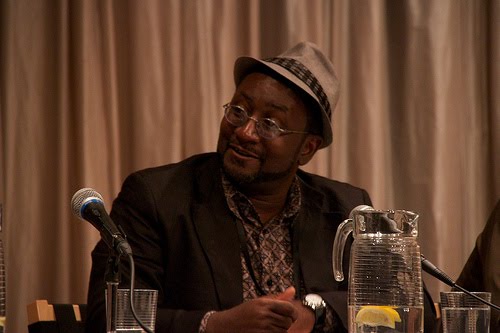
© PEN American Center/Susan Horgan. All rights reserved. Please contact media@pen.org for usage and rights.
December 23, 2009


December 22, 2009
Jesus Boy
Q: When is your next book due out and what are you working on after that?
A: The next book is called JESUS BOY and it is due out April 1, 2010. I am going to create a blogsite specifically for the book as soon as the cover and etc. are confirmed.
Well, as you know, there are a couple of books that I was born to write: A book about gambling, a book about church, a book about car salesmen, and a book about fathers. I took care of the gambling theme in ALL OR NOTHING. I did my church book in JESUS BOY. I have two more to go, car salesmen and fathers.
Two down.
Two to go.
In the meantime, I have completed a mystery/thriller about a female cop who is abducted by a serial rapist, a fantasy novel set in a world in which humans are pets, and two short story collections: one that pays homage to the work of Edgar Allan Poe, and another that pays homage to depression era gangsters John Dillinger, Pretty Boy Floyd, and Baby Face Nelson.
Thanks,
Preston
A: The next book is called JESUS BOY and it is due out April 1, 2010. I am going to create a blogsite specifically for the book as soon as the cover and etc. are confirmed.
Well, as you know, there are a couple of books that I was born to write: A book about gambling, a book about church, a book about car salesmen, and a book about fathers. I took care of the gambling theme in ALL OR NOTHING. I did my church book in JESUS BOY. I have two more to go, car salesmen and fathers.
Two down.
Two to go.
In the meantime, I have completed a mystery/thriller about a female cop who is abducted by a serial rapist, a fantasy novel set in a world in which humans are pets, and two short story collections: one that pays homage to the work of Edgar Allan Poe, and another that pays homage to depression era gangsters John Dillinger, Pretty Boy Floyd, and Baby Face Nelson.
Thanks,
Preston
September 13, 2009
Nostalgia Equals 20 to 30 Years Ago
Q: I have written a novel loosely based on my life, much of it set in the sixties through eighties. My agent has tried and failed to make a book deal she says because the publishers feel that the book needs to be updated a few decades and set in the eighties through the millenium. They want it to be more current, especially since the focus of the book is not really about those decades, but about my life and family events, which just happened to occur during those decades.
My agent agrees with the publishers who have rejected the book; thus, I am in the process of re-writing it to be more current, although with some misgivings. What do you think? Should I set my book in recent decades to make it more current?
A: If you have a publisher who is willing to make a deal based on an update and the update does not ruin the book, then go for it.
It seems that most publishers want novels that are set in present day unless there is a very good reason for setting them in the past. This makes sense, I suppose, because readers are more likely to buy books that are current.
Nostalgia does sell, however. These days people seem to be interested in the seventies and eighties. The sixties are still popular. Every now and then we get a few books set in the fifties and forties, but not so much anymore. Books about the fifties were very popular back in the seventies and eighties.
Here's something I was told by a writer friend. I do not know if this is a hard and fast rule (and I myself do not follow it)--but here it is; if the year itself is irrelevant to the plot, always set your book in present day: and if you must set it in the past, set it 20-30 years ago.
He argued that setting it 20-30 years ago will attract the "nostalgia" readers. The most active book buyers, those in the 30 to 50 age range, will be attracted to a book set during the good old days when they were teenagers and young adults.
Ten years ago is too recent--you might as well update it and make it present day. The people who were teens to young adults ten years ago, are still young adults, and as they are still getting their careers in order they are not yet in that place where they will yearn for the good old days.
Forty, fifty and more years ago is too far in the past--you might as well update it and make it present day. The people who were teens to young adults forty and more years ago have most likely already fallen in love with cherished classics (and specific writers) who feed their need for nostalgia--it will be hard to supplant them.
I do not know if I agree with this, and I am still mulling it over, but there you have it.
Thanks,
Preston
My agent agrees with the publishers who have rejected the book; thus, I am in the process of re-writing it to be more current, although with some misgivings. What do you think? Should I set my book in recent decades to make it more current?
A: If you have a publisher who is willing to make a deal based on an update and the update does not ruin the book, then go for it.
It seems that most publishers want novels that are set in present day unless there is a very good reason for setting them in the past. This makes sense, I suppose, because readers are more likely to buy books that are current.
Nostalgia does sell, however. These days people seem to be interested in the seventies and eighties. The sixties are still popular. Every now and then we get a few books set in the fifties and forties, but not so much anymore. Books about the fifties were very popular back in the seventies and eighties.
Here's something I was told by a writer friend. I do not know if this is a hard and fast rule (and I myself do not follow it)--but here it is; if the year itself is irrelevant to the plot, always set your book in present day: and if you must set it in the past, set it 20-30 years ago.
He argued that setting it 20-30 years ago will attract the "nostalgia" readers. The most active book buyers, those in the 30 to 50 age range, will be attracted to a book set during the good old days when they were teenagers and young adults.
Ten years ago is too recent--you might as well update it and make it present day. The people who were teens to young adults ten years ago, are still young adults, and as they are still getting their careers in order they are not yet in that place where they will yearn for the good old days.
Forty, fifty and more years ago is too far in the past--you might as well update it and make it present day. The people who were teens to young adults forty and more years ago have most likely already fallen in love with cherished classics (and specific writers) who feed their need for nostalgia--it will be hard to supplant them.
I do not know if I agree with this, and I am still mulling it over, but there you have it.
Thanks,
Preston
September 5, 2009
Should I Show It to My Friends?
Q: I’m currently writing a novel, and I asked my close friends to read it and let me know what I could do to improve it.
1. Is this a good thing or a bad thing? I would like for this novel to appeal to teenagers and adults, without being too graphic, and have some elements of realism to the characters and plot (even though it is a paranormal novel).
2. Any suggestions?
Thanks,
H.D.
A:
1. Finish writing the book before you show it to anyone.
2. Join a writers group or take a creative writing class.
3. Read as many books in that chosen genre as you can.
4. Don't write down to children and teenagers. They will see your con coming from a mile away.
Thanks,
Preston
1. Is this a good thing or a bad thing? I would like for this novel to appeal to teenagers and adults, without being too graphic, and have some elements of realism to the characters and plot (even though it is a paranormal novel).
2. Any suggestions?
Thanks,
H.D.
A:
1. Finish writing the book before you show it to anyone.
2. Join a writers group or take a creative writing class.
3. Read as many books in that chosen genre as you can.
4. Don't write down to children and teenagers. They will see your con coming from a mile away.
Thanks,
Preston
July 19, 2009
I Have Ideas But Not Enough Time to Write a Novel
Q: Hi Preston L. Allen. May I call you Preston? Many years ago I was in an MFA program but left it after a year to get married and start a family. I have since published several short stories in literary magazines and have a pretty good idea for a novel, but with the time constraints on my life due to full time employment and raising two children I find it impossible timewise to complete such a lengthy prose work. After two years of working on the book, I have a completed outline and a mere thirty pages of prose. I read your blog on "getting up early in the morning and working on the book every day." That does not work for me. I teach high school English and am too tired to get up so early. I need more time. Writing takes time. Where can I find more time?
Thanks, J.O.
A: At the rate you are going, in twenty years you will be on page 300 and the book will be completed. And it will probably be a great book because of all of the time you spent working and thinking about it. It will be your masterpiece. Your Magnum Opus. A book like that is worth waiting twenty years for.
On the other hand, you should clean out your emails if you want motivation to write your novel.
What?
Clean out your emails.
This week my English Department email account started bouncing back emails. The account was over full. I was way beyond the limit. I had over 3000 emails that needed to be deleted.
SO I began to delete old emails, but since some of them were important things that I needed to keep for a variety of personal and work related reasons--I opened a WORD file and began cutting and pasting the old emails into it.
I only went back a year and a half, which was enough to free up space so that I could use the system again.
A year and a half . . .
I only went back a year and a half--and I filled a WORD file that is 390 pages long, a page count that is longer than any novel I have ever published.
In other words, I wrote, in one year and a half, at least enough email prose to fill a good sized novel . . .
How much email prose have you written?
How much Myspace prose?
How much Facebook?
How Much Text Message?
How Much Twitter?
Maybe you aren't the kind of writer to rise at 5 a.m. But are you the kind who will email yourself, each day, a few paragraphs from your novel in progress?
The key is to steal some writing time from time that you ALREADY spend writing.
Your new novel will be ready in a year and a half.
I hope this helps, J.O.
Thanks,
Preston
Thanks, J.O.
A: At the rate you are going, in twenty years you will be on page 300 and the book will be completed. And it will probably be a great book because of all of the time you spent working and thinking about it. It will be your masterpiece. Your Magnum Opus. A book like that is worth waiting twenty years for.
On the other hand, you should clean out your emails if you want motivation to write your novel.
What?
Clean out your emails.
This week my English Department email account started bouncing back emails. The account was over full. I was way beyond the limit. I had over 3000 emails that needed to be deleted.
SO I began to delete old emails, but since some of them were important things that I needed to keep for a variety of personal and work related reasons--I opened a WORD file and began cutting and pasting the old emails into it.
I only went back a year and a half, which was enough to free up space so that I could use the system again.
A year and a half . . .
I only went back a year and a half--and I filled a WORD file that is 390 pages long, a page count that is longer than any novel I have ever published.
In other words, I wrote, in one year and a half, at least enough email prose to fill a good sized novel . . .
How much email prose have you written?
How much Myspace prose?
How much Facebook?
How Much Text Message?
How Much Twitter?
Maybe you aren't the kind of writer to rise at 5 a.m. But are you the kind who will email yourself, each day, a few paragraphs from your novel in progress?
The key is to steal some writing time from time that you ALREADY spend writing.
Your new novel will be ready in a year and a half.
I hope this helps, J.O.
Thanks,
Preston
July 14, 2009
What part of writing do you hate
Q: What part of the writing process do you hate?
A: There is no part of the writing process that I hate. I love to think about stories. I love to write stories, even long ones like novels, that may take years to complete. I love revising stories, even long ones like novels, that may take years to revise. I like doing research for stories I plan to write. I like workshopping stories with my friends who are writers and readers. I like getting feedback about my stories, even negative feedback. I like giving feedback. I like working with editors.
If there is a part of the process that I like least it would have to be trying to read my handwritten comments and fixes, and transfer them from the page to the computer. In truth, I do not dislike that part of it either, per se, but it has become more difficult because of my ever weakening vision.
Thanks,
Preston
A: There is no part of the writing process that I hate. I love to think about stories. I love to write stories, even long ones like novels, that may take years to complete. I love revising stories, even long ones like novels, that may take years to revise. I like doing research for stories I plan to write. I like workshopping stories with my friends who are writers and readers. I like getting feedback about my stories, even negative feedback. I like giving feedback. I like working with editors.
If there is a part of the process that I like least it would have to be trying to read my handwritten comments and fixes, and transfer them from the page to the computer. In truth, I do not dislike that part of it either, per se, but it has become more difficult because of my ever weakening vision.
Thanks,
Preston
Rejection
Q: How do you deal with negative criticism as a writer? Does it hurt?
A: Now, I have been fortunate. Knock on wood. Most of my criticism has been positive.
To answer your question, yes, negative criticism hurts. But it is a part of being a writer, and an important part. It keeps you on your toes. It keeps you performing at a high level. It keeps you from getting comfortable and slacking off.
Furthermore, you have to put it all into perspective. We writers get rejected a lot. Rejections hurt a lot, and we get rejected a lot. So when we are reading a piece of negative criticism of something of ours that was accepted by a publisher and is published and in print, it is but one defeat after a string of many successes. In short, it is a victory to find oneself in a position to even be the object of negative criticism.
And here is something else, criticism, any kind of criticism, means that you are being read, and that is not a bad thing.
Thanks,
Preston
A: Now, I have been fortunate. Knock on wood. Most of my criticism has been positive.
To answer your question, yes, negative criticism hurts. But it is a part of being a writer, and an important part. It keeps you on your toes. It keeps you performing at a high level. It keeps you from getting comfortable and slacking off.
Furthermore, you have to put it all into perspective. We writers get rejected a lot. Rejections hurt a lot, and we get rejected a lot. So when we are reading a piece of negative criticism of something of ours that was accepted by a publisher and is published and in print, it is but one defeat after a string of many successes. In short, it is a victory to find oneself in a position to even be the object of negative criticism.
And here is something else, criticism, any kind of criticism, means that you are being read, and that is not a bad thing.
Thanks,
Preston
I want to Write
Q: I want to write but my grammar is not so good. Should I give up?
A: What? I can't answer that question. There is too much about you that I do not know. You want to write what? Poetry? Stories? A novel? Essays? Have you written anything substantial? Has anyone (aside from your family and close friends) read it?
I'm not sure what you're asking, but if you want to fix your grammar, sign up for a grammar class with the public schools or with a local community college. You might also pick up Strunk and White's THE ELEMENTS OF STYLE or some other book on grammar.
Worse than having a weakness in grammar, if you plan on becoming a writer, is having a weakness in reading. . . do you read a lot? Have you read a lot? If not, go out and start buying novels, short story collections, poetry collections, or collections and books in whatever genre of writing you aspire to work in.
I hope this helps.
Thanks,
Preston
A: What? I can't answer that question. There is too much about you that I do not know. You want to write what? Poetry? Stories? A novel? Essays? Have you written anything substantial? Has anyone (aside from your family and close friends) read it?
I'm not sure what you're asking, but if you want to fix your grammar, sign up for a grammar class with the public schools or with a local community college. You might also pick up Strunk and White's THE ELEMENTS OF STYLE or some other book on grammar.
Worse than having a weakness in grammar, if you plan on becoming a writer, is having a weakness in reading. . . do you read a lot? Have you read a lot? If not, go out and start buying novels, short story collections, poetry collections, or collections and books in whatever genre of writing you aspire to work in.
I hope this helps.
Thanks,
Preston
June 20, 2009
Visit Screwiowa.com
Hey folks--here's a great new website to visit screwiowa.com.
My friend Nina Romano is doing some exciting things on that site. Plus there's a nice little piece I wrote about the craft of writing.
Thanks,
Preston
My friend Nina Romano is doing some exciting things on that site. Plus there's a nice little piece I wrote about the craft of writing.
Thanks,
Preston
June 18, 2009
Let's Say P was real . . .
Q: In your novel ALL OR NOTHING, Let's say P was real. How would his family feel about his nearly confessional novel being published? How do writers and people associated with them cope with the truth in novels? Do the living's feelings and dignity indirectly censor some of the things the author planned to write?
Thanks,
Alexander
A: Good question.
First, go read John Dufresne's excellent creative writing text called THE LIE THAT TELLS A TRUTH, or just sit there and ponder the meaning of that title.
Second, maybe I need to stick my motto on my door and on my bumper sticker so that people will know who I am: "My name is writer. I am the most honest liar you will ever meet."
Third, I would hate it if my family wrote a novel with me in it because they don't know how to lie; therefore, they would depend too much on the truth and end up hurting my feelings and my dignity with their blunt, clumsy, insincere, dishonest honesty.
On the other hand, big fat liar that I am, I write about THEM all the time, and they don't even notice.
One of my great private joys is that the cousin about whom I based "IS RANDY ROBERTS THERE?" (found in CHURCHBOYS AND OTHER SINNERS, Carolina Wren Press, 2003) is a great fan of the story and has no idea it's based on her. Tehehe.
I come from a very close-knit family, even though sometimes we hate each other, and thus there are some books that I cannot (and will not) write until certain people are dead or until I find a lie big enough to conceal their identities while at the same time revealing the truth the work aims to explore.
Fourth, it is indeed a long list of writers who have created works of fiction that have offended the friends and family members who read it and, shock of shocks, who found themselves unfavorably portrayed in it.
Fifth, before my mother passed, she read the manuscript of my forthcoming novel, JESUS BOY, which she enjoyed--I never saw her laugh so much in my life. But she did ask over and over, "Who is Sister Morrisohn in real life? Is it Sister Slade? Sister Bynes? Boy, did Sister Bynes seduce you? I cannot believe that that grown woman make a move on my child!"
And I'm like, "No, ma. I did not sleep with Sister Bynes, OR Sister Slade. This is a fiction, ma. Hahaha."
But you could see in her eyes she didn't believe me. My mother went to her grave wondering which respected sister at our church seduced me when I was 15 or 16.
Sixth, I will tell you again that my novel BOUNCE is autobiographical--just as autobiographical as JESUS BOY and ALL OR NOTHING. The protagonist of BOUNCE is a short, sexy Domincan woman named Cindique. Go figure.
Seventh, I am a gambler and P is a gambler. Thus, I know gambling. It makes me the ideal person to tell P's story, whoever he is. Is P me? Yes, in many ways, but in many ways not.
I was a church boy and Elwyn (from JESUS BOY) is a church boy. Thus, I know church boys. It makes me the ideal person to tell Elwyn's story. Is Elwyn me? Yes, in many ways, but in many ways not.
Eighth, in my next novel, THE GOSPEL ACCORDING TO ALEXANDER, I am going to tell the story of my former student Alexander Cherin . . .
Is Alexander me? In that book. he will be.
Thanks,
Preston
Thanks,
Alexander
A: Good question.
First, go read John Dufresne's excellent creative writing text called THE LIE THAT TELLS A TRUTH, or just sit there and ponder the meaning of that title.
Second, maybe I need to stick my motto on my door and on my bumper sticker so that people will know who I am: "My name is writer. I am the most honest liar you will ever meet."
Third, I would hate it if my family wrote a novel with me in it because they don't know how to lie; therefore, they would depend too much on the truth and end up hurting my feelings and my dignity with their blunt, clumsy, insincere, dishonest honesty.
On the other hand, big fat liar that I am, I write about THEM all the time, and they don't even notice.
One of my great private joys is that the cousin about whom I based "IS RANDY ROBERTS THERE?" (found in CHURCHBOYS AND OTHER SINNERS, Carolina Wren Press, 2003) is a great fan of the story and has no idea it's based on her. Tehehe.
I come from a very close-knit family, even though sometimes we hate each other, and thus there are some books that I cannot (and will not) write until certain people are dead or until I find a lie big enough to conceal their identities while at the same time revealing the truth the work aims to explore.
Fourth, it is indeed a long list of writers who have created works of fiction that have offended the friends and family members who read it and, shock of shocks, who found themselves unfavorably portrayed in it.
Fifth, before my mother passed, she read the manuscript of my forthcoming novel, JESUS BOY, which she enjoyed--I never saw her laugh so much in my life. But she did ask over and over, "Who is Sister Morrisohn in real life? Is it Sister Slade? Sister Bynes? Boy, did Sister Bynes seduce you? I cannot believe that that grown woman make a move on my child!"
And I'm like, "No, ma. I did not sleep with Sister Bynes, OR Sister Slade. This is a fiction, ma. Hahaha."
But you could see in her eyes she didn't believe me. My mother went to her grave wondering which respected sister at our church seduced me when I was 15 or 16.
Sixth, I will tell you again that my novel BOUNCE is autobiographical--just as autobiographical as JESUS BOY and ALL OR NOTHING. The protagonist of BOUNCE is a short, sexy Domincan woman named Cindique. Go figure.
Seventh, I am a gambler and P is a gambler. Thus, I know gambling. It makes me the ideal person to tell P's story, whoever he is. Is P me? Yes, in many ways, but in many ways not.
I was a church boy and Elwyn (from JESUS BOY) is a church boy. Thus, I know church boys. It makes me the ideal person to tell Elwyn's story. Is Elwyn me? Yes, in many ways, but in many ways not.
Eighth, in my next novel, THE GOSPEL ACCORDING TO ALEXANDER, I am going to tell the story of my former student Alexander Cherin . . .
Is Alexander me? In that book. he will be.
Thanks,
Preston
Subscribe to:
Posts (Atom)