Q: I want to write but my grammar is not so good. Should I give up?
A: What? I can't answer that question. There is too much about you that I do not know. You want to write what? Poetry? Stories? A novel? Essays? Have you written anything substantial? Has anyone (aside from your family and close friends) read it?
I'm not sure what you're asking, but if you want to fix your grammar, sign up for a grammar class with the public schools or with a local community college. You might also pick up Strunk and White's THE ELEMENTS OF STYLE or some other book on grammar.
Worse than having a weakness in grammar, if you plan on becoming a writer, is having a weakness in reading. . . do you read a lot? Have you read a lot? If not, go out and start buying novels, short story collections, poetry collections, or collections and books in whatever genre of writing you aspire to work in.
I hope this helps.
Thanks,
Preston
At the Pen Festival 2010
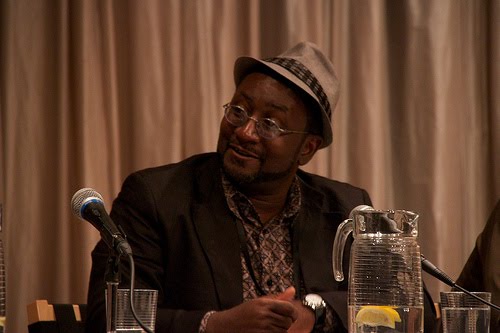
© PEN American Center/Susan Horgan. All rights reserved. Please contact media@pen.org for usage and rights.
July 14, 2009


June 20, 2009
Visit Screwiowa.com
Hey folks--here's a great new website to visit screwiowa.com.
My friend Nina Romano is doing some exciting things on that site. Plus there's a nice little piece I wrote about the craft of writing.
Thanks,
Preston
My friend Nina Romano is doing some exciting things on that site. Plus there's a nice little piece I wrote about the craft of writing.
Thanks,
Preston
June 18, 2009
Let's Say P was real . . .
Q: In your novel ALL OR NOTHING, Let's say P was real. How would his family feel about his nearly confessional novel being published? How do writers and people associated with them cope with the truth in novels? Do the living's feelings and dignity indirectly censor some of the things the author planned to write?
Thanks,
Alexander
A: Good question.
First, go read John Dufresne's excellent creative writing text called THE LIE THAT TELLS A TRUTH, or just sit there and ponder the meaning of that title.
Second, maybe I need to stick my motto on my door and on my bumper sticker so that people will know who I am: "My name is writer. I am the most honest liar you will ever meet."
Third, I would hate it if my family wrote a novel with me in it because they don't know how to lie; therefore, they would depend too much on the truth and end up hurting my feelings and my dignity with their blunt, clumsy, insincere, dishonest honesty.
On the other hand, big fat liar that I am, I write about THEM all the time, and they don't even notice.
One of my great private joys is that the cousin about whom I based "IS RANDY ROBERTS THERE?" (found in CHURCHBOYS AND OTHER SINNERS, Carolina Wren Press, 2003) is a great fan of the story and has no idea it's based on her. Tehehe.
I come from a very close-knit family, even though sometimes we hate each other, and thus there are some books that I cannot (and will not) write until certain people are dead or until I find a lie big enough to conceal their identities while at the same time revealing the truth the work aims to explore.
Fourth, it is indeed a long list of writers who have created works of fiction that have offended the friends and family members who read it and, shock of shocks, who found themselves unfavorably portrayed in it.
Fifth, before my mother passed, she read the manuscript of my forthcoming novel, JESUS BOY, which she enjoyed--I never saw her laugh so much in my life. But she did ask over and over, "Who is Sister Morrisohn in real life? Is it Sister Slade? Sister Bynes? Boy, did Sister Bynes seduce you? I cannot believe that that grown woman make a move on my child!"
And I'm like, "No, ma. I did not sleep with Sister Bynes, OR Sister Slade. This is a fiction, ma. Hahaha."
But you could see in her eyes she didn't believe me. My mother went to her grave wondering which respected sister at our church seduced me when I was 15 or 16.
Sixth, I will tell you again that my novel BOUNCE is autobiographical--just as autobiographical as JESUS BOY and ALL OR NOTHING. The protagonist of BOUNCE is a short, sexy Domincan woman named Cindique. Go figure.
Seventh, I am a gambler and P is a gambler. Thus, I know gambling. It makes me the ideal person to tell P's story, whoever he is. Is P me? Yes, in many ways, but in many ways not.
I was a church boy and Elwyn (from JESUS BOY) is a church boy. Thus, I know church boys. It makes me the ideal person to tell Elwyn's story. Is Elwyn me? Yes, in many ways, but in many ways not.
Eighth, in my next novel, THE GOSPEL ACCORDING TO ALEXANDER, I am going to tell the story of my former student Alexander Cherin . . .
Is Alexander me? In that book. he will be.
Thanks,
Preston
Thanks,
Alexander
A: Good question.
First, go read John Dufresne's excellent creative writing text called THE LIE THAT TELLS A TRUTH, or just sit there and ponder the meaning of that title.
Second, maybe I need to stick my motto on my door and on my bumper sticker so that people will know who I am: "My name is writer. I am the most honest liar you will ever meet."
Third, I would hate it if my family wrote a novel with me in it because they don't know how to lie; therefore, they would depend too much on the truth and end up hurting my feelings and my dignity with their blunt, clumsy, insincere, dishonest honesty.
On the other hand, big fat liar that I am, I write about THEM all the time, and they don't even notice.
One of my great private joys is that the cousin about whom I based "IS RANDY ROBERTS THERE?" (found in CHURCHBOYS AND OTHER SINNERS, Carolina Wren Press, 2003) is a great fan of the story and has no idea it's based on her. Tehehe.
I come from a very close-knit family, even though sometimes we hate each other, and thus there are some books that I cannot (and will not) write until certain people are dead or until I find a lie big enough to conceal their identities while at the same time revealing the truth the work aims to explore.
Fourth, it is indeed a long list of writers who have created works of fiction that have offended the friends and family members who read it and, shock of shocks, who found themselves unfavorably portrayed in it.
Fifth, before my mother passed, she read the manuscript of my forthcoming novel, JESUS BOY, which she enjoyed--I never saw her laugh so much in my life. But she did ask over and over, "Who is Sister Morrisohn in real life? Is it Sister Slade? Sister Bynes? Boy, did Sister Bynes seduce you? I cannot believe that that grown woman make a move on my child!"
And I'm like, "No, ma. I did not sleep with Sister Bynes, OR Sister Slade. This is a fiction, ma. Hahaha."
But you could see in her eyes she didn't believe me. My mother went to her grave wondering which respected sister at our church seduced me when I was 15 or 16.
Sixth, I will tell you again that my novel BOUNCE is autobiographical--just as autobiographical as JESUS BOY and ALL OR NOTHING. The protagonist of BOUNCE is a short, sexy Domincan woman named Cindique. Go figure.
Seventh, I am a gambler and P is a gambler. Thus, I know gambling. It makes me the ideal person to tell P's story, whoever he is. Is P me? Yes, in many ways, but in many ways not.
I was a church boy and Elwyn (from JESUS BOY) is a church boy. Thus, I know church boys. It makes me the ideal person to tell Elwyn's story. Is Elwyn me? Yes, in many ways, but in many ways not.
Eighth, in my next novel, THE GOSPEL ACCORDING TO ALEXANDER, I am going to tell the story of my former student Alexander Cherin . . .
Is Alexander me? In that book. he will be.
Thanks,
Preston
May 29, 2009
MY BAD
A: MY BAD
I just got an email that says I misunderstood the last question. The emailer was asking which of the erotic stories that I have written are my favorites.
Okay, thanks for the question, now that I understand it.
In Carol Taylor's BROWN SUGAR series, I would have to say that NADINE'S HUSBAND is my favorite. It is well written, touching, and STORY is the most important element in it. It set the standard for all four stories I wrote for that series. STORY comes first--all other elements, including sex, must flow logically and smoothly from the story.
I also like SOUTHERNMOST TRIANGLE, which shows up in WANDERLUST (edited by Carol Taylor) because that is the first time in any of my stories (published or unpublished) I wrote a threesome scene that worked, in my opinion, because it flowed from STORY.
In my novel BOUNCE, which is an unabashedly erotic novel, the Boo-Hoo scene is tops as far as I am concerned.
In COME WITH ME, SHEBA, Chapter 19 works for me as a culmination of erotic energy--Chapter 19 is so hot I had to write it in parts. As I recall, Chapter 19 has 6 parts.
I hope that answers your question.
Thanks,
Preston
I just got an email that says I misunderstood the last question. The emailer was asking which of the erotic stories that I have written are my favorites.
Okay, thanks for the question, now that I understand it.
In Carol Taylor's BROWN SUGAR series, I would have to say that NADINE'S HUSBAND is my favorite. It is well written, touching, and STORY is the most important element in it. It set the standard for all four stories I wrote for that series. STORY comes first--all other elements, including sex, must flow logically and smoothly from the story.
I also like SOUTHERNMOST TRIANGLE, which shows up in WANDERLUST (edited by Carol Taylor) because that is the first time in any of my stories (published or unpublished) I wrote a threesome scene that worked, in my opinion, because it flowed from STORY.
In my novel BOUNCE, which is an unabashedly erotic novel, the Boo-Hoo scene is tops as far as I am concerned.
In COME WITH ME, SHEBA, Chapter 19 works for me as a culmination of erotic energy--Chapter 19 is so hot I had to write it in parts. As I recall, Chapter 19 has 6 parts.
I hope that answers your question.
Thanks,
Preston
Erotica
Q: Two questions. First, you say that sex is one of those things you do not talk about along with religion and politics, but I have read with pleasure your erotic stories. What's up with that? Second, What are your favorite erotic stories?
A: I do not discuss sex, religion, or politics in public--it makes too many enemies and it usually ends up with one party espousing a belief rather than defending an argument. I do not talk about these topics but I do write about them. A lot!
The stories that I found to be so hot that I started writing my own erotica are listed here in no particular order and I apologize in advance for not including in some instances the author's name.
Michael Hemmingson's THE DRESS and THE NAUGHTY YARD. Sweet Jheezus, I still re-read these two lengthy (novella length) stories from time to time for inspiration to write my own pieces. Hemmingson is a very dirty boy with a wicked sense of humor and an even wickeder way with describing bedroom delights. I read most of his stuff in Maxim Jakubowski's MAMMOTH BOOK OF SEX anthologies. He's got about ten of them out there--and they're all full of good sex writing.
A short story called PG DIARY is also great for sexual inspiration on the part of yours truly. I apologize because I cannot recall the author's name without consulting the book which I do not have here in front of me, though she and I communicated via email for a while after her story came out in one of Suzy Bright's anual anthologies: I think it was Best Erotica of 2000? 2001? It's a great story about two pregnant girls who are roommates at one of those special schools for wayward teens. The story is sweet and sexy and poignant and it rings of truth.
In that same Suzy Bright anthology there was a story called SWEATING PROFUSELY IN MERIDIA that was DAYUMMM hot too. I need to go find that book and give you the names of the writers.
I found the book! It is Susie (not Suzy) Bright's THE BEST AMERICAN EROTICA 1994. The author of PG DIARY is Linda Hooper, and Carol Queen is the author of SWEATING PROFUSELY.
In my hand I also have Susie Bright's 2001 edition of that collection and there is a story called THE MAN WHO ATE WOMEN by Damian Grace. DAYUMM. This one took me back to college life and its wayward ways.
REASONS NOT TO GO TO FT. LAUDERDALE by Liz Clarke (clark?) was in an anthology I lost but need to re-purchase called SLOW HAND by Michele B. Slung. I used to read that one a lot for inspiration. There is another story that nailed college sex antics in the 80s.
Brian Fawcet (Fawcett?) wrote a story called Cuckoo in Maxim Jakubowski's MAMMOTH BOOK OF INTERNATIONAL EROTICA. If you want to learn how to write well and earnestly about threesomes, this is a good story to begin with. Very erotic. Very meaningful.
Marge Piercy's novel THREE WOMEN has a DAYUMM good section in it that I have seen anthologized somewhere. Or you can just buy her novel. It's the scene when Elena and Evan invite the new kid Chad into their sex games. Another good section to study to learn how to write threesomes earnestly and well. Too often in so-called erotica the threesome is drawn from cookie cutter and porn-flick cliche.
I'm a big fan of Anais Nin, so I love pretty much everything she has written--excluding her autobiographical stuff. Check out LITTLE BIRDS or DELTA OF VENUS.
Now let me tell you about the landmark collection EROTIQUE NOIR. That's my bible. The story in it I return to the most is THE THREE TOKEN STRADIVARIUS by R. Pope.
In the BROWN SUGAR anthologies by Carol Taylor (in which my works appear), the stories I return to the most are DRAG by Leone Ross, MOVIE LOVER by Michael Gonzales, and HOW I BECAME A WRITER by Lois Elaine Griffith.
Of course, THE STORY OF O is a favorite erotic read of mine--many scenes in that book are returned to time and time again.
Eric Jerome Dickey's BETWEEN LOVERS has a great threesome scene when Nicole and her wife make love to the narrator--DAYUMM.
A goodly number of my favorite erotic stories and scenes came as a surprise to me because they showed up in novels and story collections that had little or nothing to do with sex. If I have time I will make a list of them.
Three that come to mind are KISS OF THE SPIDERWOMAN by Manuel Puig, KINFLICKS by Lisa Alther, INVISIBLE MAN by Ralph Ellison, and RULES OF ATTRACTION by Brett Easton Ellis.
I'm out.
Preston
A: I do not discuss sex, religion, or politics in public--it makes too many enemies and it usually ends up with one party espousing a belief rather than defending an argument. I do not talk about these topics but I do write about them. A lot!
The stories that I found to be so hot that I started writing my own erotica are listed here in no particular order and I apologize in advance for not including in some instances the author's name.
Michael Hemmingson's THE DRESS and THE NAUGHTY YARD. Sweet Jheezus, I still re-read these two lengthy (novella length) stories from time to time for inspiration to write my own pieces. Hemmingson is a very dirty boy with a wicked sense of humor and an even wickeder way with describing bedroom delights. I read most of his stuff in Maxim Jakubowski's MAMMOTH BOOK OF SEX anthologies. He's got about ten of them out there--and they're all full of good sex writing.
A short story called PG DIARY is also great for sexual inspiration on the part of yours truly. I apologize because I cannot recall the author's name without consulting the book which I do not have here in front of me, though she and I communicated via email for a while after her story came out in one of Suzy Bright's anual anthologies: I think it was Best Erotica of 2000? 2001? It's a great story about two pregnant girls who are roommates at one of those special schools for wayward teens. The story is sweet and sexy and poignant and it rings of truth.
In that same Suzy Bright anthology there was a story called SWEATING PROFUSELY IN MERIDIA that was DAYUMMM hot too. I need to go find that book and give you the names of the writers.
I found the book! It is Susie (not Suzy) Bright's THE BEST AMERICAN EROTICA 1994. The author of PG DIARY is Linda Hooper, and Carol Queen is the author of SWEATING PROFUSELY.
In my hand I also have Susie Bright's 2001 edition of that collection and there is a story called THE MAN WHO ATE WOMEN by Damian Grace. DAYUMM. This one took me back to college life and its wayward ways.
REASONS NOT TO GO TO FT. LAUDERDALE by Liz Clarke (clark?) was in an anthology I lost but need to re-purchase called SLOW HAND by Michele B. Slung. I used to read that one a lot for inspiration. There is another story that nailed college sex antics in the 80s.
Brian Fawcet (Fawcett?) wrote a story called Cuckoo in Maxim Jakubowski's MAMMOTH BOOK OF INTERNATIONAL EROTICA. If you want to learn how to write well and earnestly about threesomes, this is a good story to begin with. Very erotic. Very meaningful.
Marge Piercy's novel THREE WOMEN has a DAYUMM good section in it that I have seen anthologized somewhere. Or you can just buy her novel. It's the scene when Elena and Evan invite the new kid Chad into their sex games. Another good section to study to learn how to write threesomes earnestly and well. Too often in so-called erotica the threesome is drawn from cookie cutter and porn-flick cliche.
I'm a big fan of Anais Nin, so I love pretty much everything she has written--excluding her autobiographical stuff. Check out LITTLE BIRDS or DELTA OF VENUS.
Now let me tell you about the landmark collection EROTIQUE NOIR. That's my bible. The story in it I return to the most is THE THREE TOKEN STRADIVARIUS by R. Pope.
In the BROWN SUGAR anthologies by Carol Taylor (in which my works appear), the stories I return to the most are DRAG by Leone Ross, MOVIE LOVER by Michael Gonzales, and HOW I BECAME A WRITER by Lois Elaine Griffith.
Of course, THE STORY OF O is a favorite erotic read of mine--many scenes in that book are returned to time and time again.
Eric Jerome Dickey's BETWEEN LOVERS has a great threesome scene when Nicole and her wife make love to the narrator--DAYUMM.
A goodly number of my favorite erotic stories and scenes came as a surprise to me because they showed up in novels and story collections that had little or nothing to do with sex. If I have time I will make a list of them.
Three that come to mind are KISS OF THE SPIDERWOMAN by Manuel Puig, KINFLICKS by Lisa Alther, INVISIBLE MAN by Ralph Ellison, and RULES OF ATTRACTION by Brett Easton Ellis.
I'm out.
Preston
May 25, 2009
Glad That You're Back
Q: Glad That You're back! Where were you? How has your career been going since you last blogged?
A: I'm back, I guess, because I never left. I just took a little break. I am not a true blogger, you know? There are all of these fancy things that blogs can do that mine can't and never will because I am not interested in wasting time learning how to do them. I am a writer, not a blogger. So I write, and if I have enough time and energy left over I write on the blog.
Lots of good things have been happening since last I blogged. At the very top of the list is my old friends at Akashic, who are currently editing my new novel JESUS BOY, which is due out some time in early 2010.
I am pumped! And I think the readers have waited long enough to meet the horny born again teen piano prodigy Elwyn and his much older cougar lover Sister Morrisohn, both of whom have lived in my head since . . . since I was a horny born again teen piano prodigy myself.
JESUS BOY is one of those weird books--I began writing it when I was Elwyn's age, 16, and I completed it when I was Sister Morrisohn's age, 42.
Enough about that.
I attended the Algonquin Pitch Writing Workshop in New York in March. Thanks to my wife and the bad economy, I was able to stay in a swanky Manhattan hotel across the street from the U.N. dirt cheap.
I got to meet Charles Salzberg (Swann's Last Song) and had my very positive tete a tetes with editors Sandy Harding, Zach Wagman, and Tom Colgan (Tom Clancy's editor). I am hoping one of these top editors, each of whom liked my pitch enough to request a read of the novel, will make an offer I can't refuse.
The novel is called The Virgin of Biscayne Boulevard. Wish me luck (or as Elwyn might say, Pray for me).
So I took a class at the MDC/St. Thomas University's Earth Ethics Institute this past semester. For the final assignment in that class, I wrote the short story, which became the novella, which became the full blown novel, EVERY BOY SHOULD HAVE A MAN, which is about a world where man is a house pet and the real masters of the earth are the Oafs, or Giants (as in David and Goliath Jack and the Beanstalk giants). But really, the book is about the environment. More on this later.
I have a story, THREE KISSES, coming out in a new erotic anthology edited by Robert Fleming. More on this later.
And I keep re-configuring my collection of psychopath short stories and changing its title--these days I am having a hard time finding titles for my books. Writing is easy. Titling is hard.
At any rate, I'm back!
Thanks,
Preston
A: I'm back, I guess, because I never left. I just took a little break. I am not a true blogger, you know? There are all of these fancy things that blogs can do that mine can't and never will because I am not interested in wasting time learning how to do them. I am a writer, not a blogger. So I write, and if I have enough time and energy left over I write on the blog.
Lots of good things have been happening since last I blogged. At the very top of the list is my old friends at Akashic, who are currently editing my new novel JESUS BOY, which is due out some time in early 2010.
I am pumped! And I think the readers have waited long enough to meet the horny born again teen piano prodigy Elwyn and his much older cougar lover Sister Morrisohn, both of whom have lived in my head since . . . since I was a horny born again teen piano prodigy myself.
JESUS BOY is one of those weird books--I began writing it when I was Elwyn's age, 16, and I completed it when I was Sister Morrisohn's age, 42.
Enough about that.
I attended the Algonquin Pitch Writing Workshop in New York in March. Thanks to my wife and the bad economy, I was able to stay in a swanky Manhattan hotel across the street from the U.N. dirt cheap.
I got to meet Charles Salzberg (Swann's Last Song) and had my very positive tete a tetes with editors Sandy Harding, Zach Wagman, and Tom Colgan (Tom Clancy's editor). I am hoping one of these top editors, each of whom liked my pitch enough to request a read of the novel, will make an offer I can't refuse.
The novel is called The Virgin of Biscayne Boulevard. Wish me luck (or as Elwyn might say, Pray for me).
So I took a class at the MDC/St. Thomas University's Earth Ethics Institute this past semester. For the final assignment in that class, I wrote the short story, which became the novella, which became the full blown novel, EVERY BOY SHOULD HAVE A MAN, which is about a world where man is a house pet and the real masters of the earth are the Oafs, or Giants (as in David and Goliath Jack and the Beanstalk giants). But really, the book is about the environment. More on this later.
I have a story, THREE KISSES, coming out in a new erotic anthology edited by Robert Fleming. More on this later.
And I keep re-configuring my collection of psychopath short stories and changing its title--these days I am having a hard time finding titles for my books. Writing is easy. Titling is hard.
At any rate, I'm back!
Thanks,
Preston
Characters That Are Smarter Than the Writer
Q: How do you write about characters that are smarter than you are?
Thanks,
AC
A: AC, it was great having you in class this semester. And, actually, I'm going to use your name, if you don't mind, because your short story is up for a major award--the League for Innovation Prize, and though I haven't heard back from the national judges yet, I have a sneaking suspicion that you are going to win it. We are all very proud of you at MDC, Alexander (Cherin).
Now back to your question. First of all, no character is smarter than you because you are the writer, which makes you God and thereby all powerfull and all knowing.
LOL
But never mind that. The most tried and true method for creating really smart characters is to base them on real life brainiacs. The first step, of course, is to do the research. Study the writings of the brainiac--get a bio or two on them--read up on what others have said about them, especially the writings of those who have had personal encounters with them like their friends, family, and colleagues. In this way, you will get a good feel for their personal characteristics and a sense of how others perceive them--and usually you don't need more than that to write your fictionalized clone of them. In fact, a good book about two great brains is on my list on this page--The Professor and the Mad Man--which is a really great read.
Now here is my question to you: Why do we find it difficult to write about people smarter than we are when we have no problem writing about people stronger, older, younger, sexier, braver, uglier, taller, shorter, more athletic, or more talented than we are?
Thanks,
Preston
Thanks,
AC
A: AC, it was great having you in class this semester. And, actually, I'm going to use your name, if you don't mind, because your short story is up for a major award--the League for Innovation Prize, and though I haven't heard back from the national judges yet, I have a sneaking suspicion that you are going to win it. We are all very proud of you at MDC, Alexander (Cherin).
Now back to your question. First of all, no character is smarter than you because you are the writer, which makes you God and thereby all powerfull and all knowing.
LOL
But never mind that. The most tried and true method for creating really smart characters is to base them on real life brainiacs. The first step, of course, is to do the research. Study the writings of the brainiac--get a bio or two on them--read up on what others have said about them, especially the writings of those who have had personal encounters with them like their friends, family, and colleagues. In this way, you will get a good feel for their personal characteristics and a sense of how others perceive them--and usually you don't need more than that to write your fictionalized clone of them. In fact, a good book about two great brains is on my list on this page--The Professor and the Mad Man--which is a really great read.
Now here is my question to you: Why do we find it difficult to write about people smarter than we are when we have no problem writing about people stronger, older, younger, sexier, braver, uglier, taller, shorter, more athletic, or more talented than we are?
Thanks,
Preston
November 11, 2008
Miami International Bookfair
Come join me, Preston L. Allen, at the Miami International Bookfair.
I will be reading at 10:00 a.m. on Saturday November 15 in room 7106-07 at the Wolfson Campus of Miami-Dade College (the downtown campus).
Hope to see you there.
Be there or be square.
Thanks,
Preston
I will be reading at 10:00 a.m. on Saturday November 15 in room 7106-07 at the Wolfson Campus of Miami-Dade College (the downtown campus).
Hope to see you there.
Be there or be square.
Thanks,
Preston
October 20, 2008
Skill or Luck
Q: Is poker a game of skill or luck?
A: Easy answer: Poker is a game of skill.
Note that there are those who make a living playing it every day. It takes skill to be consistently a winner at anything.
Note that at the final table in every major tournament, the same dozen or so names show up again and again. Such a hierarchy of success implies skill, and skill implies that some are better at it than others. Luck creates no hierarchy of success.
Nevertheless, if you sit at any poker table long enough, you will hear the grumbling player: "My cards have gone cold. I haven't hit anything in 2 hours. My seat is bad. Boy, it would be nice to see a few good cards." This implies that a poker player only wins when he/she gets good cards. In other words, a player only wins if he/she is lucky.
Well, this may be true if you are a bad player. If you are a bad player, you need to be lucky to win. You need the right cards to fall your way.
Good players, on the other hand, win with skill. They study the other players at the table and strive to outplay them, out fox them, out think them. Sure, cards are important, but it is more important to know HOW to play those cards.
Here's another way to look at it.
Bad players pay to see cards--they are depending on lucky cards to come and help them win. They think this is what poker is all about.
More often than not, good players pay NOT to see cards. They are so much better than you that realistically the only thing that can beat them is luck--bad luck.
Thanks,
Preston
A: Easy answer: Poker is a game of skill.
Note that there are those who make a living playing it every day. It takes skill to be consistently a winner at anything.
Note that at the final table in every major tournament, the same dozen or so names show up again and again. Such a hierarchy of success implies skill, and skill implies that some are better at it than others. Luck creates no hierarchy of success.
Nevertheless, if you sit at any poker table long enough, you will hear the grumbling player: "My cards have gone cold. I haven't hit anything in 2 hours. My seat is bad. Boy, it would be nice to see a few good cards." This implies that a poker player only wins when he/she gets good cards. In other words, a player only wins if he/she is lucky.
Well, this may be true if you are a bad player. If you are a bad player, you need to be lucky to win. You need the right cards to fall your way.
Good players, on the other hand, win with skill. They study the other players at the table and strive to outplay them, out fox them, out think them. Sure, cards are important, but it is more important to know HOW to play those cards.
Here's another way to look at it.
Bad players pay to see cards--they are depending on lucky cards to come and help them win. They think this is what poker is all about.
More often than not, good players pay NOT to see cards. They are so much better than you that realistically the only thing that can beat them is luck--bad luck.
Thanks,
Preston
October 19, 2008
Looking for Magic
Q: How do you know when your book is done and you can send it to the publishers?
A: I used to know how to answer this question, and I think that I actually did on an earlier blog--but since I just finished my latest novel, whose title changes each time the sun rises--I am going to tell you that writing gives me a high, maybe not as great as gambling, but pretty dang close. Here's what happened.
I finished the book a couple weeks ago and started reading it for magic--now magic is what happens when you start making connections between the parts of what you have written, seeing echoes and allusions and themes that you hadn't planned but that are much truer and more real than the ones you had planned.
When this happens, I sit there and think, "Is there someone up there writing this book for me? Leading me to these connections? What is going on here? The book seems to be writing itself. This new idea is soooooo good--how come I didn't PLAN for this in the first place?"
Then when I look at other books and stories that I have written, I do a quick survey of those magical things that happened without my planning for them to have happened. They are usually the BEST parts of the story. In fact, they are the things that people remember most--and I stumbled upon them last. Thank god.
Now I don't want to explain away the rainbow, but I think what happens in my case is that when my stories are finally written down in a completed form on the page, I can begin to read them critically and objectively, and so my mind is actively, though subconsciously, seeking theme and mystical coincidence.
Theme is what the story is (consistently) about--the deep meaning as your high school teachers used to say.
Mystical coincidences are the most fun. They are those moments that resonate with other parts of the story and make you say, "Wow, that is so true," or "He got just what he deserved," or "Thank god she came to his rescue--I was hoping and praying that she would." They are like punchlines to jokes that you didn't know you were even telling. You set them up in the reader's mind, but if you don't go back and become a reader yourself, you, the writer of the story and their creator, more often than not won't even realize that they are there.
Sometimes it's in a name--you notice all the villains' names begin with H, but one of them begins with an M--change it to an H or make it an M for a reason that echoes.
Sometimes it's a color--It happened to me in the story "Crip" with the main character who wore the mustard color suit--AFTER I had written the story I discovered a way to make the color mustard echo long after the story had ended.
Sometimes it's a missing scene--in my latest novel, I realized that the hero and the villain had so much in common except one thing--a chance for someone other than himself to tell his side--I went back and inserted that scene--it is now, probably, the most poignant scene in the book.
Sometimes it's an incomplete resolution--a minor character in my novel ALL OR NOTHING appeared twice--I brought him back because he was interesting and also in order that he would be able to complete the minor little sub-story that I didn't realize he was telling--this minor character was the protagonist's son, the lucky son, and his reappearance MADE the book what it was meant to be. It would be a completey different novel without his evolution, which came in one of the magical moments AFTER the book was supposedly completed.
There are lots of things like that--and you must take time to find them.
Finding magic like that is the best part of writing a book. Finding magic like that often MAKES the book.
When I stop finding magic like that, then I know that it is time to send it off to the publisher.
Thanks,
Preston
A: I used to know how to answer this question, and I think that I actually did on an earlier blog--but since I just finished my latest novel, whose title changes each time the sun rises--I am going to tell you that writing gives me a high, maybe not as great as gambling, but pretty dang close. Here's what happened.
I finished the book a couple weeks ago and started reading it for magic--now magic is what happens when you start making connections between the parts of what you have written, seeing echoes and allusions and themes that you hadn't planned but that are much truer and more real than the ones you had planned.
When this happens, I sit there and think, "Is there someone up there writing this book for me? Leading me to these connections? What is going on here? The book seems to be writing itself. This new idea is soooooo good--how come I didn't PLAN for this in the first place?"
Then when I look at other books and stories that I have written, I do a quick survey of those magical things that happened without my planning for them to have happened. They are usually the BEST parts of the story. In fact, they are the things that people remember most--and I stumbled upon them last. Thank god.
Now I don't want to explain away the rainbow, but I think what happens in my case is that when my stories are finally written down in a completed form on the page, I can begin to read them critically and objectively, and so my mind is actively, though subconsciously, seeking theme and mystical coincidence.
Theme is what the story is (consistently) about--the deep meaning as your high school teachers used to say.
Mystical coincidences are the most fun. They are those moments that resonate with other parts of the story and make you say, "Wow, that is so true," or "He got just what he deserved," or "Thank god she came to his rescue--I was hoping and praying that she would." They are like punchlines to jokes that you didn't know you were even telling. You set them up in the reader's mind, but if you don't go back and become a reader yourself, you, the writer of the story and their creator, more often than not won't even realize that they are there.
Sometimes it's in a name--you notice all the villains' names begin with H, but one of them begins with an M--change it to an H or make it an M for a reason that echoes.
Sometimes it's a color--It happened to me in the story "Crip" with the main character who wore the mustard color suit--AFTER I had written the story I discovered a way to make the color mustard echo long after the story had ended.
Sometimes it's a missing scene--in my latest novel, I realized that the hero and the villain had so much in common except one thing--a chance for someone other than himself to tell his side--I went back and inserted that scene--it is now, probably, the most poignant scene in the book.
Sometimes it's an incomplete resolution--a minor character in my novel ALL OR NOTHING appeared twice--I brought him back because he was interesting and also in order that he would be able to complete the minor little sub-story that I didn't realize he was telling--this minor character was the protagonist's son, the lucky son, and his reappearance MADE the book what it was meant to be. It would be a completey different novel without his evolution, which came in one of the magical moments AFTER the book was supposedly completed.
There are lots of things like that--and you must take time to find them.
Finding magic like that is the best part of writing a book. Finding magic like that often MAKES the book.
When I stop finding magic like that, then I know that it is time to send it off to the publisher.
Thanks,
Preston
Subscribe to:
Posts (Atom)