"Preston, I read in your bio that you hold an MFA and that you have taught creative writing. What is your favorite creative writing exercise? What is the most valuable thing you learned in your MFA program? How did you get the idea to write ALL OR NOTHING? Thanks, a writing student."
Good questions all. I'll handle them in reverse order.
1. I got the impulse to write ALL OR NOTHING because of my experiences in the casino and GA. I write to understand that which I do not understand. I did not understand the tragic things I was witnessing. There was a particular tragedy that I was somewhat close to . . . I myself was almost a tragic statistic. There was a time when I believed that I could not be helped, and it scared me. I opened my mouth to say all this and P's voice came out. At first, I thought that he would speak a short story, then a novella--before I knew it, he had spoken a novel. He had much to say. It is one of two novels I have written from beginning to end in a burst (the other is IMAJ, which is now entitled COME WITH ME, SHEBA). The editing was difficult because even those parts that were removed to improve the book are worthy and true. The book was originally written so that the chapters could be read in any order. Then I met Missy, and put her in the book, and she gave it order.
2. The most valuable lesson I learned in the MFA program is how to tell a story. Beginning, middle, end--it sounds so simple, but I was one of many who did not know what a story was, though from time to time I accidentally told one. I was very artsy before the MFA program--I wanted to impress with words. Now I am more interested in impressing with story. No matter how beautiful be your prose, it is story that the reader remembers. The reader returns to his/her favorite book, for story, not for seamless prose.
I am often a harsh critic of some of the lurid, poorly written works I find on bookstore shelves these days, but to their credit, these novels sell because of one thing: they tell a story (however badly). Here is something to keep in mind, dear writing student--long before the printed word, there was the "Storyteller." We artsy ones often get so caught up in the WAY we tell a story that we forget to actually TELL a story.
Truth be told, I still find it necessary to write short stories that are not really "stories" from time to time because of their other worthy characteristics--such is the nature of the short story, as the prettiness of its writing allows it to hover somewhere between prose and poetry. In fact, some of my favorite short stories are not really "stories": "Orientation" by Daniel Orozco, "Girl" by Jamaica Kincaid, and Italo Calvino's pieces in the venerable masterpiece INVISIBLE CITIES. That is the way it is with short stories from time to time. With my novels, however, I always tell a story. Why else would my reader read all the way to page 300 if not to find out how it all ends? He/she certainly would not read all that way because of my pretty sentences.
3. Two exercises
The End is the Beginning. (plot builder)
Go to a train station or some other public place and watch people. Take notes as you do: the sensory things--the smells, the sounds, the sights. When you find an interesting person (or persons) doing something interesting (or not so interesting--if the homeless man stretches out to sleep on the bench, if the lady in the smart dress kisses her poodle on the nose, if the man in the suit lights a cigarette and smiles), see this as the end of your story. Now write towards this end.
The Hero With No Name. (description, narrative voice)
Set your story in an unremarkable place (at home, at work, train station, grocery store check out lane, bus stop) and people it with normal people doing normal things, except one character who refuses, politely, to state his/her name. You may describe him/her but are not permitted to state the name, and he/she never states the name even in dialogue. Set the story in the third person.
At the Pen Festival 2010
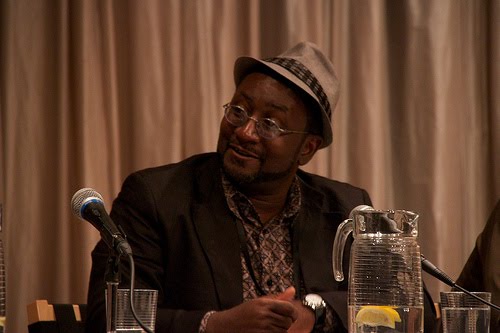
© PEN American Center/Susan Horgan. All rights reserved. Please contact media@pen.org for usage and rights.
January 17, 2008


January 15, 2008
Do Gamblers Really Commit Suicide?
"Preston,
I must tell you that your book is good but also very scary. Not to take anything away from your skills as a writer and storyteller, but I enjoyed the book especially because of what I learned about the gambling lifestyle as I have many friends who are gamblers or love going to the casino and the dog track.
When reading a book of fiction, however, it is sometimes difficult to tell what is real and what is made up by the writer. Do gamblers really commit suicide a lot? Thanks, a fan."
Oh boy. Gamblers committing suicide. Groan. This is the big one.
Thanks for the question, fan, but I have to admit that this is a serious subject with which I have firsthand experience, but limited knowledge.
Sadly, I must tell you, it does happen.
This is the one aspect of gambling that I don't like talking about, though, as you know, I addressed it in the novel, ALL OR NOTHING.
I find it much easier to handle in the medium of fiction.
One day I will be courageous enough to write a non-fiction piece about it.
I have seen enough of that to make me sick for life. See, because of your addiction you sink so low in self esteem and debt (my god the astronomical debt!) that the only way out for you is a big, big mega-impossible win or . . . suicide. You just get so tired you don't want to fight anymore. You get tired of struggling, and lying, and hiding, and hoping, and being disappointed, and cheating, and stealing, and doing other stupid, sleazy, selfish shit to the people you love, and hiding under that mountain of lies just waiting for the day when it all comes crashing down and you get arrested or evicted and then everybody knows.
Sometimes we could tell that someone we knew was going to do it. They would go awol from the GA meetings for the last couple of weeks, you would see them banging their last meager pennies at the casino for the last couple of weeks, they would be playing the really expensive games with the really high jackpots, the mega-impossible jackpots, and you would be praying, just praying, that they win. Come on, Lord, let him win. Of course, they would lose. Then they would disappear and we would hear at the next GA meeting that so-and-so couldn't take it anymore and shot himself. Slit her wrists. Jumped in front of traffic. Drank rat poison. But we knew already. We knew already. And there wasn't shit we could do about it because we were so close to making that same fateful decision. Every day eyeing that mega-impossible jackpot machine as we walked past it. The machine that never wins. The machine that would fix everything if it would just win.
Yeah, suicide--all kidding aside, this is one of the main reasons you should demand that any gambler you know and love seek help immediately for his/her addiction.
And here is the big lie I told in the book. Gambles don't go to each other's funerals; Gamblers play poker for their dead.
On the website Getting Past Gambling ( http://www.gettingpastgambling.com/ )there is a great explanation of why it happens. I will cut and paste the brief, though pertinent passage from that essay here.
"Gambling addiction has one of the highest suicide rates of all addictions and this is partially due to the nature of the consequences.
With most addictions, the addict can lose everything he had, his family, his job, his self-respect, he can take himself down to having nothing left, zero, zip, nada.
However, the gambling addict may have lost all of those things, but his aftermath doesn't stop merely at zero.
The gambler may have lost his family, job, self-respect AND may be thousands, tens of thousands or hundreds of thousands of dollars in debt and the only way he knows of to get out of debt is........(insert drum roll) ....................to gamble and win the big one.
When the alcoholic quits drinking, he picks up the pieces and moves on, but the gambler may be faced with overwhelming debt that he cannot see a way out of when he quits gambling.
Don't despair, many gambling addicts make it through, quit gambling and move on with their lives, but as with any other addiction it can be a life time struggle both for the gambler and the people who love them."
Copyright 2007 All material remains the property of the author http://www.oagaa.org/html/who_is_this_person_.htm posted by LindaH @ 10:49 PM
Thanks,
Preston
I must tell you that your book is good but also very scary. Not to take anything away from your skills as a writer and storyteller, but I enjoyed the book especially because of what I learned about the gambling lifestyle as I have many friends who are gamblers or love going to the casino and the dog track.
When reading a book of fiction, however, it is sometimes difficult to tell what is real and what is made up by the writer. Do gamblers really commit suicide a lot? Thanks, a fan."
Oh boy. Gamblers committing suicide. Groan. This is the big one.
Thanks for the question, fan, but I have to admit that this is a serious subject with which I have firsthand experience, but limited knowledge.
Sadly, I must tell you, it does happen.
This is the one aspect of gambling that I don't like talking about, though, as you know, I addressed it in the novel, ALL OR NOTHING.
I find it much easier to handle in the medium of fiction.
One day I will be courageous enough to write a non-fiction piece about it.
I have seen enough of that to make me sick for life. See, because of your addiction you sink so low in self esteem and debt (my god the astronomical debt!) that the only way out for you is a big, big mega-impossible win or . . . suicide. You just get so tired you don't want to fight anymore. You get tired of struggling, and lying, and hiding, and hoping, and being disappointed, and cheating, and stealing, and doing other stupid, sleazy, selfish shit to the people you love, and hiding under that mountain of lies just waiting for the day when it all comes crashing down and you get arrested or evicted and then everybody knows.
Sometimes we could tell that someone we knew was going to do it. They would go awol from the GA meetings for the last couple of weeks, you would see them banging their last meager pennies at the casino for the last couple of weeks, they would be playing the really expensive games with the really high jackpots, the mega-impossible jackpots, and you would be praying, just praying, that they win. Come on, Lord, let him win. Of course, they would lose. Then they would disappear and we would hear at the next GA meeting that so-and-so couldn't take it anymore and shot himself. Slit her wrists. Jumped in front of traffic. Drank rat poison. But we knew already. We knew already. And there wasn't shit we could do about it because we were so close to making that same fateful decision. Every day eyeing that mega-impossible jackpot machine as we walked past it. The machine that never wins. The machine that would fix everything if it would just win.
Yeah, suicide--all kidding aside, this is one of the main reasons you should demand that any gambler you know and love seek help immediately for his/her addiction.
And here is the big lie I told in the book. Gambles don't go to each other's funerals; Gamblers play poker for their dead.
On the website Getting Past Gambling ( http://www.gettingpastgambling.com/ )there is a great explanation of why it happens. I will cut and paste the brief, though pertinent passage from that essay here.
"Gambling addiction has one of the highest suicide rates of all addictions and this is partially due to the nature of the consequences.
With most addictions, the addict can lose everything he had, his family, his job, his self-respect, he can take himself down to having nothing left, zero, zip, nada.
However, the gambling addict may have lost all of those things, but his aftermath doesn't stop merely at zero.
The gambler may have lost his family, job, self-respect AND may be thousands, tens of thousands or hundreds of thousands of dollars in debt and the only way he knows of to get out of debt is........(insert drum roll) ....................to gamble and win the big one.
When the alcoholic quits drinking, he picks up the pieces and moves on, but the gambler may be faced with overwhelming debt that he cannot see a way out of when he quits gambling.
Don't despair, many gambling addicts make it through, quit gambling and move on with their lives, but as with any other addiction it can be a life time struggle both for the gambler and the people who love them."
Copyright 2007 All material remains the property of the author http://www.oagaa.org/html/who_is_this_person_.htm posted by LindaH @ 10:49 PM
Thanks,
Preston
My Friend Juan
"Preston,
There are very few books that I cannot put down once I have picked them up. I devour textbooks (engineering . . . I know, I know . . . I love numbers but in another way, not like P), but novels, or sci-fi etc., well that’s another story.
When I got ANGELS AND DEMONS, I did not sleep for 2 days until I finished it, then came DA VINCI CODE . . . the same thing happened to me with the Dr. Alex Cross novels (James Patterson’s string of books).
But man . . . I did not sleep last night reading your book. You have gotten me hooked on it, I am almost at the end . . . I have come to hate you, but love you at the same time.
Without further ado,
AWESOME STORY DUDE!!!!
Your friend Juan V."
Thanks, Juan. Your email made my day. I am honored to have written something that you would mention in the same breath as Brown's Da Vinci Code and Patterson's Alex Cross books. Here's to hoping that ALL OR NOTHING continues its success and reaches the status of those authors' novels. Pass the book on to a friend. Write a review on Amazon. See you at work tomorrow, dude.
I owe you lunch.
Thanks,
Preston
There are very few books that I cannot put down once I have picked them up. I devour textbooks (engineering . . . I know, I know . . . I love numbers but in another way, not like P), but novels, or sci-fi etc., well that’s another story.
When I got ANGELS AND DEMONS, I did not sleep for 2 days until I finished it, then came DA VINCI CODE . . . the same thing happened to me with the Dr. Alex Cross novels (James Patterson’s string of books).
But man . . . I did not sleep last night reading your book. You have gotten me hooked on it, I am almost at the end . . . I have come to hate you, but love you at the same time.
Without further ado,
AWESOME STORY DUDE!!!!
Your friend Juan V."
Thanks, Juan. Your email made my day. I am honored to have written something that you would mention in the same breath as Brown's Da Vinci Code and Patterson's Alex Cross books. Here's to hoping that ALL OR NOTHING continues its success and reaches the status of those authors' novels. Pass the book on to a friend. Write a review on Amazon. See you at work tomorrow, dude.
I owe you lunch.
Thanks,
Preston
January 10, 2008
Your Book Is Humorous
"I agree with the reviewer from Foreward Magazine who said 'ALL OR NOTHING is funny, relentless, haunting, and highly readable.' I am half way through the first half and it is cracking me up. Some fairly dark deeds are being done, but I can't help but laugh at times. It takes nothing away from the seriousness of the subject matter, your tone, and in fact makes P and his plight more endearing to the reader. I am rooting for him, though I do not suspect it will turn out all right. I am tempted to skip to the end to find out. How does a writer write seriously but humorously at the same time?"
Thanks for the question.
I used to think I knew the answer to that question, but now I am not so sure that I am right.
I used to think that a sense of humor was innate in some of us, a talent some of us had, and I had it, oh lucky class clown me . . . now upon reflection, I suspect that the watching in my youth of self-deprecating comedians--such as Woody Allen (at one extreme) and Richard Pryor (at the other)--coupled with a freshman composition instructor who had us read Ken Macrorie's textbook TELLING WRITING, in which he emphasized the jotting down of "fabulous realities," might have had something to do with it.
The collecting of fabulous realities was an excellent exercise for a young writer such as I. I don't remember exactly how it was done, but I think we were told to go out and "see" the truth in things and then to create a list of them, written down honestly and without adornment. When we read them to the class, there were many that got oohs and ahs and occasional titters of laughter.
I began to see that truth, though it made us uncomfortable, was funny.
I also learned that trying too hard to be funny, unless you were very good at it (which I was not), almost never made anyone laugh.
It was an important lesson for me. Though people often laugh at the situations my characters find themselves in, I NEVER try to be funny. I just try to be honest.
This is what the best comedians know: the truth of the human condition is . . . funny.
Great question! (I guess that means I like my answer to it.)
Thanks.
Preston
Thanks for the question.
I used to think I knew the answer to that question, but now I am not so sure that I am right.
I used to think that a sense of humor was innate in some of us, a talent some of us had, and I had it, oh lucky class clown me . . . now upon reflection, I suspect that the watching in my youth of self-deprecating comedians--such as Woody Allen (at one extreme) and Richard Pryor (at the other)--coupled with a freshman composition instructor who had us read Ken Macrorie's textbook TELLING WRITING, in which he emphasized the jotting down of "fabulous realities," might have had something to do with it.
The collecting of fabulous realities was an excellent exercise for a young writer such as I. I don't remember exactly how it was done, but I think we were told to go out and "see" the truth in things and then to create a list of them, written down honestly and without adornment. When we read them to the class, there were many that got oohs and ahs and occasional titters of laughter.
I began to see that truth, though it made us uncomfortable, was funny.
I also learned that trying too hard to be funny, unless you were very good at it (which I was not), almost never made anyone laugh.
It was an important lesson for me. Though people often laugh at the situations my characters find themselves in, I NEVER try to be funny. I just try to be honest.
This is what the best comedians know: the truth of the human condition is . . . funny.
Great question! (I guess that means I like my answer to it.)
Thanks.
Preston
My Friend's Agent
"First I have a suggestion/comment about your book and then I have a question. The last time I asked you that question about the character named 'U,' you made a good point about not analyzing your own characters because it ruins it for the reader. However, this time I am going to make a suggestion. In your novel, the character 'U' is arguing that gambling is not an addiction it is more like baseball and chess like the examples he gives. I don't know if I agree with him or with P, who says that it is an addiction because there are many professionals such as 'U' who play poker as a sport and don't seem to be addicted to poker anymore than baseball players are to baseball. For them it is a profession. Do you agree with 'P' or with 'U'?
Second, I have a friend/associate who has an agent that helped him to sell his book. I have a self-published book that is selling decently online and I am seeking an agent so that I can sell it to a major publiser. I have hinted to my 'friend' several times to put in a good word for me with his agent but he has never done so always making excuses about how busy she (the agent) is every time I bring it up. Is he trying to say that he thinks my book is not good enough for his agent? Thanks, a writer/reader."
Okay, let's take the easy question first.
I agree with both P and U. I believe that gambling is an addiction and very, very few people who play it at that high level are free from its addictive powers, despite what they may believe about themselves as professionals.
Poker, a form of gambling, is similar to baseball (or any sport) in that it is a game that must be learned, can be mastered, and it can be played at a professional levels by professionals.
The difference between poker and professional baseball is that a gambler uses his own money--baseball players, and other athletes, are paid to play. If they lose a game of baseball, they still earn a paycheck . . .
If a boxer loses a match, he is still paid . . . if a boxer puts up his own money, betting on himself to win, and he loses, not only does he go home with a bruised nose and ego, but with a bruised bank account.
If they extend the concept of poker leagues that pay professional poker players to compete with each other for the viewing pleasure of others, then that type of poker playing will be different from gambling and similar to what we see in professional sports.
If Tom Brady announces to Peyton Manning, "I will win a Super Bowl this year." That is a prediction. But if Tom Brady says, "I will win a Super Bowl this year, and I will put up my salary this year against Peyton Manning's salary this year to back it up." That is gambling.
Big difference.
And Tom Brady loses either way. If he does not win a Super Bowl, he has to fork over his salary to Peyton Manning. If he wins a Super Bowl and wins the bet, taking Peyton Manning's salary, then he gets hooked on that feeling and becomes a gambler. In a few years he will be broke making those kinds of bets.
Your second question. Some writers, for whatever reason, tend to be jealous of their agents, and unless they really like your book and think you are talented and can trust you not to steal their agent's attention away from them, then they will give your their agent's info and put in a good word for you. A writer who does that for you is showing a great deal of confidence in you.
A great deal.
Thanks,
Preston
Second, I have a friend/associate who has an agent that helped him to sell his book. I have a self-published book that is selling decently online and I am seeking an agent so that I can sell it to a major publiser. I have hinted to my 'friend' several times to put in a good word for me with his agent but he has never done so always making excuses about how busy she (the agent) is every time I bring it up. Is he trying to say that he thinks my book is not good enough for his agent? Thanks, a writer/reader."
Okay, let's take the easy question first.
I agree with both P and U. I believe that gambling is an addiction and very, very few people who play it at that high level are free from its addictive powers, despite what they may believe about themselves as professionals.
Poker, a form of gambling, is similar to baseball (or any sport) in that it is a game that must be learned, can be mastered, and it can be played at a professional levels by professionals.
The difference between poker and professional baseball is that a gambler uses his own money--baseball players, and other athletes, are paid to play. If they lose a game of baseball, they still earn a paycheck . . .
If a boxer loses a match, he is still paid . . . if a boxer puts up his own money, betting on himself to win, and he loses, not only does he go home with a bruised nose and ego, but with a bruised bank account.
If they extend the concept of poker leagues that pay professional poker players to compete with each other for the viewing pleasure of others, then that type of poker playing will be different from gambling and similar to what we see in professional sports.
If Tom Brady announces to Peyton Manning, "I will win a Super Bowl this year." That is a prediction. But if Tom Brady says, "I will win a Super Bowl this year, and I will put up my salary this year against Peyton Manning's salary this year to back it up." That is gambling.
Big difference.
And Tom Brady loses either way. If he does not win a Super Bowl, he has to fork over his salary to Peyton Manning. If he wins a Super Bowl and wins the bet, taking Peyton Manning's salary, then he gets hooked on that feeling and becomes a gambler. In a few years he will be broke making those kinds of bets.
Your second question. Some writers, for whatever reason, tend to be jealous of their agents, and unless they really like your book and think you are talented and can trust you not to steal their agent's attention away from them, then they will give your their agent's info and put in a good word for you. A writer who does that for you is showing a great deal of confidence in you.
A great deal.
Thanks,
Preston
January 8, 2008
A Character in Your Novel
"I am enjoying the book so far. I just finished the CORINTHIANS Chapter and I had to email you to tell you how excellent that part is. As a religious man myself, I completely get it--the title of the chapter and all.
I noticed that the gamblers in your book seem to represent many levels and many types of addiction; however, the gambler you named 'U' stands out from the rest as being not so depraved. What if anything does 'U' represent or symbolize? I did not miss the fact that his name is 'U'."
Thanks for sending me the email. The CORINTHIANS chapter is special for me, too. In some ways gambling becomes a gambler's religion: the devotion, the belief system, the hope, the sacrifice. But gambling offers the gambler a false covenant and transforms him in ways that are the exact opposite of that postulated by Paul about love (charity) in that famous section in the Corinthians.
As concerns U . . . U is the successful gambling celebrity. He does everything right. He makes it seem easy, but he works hard at it. Harder than you. He too is quietly suffering from the effects of his addiction, and you choose not to notice the suffering because you want to be U. But you can never be U. You are in too deep.
Wow that was deep. What did I just say? It sounded kinda good. I have no idea what I just said. I hope it makes sense to you or to any future literary scholars interested in deconstructing the novel for their students. If a student of mine had written what I just said, I would have given him a B, okay a B+. It is a good answer. But not the only answer.
In truth, I am uncomfortable with literary questions like this. I'm just a writer. I just tell the story; you the reader have to decide for yourself what it all means. And when it comes down to who is right, me the writer or you the reader, well, of course the reader is always right.
A writer, because of her implied, but false authority, ruins the story if she establishes set explanations for things.
The story exists in your head. It is now your story. So what, it differs from mine just a little bit.
I will gladly discuss the symbolism in someone else's book, but not my own. I am the writer. I don't want to ruin what it means for you.
On the other hand, I am very interested in listening to others discuss the book, or sharing with me their opinions of things in the book. In fact, I am honored by it.
(Joyce Carol Oates once responded in like kind to a question about her famous story "WHERE ARE YOU GOING WHERE HAVE YOU BEEN." If anyone can find her well articulated response to a student who was asking her to analyze her own story and to comment on his analysis of it, please email it to me prestonthewriterallen@gmail.com so that I can link it to the blog.)
Thanks,
Preston
I noticed that the gamblers in your book seem to represent many levels and many types of addiction; however, the gambler you named 'U' stands out from the rest as being not so depraved. What if anything does 'U' represent or symbolize? I did not miss the fact that his name is 'U'."
Thanks for sending me the email. The CORINTHIANS chapter is special for me, too. In some ways gambling becomes a gambler's religion: the devotion, the belief system, the hope, the sacrifice. But gambling offers the gambler a false covenant and transforms him in ways that are the exact opposite of that postulated by Paul about love (charity) in that famous section in the Corinthians.
As concerns U . . . U is the successful gambling celebrity. He does everything right. He makes it seem easy, but he works hard at it. Harder than you. He too is quietly suffering from the effects of his addiction, and you choose not to notice the suffering because you want to be U. But you can never be U. You are in too deep.
Wow that was deep. What did I just say? It sounded kinda good. I have no idea what I just said. I hope it makes sense to you or to any future literary scholars interested in deconstructing the novel for their students. If a student of mine had written what I just said, I would have given him a B, okay a B+. It is a good answer. But not the only answer.
In truth, I am uncomfortable with literary questions like this. I'm just a writer. I just tell the story; you the reader have to decide for yourself what it all means. And when it comes down to who is right, me the writer or you the reader, well, of course the reader is always right.
A writer, because of her implied, but false authority, ruins the story if she establishes set explanations for things.
The story exists in your head. It is now your story. So what, it differs from mine just a little bit.
I will gladly discuss the symbolism in someone else's book, but not my own. I am the writer. I don't want to ruin what it means for you.
On the other hand, I am very interested in listening to others discuss the book, or sharing with me their opinions of things in the book. In fact, I am honored by it.
(Joyce Carol Oates once responded in like kind to a question about her famous story "WHERE ARE YOU GOING WHERE HAVE YOU BEEN." If anyone can find her well articulated response to a student who was asking her to analyze her own story and to comment on his analysis of it, please email it to me prestonthewriterallen@gmail.com so that I can link it to the blog.)
Thanks,
Preston
January 7, 2008
Do Agents Charge a Fee?
"Preston, good job on the blog. Here's my question. Do agents charge a fee for reading? Young writer."
Thanks for the question, young writer. No. From my experience agents do not charge a fee. Some of the smaller houses may charge a small sum at the beginning for postage and even this is rare.
Agents make their money in the commission they earn from your book (about 15%). If an agent feels that he/she can make money from your book, then they will represent you. If they feel they cannot make a sale from your book, then they will not sign you.
Think about it. If an agent could make $100 for reading your book, he/she would never really need to make a sale. Why? There are so many people out there with books . . . all the agent has to do is sign, say, 500 people at $100 a pop, and he/she has just earned fifty grand, and believe me with the number of unpublished writers out there it would be a piece of cake to sign 500 clients.
Trying to sell their books would not seem a very profitable venture compared to that easy hundred.
Thanks,
Preston
Thanks for the question, young writer. No. From my experience agents do not charge a fee. Some of the smaller houses may charge a small sum at the beginning for postage and even this is rare.
Agents make their money in the commission they earn from your book (about 15%). If an agent feels that he/she can make money from your book, then they will represent you. If they feel they cannot make a sale from your book, then they will not sign you.
Think about it. If an agent could make $100 for reading your book, he/she would never really need to make a sale. Why? There are so many people out there with books . . . all the agent has to do is sign, say, 500 people at $100 a pop, and he/she has just earned fifty grand, and believe me with the number of unpublished writers out there it would be a piece of cake to sign 500 clients.
Trying to sell their books would not seem a very profitable venture compared to that easy hundred.
Thanks,
Preston
Why Can't You Stop Gambling on Your Own?
"My b/f is just like the gamblers in your novel, especially P. He has stopped gambling many times and then gone right back to it. Why do you think a gambler just can't quit when he really means it and says he is going to quit?"
Thanks,
I'm sorry to hear about your b/f, but you would have to ask a professional that question for the best answer. I am just a novelist and, unfortunately, a gambler myself. I do not go to the casino anymore, but I think about it every day. EVERY day.
GA helped me to get a grip on the behavior, and so did my love for my family and the things that I would potentially destroy if I continued to go. The fact that I am a control freak probably helped too--I did not like the fact that I was being controlled by an external force. But every day that passes I see a number combination that tugs at my "intuition," and I get this urge to play it on the slots.
One of the things I have learned through my experiences and from the gamblers I know is that gambling is fun. Gambling is a thrill. Gambling is an opportunity for good things to come. With gambling, anything is possible. Gambling is like childhood all over again. You know, like when you were a child--it seemed like anything was possible. In a casino, it seems like anything is possible. And it is. If you're lucky.
I was at a casino in the middle of the night playing poker and one of the regulars asked if I could give him a lift home. He had no car and he had, as was his habit, arrived there on foot. Sure, I told him.
But there was no need to do that. He hit a royal flush jackpot at our table for $25,000. They paid him off in the manner he requested: $10,000 in cash and the rest in check. He waited for the sun to come up and walked across the street to the car dealership, bought a spiffy little Toyota (in cash!), and drove himself home.
Wow. Anything is possible we all said, watching.
A dealer we all knew and loved started annoying us with his complaints about the way he was being treated at the casino by management: shorting him on his hours, giving others with less seniority preferential treatment, over-criticizing the few mistakes he made while dealing (he was one of the best--he rarely made mistakes dealing).
Then he disappeared, and a few weeks passed before we saw him again. This time he was there as a player. I was at the table with him as he was telling everyone about what had happened: He won half a million dollars on the slots at one of the other local casinos and he quit his job the next day.
Wow. Anything is possible.
Stuff like that happens in casinos all the time. People hit amazing amounts of money that change their lives. They can quit their jobs, they can buy a new car, a new house. I have seen it. No problem is too big that the casino can't solve, it seems.
And maybe that is the problem. See, once people like your b/f get so deep in debt from their indiscriminate gambling, the only place they can go and not feel bad about their desperate situation is, believe it or not, the casino. Because the casino, if they hit it big, represents the solution to the finanacial hole that they are buried up to their eyeballs in.
As long as there is a casino, there is a hope that they can get out of their misery.
And it is at times like these that they conveniently forget the impossible odds they have to overcome in order to win, and most of all they forget that it is the casino that has put them in their misery in the first place.
They just keep pressing PLAY and wishing like children on a star.
Anything is possible.
Anything is possible.
Anything is possible--except for quitting gambling, no matter how strong you think you are.
Thanks,
Preston
Thanks,
I'm sorry to hear about your b/f, but you would have to ask a professional that question for the best answer. I am just a novelist and, unfortunately, a gambler myself. I do not go to the casino anymore, but I think about it every day. EVERY day.
GA helped me to get a grip on the behavior, and so did my love for my family and the things that I would potentially destroy if I continued to go. The fact that I am a control freak probably helped too--I did not like the fact that I was being controlled by an external force. But every day that passes I see a number combination that tugs at my "intuition," and I get this urge to play it on the slots.
One of the things I have learned through my experiences and from the gamblers I know is that gambling is fun. Gambling is a thrill. Gambling is an opportunity for good things to come. With gambling, anything is possible. Gambling is like childhood all over again. You know, like when you were a child--it seemed like anything was possible. In a casino, it seems like anything is possible. And it is. If you're lucky.
I was at a casino in the middle of the night playing poker and one of the regulars asked if I could give him a lift home. He had no car and he had, as was his habit, arrived there on foot. Sure, I told him.
But there was no need to do that. He hit a royal flush jackpot at our table for $25,000. They paid him off in the manner he requested: $10,000 in cash and the rest in check. He waited for the sun to come up and walked across the street to the car dealership, bought a spiffy little Toyota (in cash!), and drove himself home.
Wow. Anything is possible we all said, watching.
A dealer we all knew and loved started annoying us with his complaints about the way he was being treated at the casino by management: shorting him on his hours, giving others with less seniority preferential treatment, over-criticizing the few mistakes he made while dealing (he was one of the best--he rarely made mistakes dealing).
Then he disappeared, and a few weeks passed before we saw him again. This time he was there as a player. I was at the table with him as he was telling everyone about what had happened: He won half a million dollars on the slots at one of the other local casinos and he quit his job the next day.
Wow. Anything is possible.
Stuff like that happens in casinos all the time. People hit amazing amounts of money that change their lives. They can quit their jobs, they can buy a new car, a new house. I have seen it. No problem is too big that the casino can't solve, it seems.
And maybe that is the problem. See, once people like your b/f get so deep in debt from their indiscriminate gambling, the only place they can go and not feel bad about their desperate situation is, believe it or not, the casino. Because the casino, if they hit it big, represents the solution to the finanacial hole that they are buried up to their eyeballs in.
As long as there is a casino, there is a hope that they can get out of their misery.
And it is at times like these that they conveniently forget the impossible odds they have to overcome in order to win, and most of all they forget that it is the casino that has put them in their misery in the first place.
They just keep pressing PLAY and wishing like children on a star.
Anything is possible.
Anything is possible.
Anything is possible--except for quitting gambling, no matter how strong you think you are.
Thanks,
Preston
January 6, 2008
I Love the Degenerate P
"I just finished ALL OR NOTHING and could not wait to write a review for it on Amazon.com, which I did, and to contact you to ask a couple questions.
First of all, I think it is a great book, I have never read anything like it and I do not see how you would be able to write a sequel. You covered all angles in the first book.
Second, P. I love P. Why? What is your formula to make this otherwise vile character so endearing to the reader?"
Thanks for the questions. Hmmm. Okay, the sequel deals with P's son, and while I did cover pretty much the entire spectrum of addiction in the first book, I am a writer who loves to explore character and there are layers and layers of P's son's character that merit exploring. While P was a poor bus driver born in the early sixites, this son is a young, good-looking athlete coming of age in present day . . . note also that this is the age of online gambling . . . and P's wife now becomes the MOTHER of a gambler . . . and the kid is . . . lucky.
And Question # 2. I have no formula for making P lovable, except that I withhold judgment and allow you to experience him the way the characters in the story experience him--he is truly a nice guy, that is not fake, and so you will like him as they like him.
So if there is a formula to creating likable charatcers, then it is this: State the facts without bias or adornment, let the character be on the page who he is.
Thanks,
Preston
First of all, I think it is a great book, I have never read anything like it and I do not see how you would be able to write a sequel. You covered all angles in the first book.
Second, P. I love P. Why? What is your formula to make this otherwise vile character so endearing to the reader?"
Thanks for the questions. Hmmm. Okay, the sequel deals with P's son, and while I did cover pretty much the entire spectrum of addiction in the first book, I am a writer who loves to explore character and there are layers and layers of P's son's character that merit exploring. While P was a poor bus driver born in the early sixites, this son is a young, good-looking athlete coming of age in present day . . . note also that this is the age of online gambling . . . and P's wife now becomes the MOTHER of a gambler . . . and the kid is . . . lucky.
And Question # 2. I have no formula for making P lovable, except that I withhold judgment and allow you to experience him the way the characters in the story experience him--he is truly a nice guy, that is not fake, and so you will like him as they like him.
So if there is a formula to creating likable charatcers, then it is this: State the facts without bias or adornment, let the character be on the page who he is.
Thanks,
Preston
What Is Your Favorite John Cheever Story?
"Preston,
I see that you like John Cheever. I am also a fan of John Cheever! What is your favorite John Cheever story? My favorite is THE CHASTE CLARISSA."
Easy question. I admire John Cheever's body of work--my favorite story of his is THE COUNTRY HUSBAND, which resonated for me way back when. Though I was not a quietly suffering yankee suburbanite of manners, I was quietly suffering. I liked the story so much that I retyped the first five pages of it as practice--then I wrote my first Elwyn and Sister Morrisohn story using the identical sentence pattern of that story--then I wrote a poem based on it.
Then, like Francis Weed in the story, I tried to sleep with the babysitter.
I did not succeed.
Preston
I see that you like John Cheever. I am also a fan of John Cheever! What is your favorite John Cheever story? My favorite is THE CHASTE CLARISSA."
Easy question. I admire John Cheever's body of work--my favorite story of his is THE COUNTRY HUSBAND, which resonated for me way back when. Though I was not a quietly suffering yankee suburbanite of manners, I was quietly suffering. I liked the story so much that I retyped the first five pages of it as practice--then I wrote my first Elwyn and Sister Morrisohn story using the identical sentence pattern of that story--then I wrote a poem based on it.
Then, like Francis Weed in the story, I tried to sleep with the babysitter.
I did not succeed.
Preston
Subscribe to:
Posts (Atom)