"I am enjoying the book so far. I just finished the CORINTHIANS Chapter and I had to email you to tell you how excellent that part is. As a religious man myself, I completely get it--the title of the chapter and all.
I noticed that the gamblers in your book seem to represent many levels and many types of addiction; however, the gambler you named 'U' stands out from the rest as being not so depraved. What if anything does 'U' represent or symbolize? I did not miss the fact that his name is 'U'."
Thanks for sending me the email. The CORINTHIANS chapter is special for me, too. In some ways gambling becomes a gambler's religion: the devotion, the belief system, the hope, the sacrifice. But gambling offers the gambler a false covenant and transforms him in ways that are the exact opposite of that postulated by Paul about love (charity) in that famous section in the Corinthians.
As concerns U . . . U is the successful gambling celebrity. He does everything right. He makes it seem easy, but he works hard at it. Harder than you. He too is quietly suffering from the effects of his addiction, and you choose not to notice the suffering because you want to be U. But you can never be U. You are in too deep.
Wow that was deep. What did I just say? It sounded kinda good. I have no idea what I just said. I hope it makes sense to you or to any future literary scholars interested in deconstructing the novel for their students. If a student of mine had written what I just said, I would have given him a B, okay a B+. It is a good answer. But not the only answer.
In truth, I am uncomfortable with literary questions like this. I'm just a writer. I just tell the story; you the reader have to decide for yourself what it all means. And when it comes down to who is right, me the writer or you the reader, well, of course the reader is always right.
A writer, because of her implied, but false authority, ruins the story if she establishes set explanations for things.
The story exists in your head. It is now your story. So what, it differs from mine just a little bit.
I will gladly discuss the symbolism in someone else's book, but not my own. I am the writer. I don't want to ruin what it means for you.
On the other hand, I am very interested in listening to others discuss the book, or sharing with me their opinions of things in the book. In fact, I am honored by it.
(Joyce Carol Oates once responded in like kind to a question about her famous story "WHERE ARE YOU GOING WHERE HAVE YOU BEEN." If anyone can find her well articulated response to a student who was asking her to analyze her own story and to comment on his analysis of it, please email it to me prestonthewriterallen@gmail.com so that I can link it to the blog.)
Thanks,
Preston
At the Pen Festival 2010
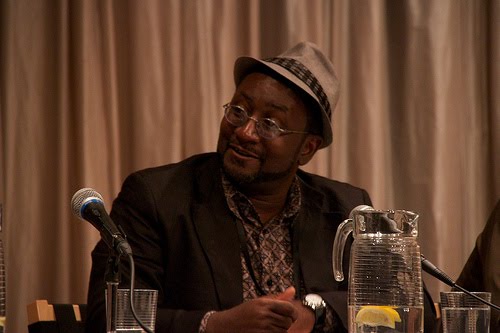
© PEN American Center/Susan Horgan. All rights reserved. Please contact media@pen.org for usage and rights.
January 8, 2008


January 7, 2008
Do Agents Charge a Fee?
"Preston, good job on the blog. Here's my question. Do agents charge a fee for reading? Young writer."
Thanks for the question, young writer. No. From my experience agents do not charge a fee. Some of the smaller houses may charge a small sum at the beginning for postage and even this is rare.
Agents make their money in the commission they earn from your book (about 15%). If an agent feels that he/she can make money from your book, then they will represent you. If they feel they cannot make a sale from your book, then they will not sign you.
Think about it. If an agent could make $100 for reading your book, he/she would never really need to make a sale. Why? There are so many people out there with books . . . all the agent has to do is sign, say, 500 people at $100 a pop, and he/she has just earned fifty grand, and believe me with the number of unpublished writers out there it would be a piece of cake to sign 500 clients.
Trying to sell their books would not seem a very profitable venture compared to that easy hundred.
Thanks,
Preston
Thanks for the question, young writer. No. From my experience agents do not charge a fee. Some of the smaller houses may charge a small sum at the beginning for postage and even this is rare.
Agents make their money in the commission they earn from your book (about 15%). If an agent feels that he/she can make money from your book, then they will represent you. If they feel they cannot make a sale from your book, then they will not sign you.
Think about it. If an agent could make $100 for reading your book, he/she would never really need to make a sale. Why? There are so many people out there with books . . . all the agent has to do is sign, say, 500 people at $100 a pop, and he/she has just earned fifty grand, and believe me with the number of unpublished writers out there it would be a piece of cake to sign 500 clients.
Trying to sell their books would not seem a very profitable venture compared to that easy hundred.
Thanks,
Preston
Why Can't You Stop Gambling on Your Own?
"My b/f is just like the gamblers in your novel, especially P. He has stopped gambling many times and then gone right back to it. Why do you think a gambler just can't quit when he really means it and says he is going to quit?"
Thanks,
I'm sorry to hear about your b/f, but you would have to ask a professional that question for the best answer. I am just a novelist and, unfortunately, a gambler myself. I do not go to the casino anymore, but I think about it every day. EVERY day.
GA helped me to get a grip on the behavior, and so did my love for my family and the things that I would potentially destroy if I continued to go. The fact that I am a control freak probably helped too--I did not like the fact that I was being controlled by an external force. But every day that passes I see a number combination that tugs at my "intuition," and I get this urge to play it on the slots.
One of the things I have learned through my experiences and from the gamblers I know is that gambling is fun. Gambling is a thrill. Gambling is an opportunity for good things to come. With gambling, anything is possible. Gambling is like childhood all over again. You know, like when you were a child--it seemed like anything was possible. In a casino, it seems like anything is possible. And it is. If you're lucky.
I was at a casino in the middle of the night playing poker and one of the regulars asked if I could give him a lift home. He had no car and he had, as was his habit, arrived there on foot. Sure, I told him.
But there was no need to do that. He hit a royal flush jackpot at our table for $25,000. They paid him off in the manner he requested: $10,000 in cash and the rest in check. He waited for the sun to come up and walked across the street to the car dealership, bought a spiffy little Toyota (in cash!), and drove himself home.
Wow. Anything is possible we all said, watching.
A dealer we all knew and loved started annoying us with his complaints about the way he was being treated at the casino by management: shorting him on his hours, giving others with less seniority preferential treatment, over-criticizing the few mistakes he made while dealing (he was one of the best--he rarely made mistakes dealing).
Then he disappeared, and a few weeks passed before we saw him again. This time he was there as a player. I was at the table with him as he was telling everyone about what had happened: He won half a million dollars on the slots at one of the other local casinos and he quit his job the next day.
Wow. Anything is possible.
Stuff like that happens in casinos all the time. People hit amazing amounts of money that change their lives. They can quit their jobs, they can buy a new car, a new house. I have seen it. No problem is too big that the casino can't solve, it seems.
And maybe that is the problem. See, once people like your b/f get so deep in debt from their indiscriminate gambling, the only place they can go and not feel bad about their desperate situation is, believe it or not, the casino. Because the casino, if they hit it big, represents the solution to the finanacial hole that they are buried up to their eyeballs in.
As long as there is a casino, there is a hope that they can get out of their misery.
And it is at times like these that they conveniently forget the impossible odds they have to overcome in order to win, and most of all they forget that it is the casino that has put them in their misery in the first place.
They just keep pressing PLAY and wishing like children on a star.
Anything is possible.
Anything is possible.
Anything is possible--except for quitting gambling, no matter how strong you think you are.
Thanks,
Preston
Thanks,
I'm sorry to hear about your b/f, but you would have to ask a professional that question for the best answer. I am just a novelist and, unfortunately, a gambler myself. I do not go to the casino anymore, but I think about it every day. EVERY day.
GA helped me to get a grip on the behavior, and so did my love for my family and the things that I would potentially destroy if I continued to go. The fact that I am a control freak probably helped too--I did not like the fact that I was being controlled by an external force. But every day that passes I see a number combination that tugs at my "intuition," and I get this urge to play it on the slots.
One of the things I have learned through my experiences and from the gamblers I know is that gambling is fun. Gambling is a thrill. Gambling is an opportunity for good things to come. With gambling, anything is possible. Gambling is like childhood all over again. You know, like when you were a child--it seemed like anything was possible. In a casino, it seems like anything is possible. And it is. If you're lucky.
I was at a casino in the middle of the night playing poker and one of the regulars asked if I could give him a lift home. He had no car and he had, as was his habit, arrived there on foot. Sure, I told him.
But there was no need to do that. He hit a royal flush jackpot at our table for $25,000. They paid him off in the manner he requested: $10,000 in cash and the rest in check. He waited for the sun to come up and walked across the street to the car dealership, bought a spiffy little Toyota (in cash!), and drove himself home.
Wow. Anything is possible we all said, watching.
A dealer we all knew and loved started annoying us with his complaints about the way he was being treated at the casino by management: shorting him on his hours, giving others with less seniority preferential treatment, over-criticizing the few mistakes he made while dealing (he was one of the best--he rarely made mistakes dealing).
Then he disappeared, and a few weeks passed before we saw him again. This time he was there as a player. I was at the table with him as he was telling everyone about what had happened: He won half a million dollars on the slots at one of the other local casinos and he quit his job the next day.
Wow. Anything is possible.
Stuff like that happens in casinos all the time. People hit amazing amounts of money that change their lives. They can quit their jobs, they can buy a new car, a new house. I have seen it. No problem is too big that the casino can't solve, it seems.
And maybe that is the problem. See, once people like your b/f get so deep in debt from their indiscriminate gambling, the only place they can go and not feel bad about their desperate situation is, believe it or not, the casino. Because the casino, if they hit it big, represents the solution to the finanacial hole that they are buried up to their eyeballs in.
As long as there is a casino, there is a hope that they can get out of their misery.
And it is at times like these that they conveniently forget the impossible odds they have to overcome in order to win, and most of all they forget that it is the casino that has put them in their misery in the first place.
They just keep pressing PLAY and wishing like children on a star.
Anything is possible.
Anything is possible.
Anything is possible--except for quitting gambling, no matter how strong you think you are.
Thanks,
Preston
January 6, 2008
I Love the Degenerate P
"I just finished ALL OR NOTHING and could not wait to write a review for it on Amazon.com, which I did, and to contact you to ask a couple questions.
First of all, I think it is a great book, I have never read anything like it and I do not see how you would be able to write a sequel. You covered all angles in the first book.
Second, P. I love P. Why? What is your formula to make this otherwise vile character so endearing to the reader?"
Thanks for the questions. Hmmm. Okay, the sequel deals with P's son, and while I did cover pretty much the entire spectrum of addiction in the first book, I am a writer who loves to explore character and there are layers and layers of P's son's character that merit exploring. While P was a poor bus driver born in the early sixites, this son is a young, good-looking athlete coming of age in present day . . . note also that this is the age of online gambling . . . and P's wife now becomes the MOTHER of a gambler . . . and the kid is . . . lucky.
And Question # 2. I have no formula for making P lovable, except that I withhold judgment and allow you to experience him the way the characters in the story experience him--he is truly a nice guy, that is not fake, and so you will like him as they like him.
So if there is a formula to creating likable charatcers, then it is this: State the facts without bias or adornment, let the character be on the page who he is.
Thanks,
Preston
First of all, I think it is a great book, I have never read anything like it and I do not see how you would be able to write a sequel. You covered all angles in the first book.
Second, P. I love P. Why? What is your formula to make this otherwise vile character so endearing to the reader?"
Thanks for the questions. Hmmm. Okay, the sequel deals with P's son, and while I did cover pretty much the entire spectrum of addiction in the first book, I am a writer who loves to explore character and there are layers and layers of P's son's character that merit exploring. While P was a poor bus driver born in the early sixites, this son is a young, good-looking athlete coming of age in present day . . . note also that this is the age of online gambling . . . and P's wife now becomes the MOTHER of a gambler . . . and the kid is . . . lucky.
And Question # 2. I have no formula for making P lovable, except that I withhold judgment and allow you to experience him the way the characters in the story experience him--he is truly a nice guy, that is not fake, and so you will like him as they like him.
So if there is a formula to creating likable charatcers, then it is this: State the facts without bias or adornment, let the character be on the page who he is.
Thanks,
Preston
What Is Your Favorite John Cheever Story?
"Preston,
I see that you like John Cheever. I am also a fan of John Cheever! What is your favorite John Cheever story? My favorite is THE CHASTE CLARISSA."
Easy question. I admire John Cheever's body of work--my favorite story of his is THE COUNTRY HUSBAND, which resonated for me way back when. Though I was not a quietly suffering yankee suburbanite of manners, I was quietly suffering. I liked the story so much that I retyped the first five pages of it as practice--then I wrote my first Elwyn and Sister Morrisohn story using the identical sentence pattern of that story--then I wrote a poem based on it.
Then, like Francis Weed in the story, I tried to sleep with the babysitter.
I did not succeed.
Preston
I see that you like John Cheever. I am also a fan of John Cheever! What is your favorite John Cheever story? My favorite is THE CHASTE CLARISSA."
Easy question. I admire John Cheever's body of work--my favorite story of his is THE COUNTRY HUSBAND, which resonated for me way back when. Though I was not a quietly suffering yankee suburbanite of manners, I was quietly suffering. I liked the story so much that I retyped the first five pages of it as practice--then I wrote my first Elwyn and Sister Morrisohn story using the identical sentence pattern of that story--then I wrote a poem based on it.
Then, like Francis Weed in the story, I tried to sleep with the babysitter.
I did not succeed.
Preston
January 5, 2008
I Think My Publisher Is Ripping Me Off
"I have not read your novel ALL OR NOTHING yet, but I have ordered it on Amazon. It sounds intriguing. I have a question about a poetry contest I entered a few weeks ago. The company has emailed to say that I am a semi-finalist and that my poem will be published in their poetry anthology. They want me to purchase a copy of the anthology . . ."
Enough. I know where this is going. Yes, it sounds like a scam. There are many poetry "contests" in which all of the contestants win or are semi-finalists and are published in the company's anthology. The winner is then encouraged to purchase copies of the over-priced anthology to give to family and friends.
This is not a contest, emailer, because everybody who enters wins. My daughter won when she was in third grade. Think about it. These people make money by having you and every other entrant purchase the anthology. They are in the business of selling anthologies, not judging contests.
Please check out the following website, Predators and Editors, before you submit your work to a company that you think is shady. http://anotherealm.com/prededitors/
There are many poets and writers eager to get published and there are quite a few shady companies out there who will pretend to legitimacy in order to steal their money.
Thanks,
Preston
Enough. I know where this is going. Yes, it sounds like a scam. There are many poetry "contests" in which all of the contestants win or are semi-finalists and are published in the company's anthology. The winner is then encouraged to purchase copies of the over-priced anthology to give to family and friends.
This is not a contest, emailer, because everybody who enters wins. My daughter won when she was in third grade. Think about it. These people make money by having you and every other entrant purchase the anthology. They are in the business of selling anthologies, not judging contests.
Please check out the following website, Predators and Editors, before you submit your work to a company that you think is shady. http://anotherealm.com/prededitors/
There are many poets and writers eager to get published and there are quite a few shady companies out there who will pretend to legitimacy in order to steal their money.
Thanks,
Preston
January 4, 2008
Which Is Harder to Write, Poetry or Stories?
"I don't know what else to ask. Which, in your opinion is harder to write, poetry or fiction? Thanks. Budding Writer."
Okay, budding writer, I'll bite at this trick question.
First, let's rephrase the question: which is harder to write well, poetry or fiction?
If you ask this question, you are probably thinking that you have some poetic talent, but that short stories and novels seem so long and therefore must take so long to write. If you are a poet and you want to write stories, just go ahead and learn to write them. Stop focusing on length.
I know, I know, I know, dear poet, you are used to beginning a project in the morning and seeing the finished project in the evening. Get over it. If you want to write stories and novels, prose fiction, you are going to have to stop being intimidated by major investments of time.
Now to get back to the question. Which is harder to write well, poetry or stories?
I'm going to surprise you. I think novels are easier to write well, short stories are the next easiest, and poetry is probably the hardest of the three to write well. With the emphasis on well.
Think about it like this:
A novel can have a few bad chapters and still be considered a great novel. As novelist E.M. Forster put it: "A novel is a loose, baggy monster."
A short story is harder. If it has a bad chapter--the thing fails. Think about it--a short story sometimes is the length of a novel chapter. But a short story can have a few bad sentences, maybe even a bad paragraph, and still be considered great.
A poem can't even have a bad line or a poorly chosen word. It is a denser work. Every word must be carefully chosen. Every word counts.
I hope that helps.
Thanks for the question, Budding Writer.
Preston
Okay, budding writer, I'll bite at this trick question.
First, let's rephrase the question: which is harder to write well, poetry or fiction?
If you ask this question, you are probably thinking that you have some poetic talent, but that short stories and novels seem so long and therefore must take so long to write. If you are a poet and you want to write stories, just go ahead and learn to write them. Stop focusing on length.
I know, I know, I know, dear poet, you are used to beginning a project in the morning and seeing the finished project in the evening. Get over it. If you want to write stories and novels, prose fiction, you are going to have to stop being intimidated by major investments of time.
Now to get back to the question. Which is harder to write well, poetry or stories?
I'm going to surprise you. I think novels are easier to write well, short stories are the next easiest, and poetry is probably the hardest of the three to write well. With the emphasis on well.
Think about it like this:
A novel can have a few bad chapters and still be considered a great novel. As novelist E.M. Forster put it: "A novel is a loose, baggy monster."
A short story is harder. If it has a bad chapter--the thing fails. Think about it--a short story sometimes is the length of a novel chapter. But a short story can have a few bad sentences, maybe even a bad paragraph, and still be considered great.
A poem can't even have a bad line or a poorly chosen word. It is a denser work. Every word must be carefully chosen. Every word counts.
I hope that helps.
Thanks for the question, Budding Writer.
Preston
These Are the Things That Drive a Gambler Mad
So . . .
Last night I was playing Parchesi with my kids. I was winning. Yippieee! I got two of my pawns home and had the last two in the zone waiting to be sent home. Unfortunately, they were occupying the same spot and they both needed a "7," a difficult roll, to get home. In other words, I needed to roll a "7" twice in order to win.
My lead quickly dwindled as I waited to roll a "7." I was rolling everything, it seemed, but a "7." Eventually, my son and daughter got their pawns into positon. They looked like they were positioned to overtake me while I was waiting for that stingy "7," and I needed two of them!
Then suddenly, I rolled a "7."
Yippieee!
Now all I needed was one more "7" to win.
When my turn came again, I rolled a "7." Game over. Papa wins!!!!
My daughter said, "Well, you got your lucky "7."
So the next day, as I was going to check the winning numbers in the Cash-3, my daughter said, "I hope you played 7s because you won with them last night in Parchesi."
What a strange thing for the child to say.
When I checked the winning numbers, my jaw dropped.
777.
The 7s had played.
Now granted, I do not gamble anymore, but good googly moogly if I had had the slightest inkling that the 7s were going to play, I would have racked up.
And not just one 7, but three of them.
These are the things that drive gamblers mad.
Sad Preston tonight
Sad, sad Preston tonight
Last night I was playing Parchesi with my kids. I was winning. Yippieee! I got two of my pawns home and had the last two in the zone waiting to be sent home. Unfortunately, they were occupying the same spot and they both needed a "7," a difficult roll, to get home. In other words, I needed to roll a "7" twice in order to win.
My lead quickly dwindled as I waited to roll a "7." I was rolling everything, it seemed, but a "7." Eventually, my son and daughter got their pawns into positon. They looked like they were positioned to overtake me while I was waiting for that stingy "7," and I needed two of them!
Then suddenly, I rolled a "7."
Yippieee!
Now all I needed was one more "7" to win.
When my turn came again, I rolled a "7." Game over. Papa wins!!!!
My daughter said, "Well, you got your lucky "7."
So the next day, as I was going to check the winning numbers in the Cash-3, my daughter said, "I hope you played 7s because you won with them last night in Parchesi."
What a strange thing for the child to say.
When I checked the winning numbers, my jaw dropped.
777.
The 7s had played.
Now granted, I do not gamble anymore, but good googly moogly if I had had the slightest inkling that the 7s were going to play, I would have racked up.
And not just one 7, but three of them.
These are the things that drive gamblers mad.
Sad Preston tonight
Sad, sad Preston tonight
January 2, 2008
How can I get my work published?
"Preston,
Loved ALL OR NOTHING. P is so frustrating. One minute he is sweet, the next he is doing something sneaky and disgusting so that he can gamble. He is so real. It is hard to put down the book. I'm glad you have this blog up. It's like a fan page. Are you on Myspace?
I deliver pizzas and as a female in pizza delivery, I have some stories to tell. I have written three of them as essays, and my professor at SMU said that I should try to get some of them published and I have enough of them in my head to write a book. Do you have any tips in trying to get short stories published? Do I need an agent?
Pizza-girl"
Thanks, for the email, Pizza-girl. I delivered pizza when I was in college, so I think I know some of what you are going through. Do they still pay you one half the minimum wage and you make up the rest in tips? Do you still have to use your own car and they pay you nothing for wear and tear? Do they still take five percent of your tips to pay the pizza-maker? What an adventure. There is a novel in that. There are probably many novels in that. I plan to write one one day. Good luck with yours.
Yes, I am on Myspace, but I haven't done much to build up my page yet. On Myspace, I am PLAR. One day I will fix up my Myspace page--but I love blogging! Keep those emails coming.
Some tips on publishing short stories.
First of all, you do not need an agent for short stories unless you are going to publish them as a collection.
Tips:
Use the WRITER'S MARKET to locate the names and addresses of magazines to submit to. Then submit. The WRITER'S MARKET can be purchased in a bookstore or accessed online. I'm sure SMU's campus bookstore has a copy.
Submit to writing contests. Writing contests, in addition to paying cash prizes or awards and trophies, will often publish your story if you win. Writing contests often give you feedback on your stories even if you do not win. You can also be relatively sure that your story was read if you submitted it to a writing contest. Sometimes magazines reject your story without reading it because they are under tremendous time constraints.
Simultaneous submissions. Do not simultaneously submit your manuscript if your target magazines say "No simultaneous submissions" as part of their requirements. On the other hand, you might try submitting to several magazines at the same time that say "simultaneous submissions OK" as part of their requirements.
Do not write an overly long cover letter or longwinded bio in your email (if you submit online). The cover letter is not what is going to get you read; the story itself will get you read. So make your story compelling and make your cover letter brief and professional.
Finally, does your college have a student literary magazine? Submit to that. It will get you exposure and also bring you into contact with the students on campus who are into writing. Many of them have publishing contacts among the professors and in the larger writing world. Join the campus literary magazine. Help them put it together and see how much work that takes and keep making contacts. Contacts will help you get published.
Good luck,
Preston
Loved ALL OR NOTHING. P is so frustrating. One minute he is sweet, the next he is doing something sneaky and disgusting so that he can gamble. He is so real. It is hard to put down the book. I'm glad you have this blog up. It's like a fan page. Are you on Myspace?
I deliver pizzas and as a female in pizza delivery, I have some stories to tell. I have written three of them as essays, and my professor at SMU said that I should try to get some of them published and I have enough of them in my head to write a book. Do you have any tips in trying to get short stories published? Do I need an agent?
Pizza-girl"
Thanks, for the email, Pizza-girl. I delivered pizza when I was in college, so I think I know some of what you are going through. Do they still pay you one half the minimum wage and you make up the rest in tips? Do you still have to use your own car and they pay you nothing for wear and tear? Do they still take five percent of your tips to pay the pizza-maker? What an adventure. There is a novel in that. There are probably many novels in that. I plan to write one one day. Good luck with yours.
Yes, I am on Myspace, but I haven't done much to build up my page yet. On Myspace, I am PLAR. One day I will fix up my Myspace page--but I love blogging! Keep those emails coming.
Some tips on publishing short stories.
First of all, you do not need an agent for short stories unless you are going to publish them as a collection.
Tips:
Use the WRITER'S MARKET to locate the names and addresses of magazines to submit to. Then submit. The WRITER'S MARKET can be purchased in a bookstore or accessed online. I'm sure SMU's campus bookstore has a copy.
Submit to writing contests. Writing contests, in addition to paying cash prizes or awards and trophies, will often publish your story if you win. Writing contests often give you feedback on your stories even if you do not win. You can also be relatively sure that your story was read if you submitted it to a writing contest. Sometimes magazines reject your story without reading it because they are under tremendous time constraints.
Simultaneous submissions. Do not simultaneously submit your manuscript if your target magazines say "No simultaneous submissions" as part of their requirements. On the other hand, you might try submitting to several magazines at the same time that say "simultaneous submissions OK" as part of their requirements.
Do not write an overly long cover letter or longwinded bio in your email (if you submit online). The cover letter is not what is going to get you read; the story itself will get you read. So make your story compelling and make your cover letter brief and professional.
Finally, does your college have a student literary magazine? Submit to that. It will get you exposure and also bring you into contact with the students on campus who are into writing. Many of them have publishing contacts among the professors and in the larger writing world. Join the campus literary magazine. Help them put it together and see how much work that takes and keep making contacts. Contacts will help you get published.
Good luck,
Preston
Have You Ever Hit It Big Gambling?
"In reading your novel, ALL OR NOTHING, I was really into the scenes in which P was playing the slots at the casino. Those were great!! My adrenaline was pumping when he hit it big. That was well written. You seem to know that feeling. Have you ever hit it big like that at a casino? A fan."
Thanks for the question, fan. Thanks for being a fan. We all need more fans!
I was at an Indian casino back in . . . 1992, yes, Hurricane Andrew. I was there with a serious gambler. I was bored watching him play poker. So I turned to the slot machine behind his table and put in a $5 I think, and I played it for a quarter because I am a cheapskate. Then I got brave and raised my bet to 50 cents and bang! The machine started pinging. Ping-ping-ping-ping-ping-ping.
I tapped my companion (a kinsman who wants his identity withheld) on the shoulder and told him, "Look, I just won a hundred dollars!"
He twisted his neck to glance at the machine and frowned. "You did not win a hundred dollars, you knucklehead. You just won ten thousand dollars."
Holy sh . . . ten grand!!!
They weren't kidding either. They came around and asked me if I wanted it in cash or check. Check, I said, of course. I was not a gambler. I did not know what to do with a large sum of money like that. . . well, I did have a wedding coming up.
Later, after I had become a gambler and before GA, I hit other, larger sums--but mostly I learned to write scenes like that from watching other gamblers who won; and from wishing it were me.
I watched an older man, a Canadian tourist, a stranger to the Indian casino, fumbling around with the controls, grumbling, and muttering, "How do you get this dang thing off zero? Is zero the only number it plays?"
The guy had all zeroes on all four screens.
"And how do you lower the dang bet?"
The guy had the maximum $10 bet on all four screens. Forty bucks would be lost if he hit PLAY.
I was laughing to myself playing my own machine. I'm a nice guy. I was thinking that if no floor help came to them (his wife was there fumbling around, too) that I would show them how to work the controls on the machine.
The next thing I knew, their machine was singing, ping-ping-ping-ping-ping like crazy. The old man, or maybe his wife, had accidentally touched the PLAY button and the incredible number 0-0-0-0-0-0 had come tumbling out. They had just hit all zeroes on all four screens for the max bet on all four screens: i.e., $50,000 x 4= $200,000.
Holy sh . . .
Witnessing things like that helped me to write those casino scenes. Wishing things like that would happen to me helped me to write those casino scenes.
Thanks,
Preston
Thanks for the question, fan. Thanks for being a fan. We all need more fans!
I was at an Indian casino back in . . . 1992, yes, Hurricane Andrew. I was there with a serious gambler. I was bored watching him play poker. So I turned to the slot machine behind his table and put in a $5 I think, and I played it for a quarter because I am a cheapskate. Then I got brave and raised my bet to 50 cents and bang! The machine started pinging. Ping-ping-ping-ping-ping-ping.
I tapped my companion (a kinsman who wants his identity withheld) on the shoulder and told him, "Look, I just won a hundred dollars!"
He twisted his neck to glance at the machine and frowned. "You did not win a hundred dollars, you knucklehead. You just won ten thousand dollars."
Holy sh . . . ten grand!!!
They weren't kidding either. They came around and asked me if I wanted it in cash or check. Check, I said, of course. I was not a gambler. I did not know what to do with a large sum of money like that. . . well, I did have a wedding coming up.
Later, after I had become a gambler and before GA, I hit other, larger sums--but mostly I learned to write scenes like that from watching other gamblers who won; and from wishing it were me.
I watched an older man, a Canadian tourist, a stranger to the Indian casino, fumbling around with the controls, grumbling, and muttering, "How do you get this dang thing off zero? Is zero the only number it plays?"
The guy had all zeroes on all four screens.
"And how do you lower the dang bet?"
The guy had the maximum $10 bet on all four screens. Forty bucks would be lost if he hit PLAY.
I was laughing to myself playing my own machine. I'm a nice guy. I was thinking that if no floor help came to them (his wife was there fumbling around, too) that I would show them how to work the controls on the machine.
The next thing I knew, their machine was singing, ping-ping-ping-ping-ping like crazy. The old man, or maybe his wife, had accidentally touched the PLAY button and the incredible number 0-0-0-0-0-0 had come tumbling out. They had just hit all zeroes on all four screens for the max bet on all four screens: i.e., $50,000 x 4= $200,000.
Holy sh . . .
Witnessing things like that helped me to write those casino scenes. Wishing things like that would happen to me helped me to write those casino scenes.
Thanks,
Preston
Subscribe to:
Posts (Atom)